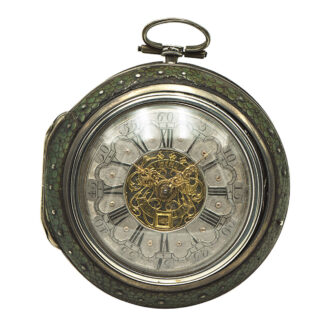
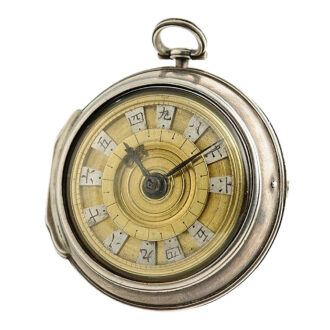
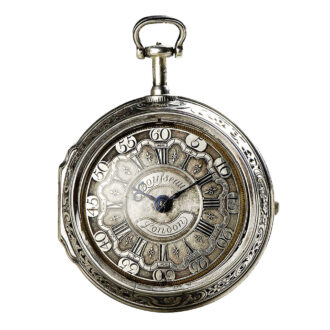
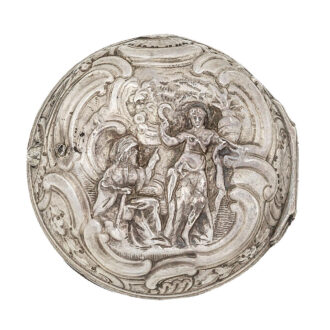
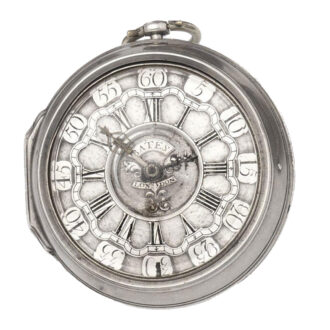
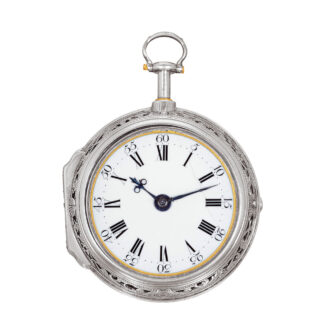
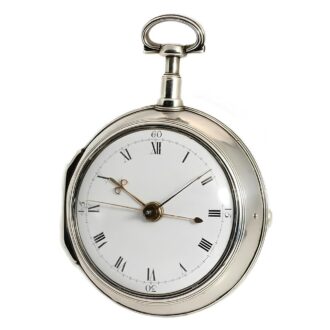
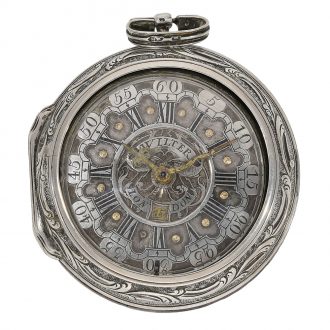
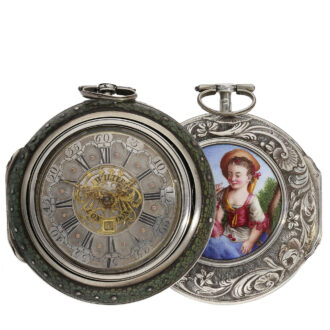
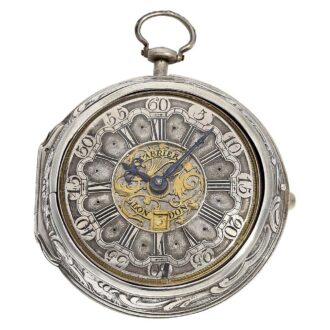
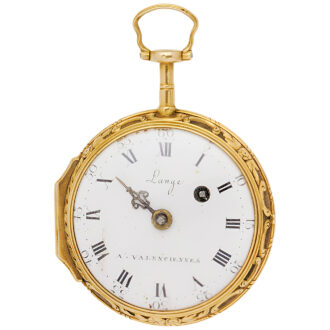
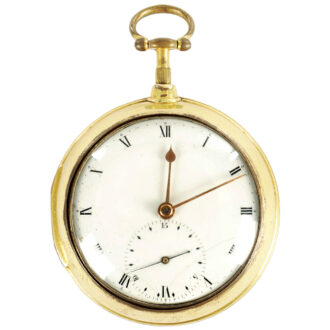
English cylinder watch with annular calendar Circa 1760
- Kenmerk
- SA0127
- Diameter
- 52 mm
- Estimate
- € 30.000 - 60.000
- Price sold
- € 66.000
Double dialled cylinder watch with annular calendar
–
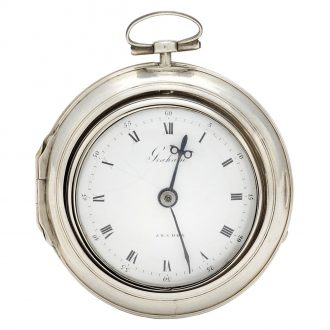
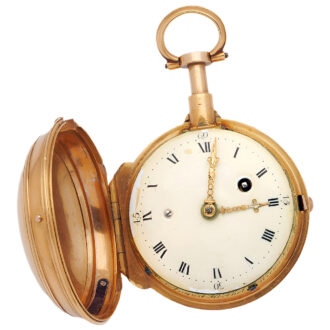
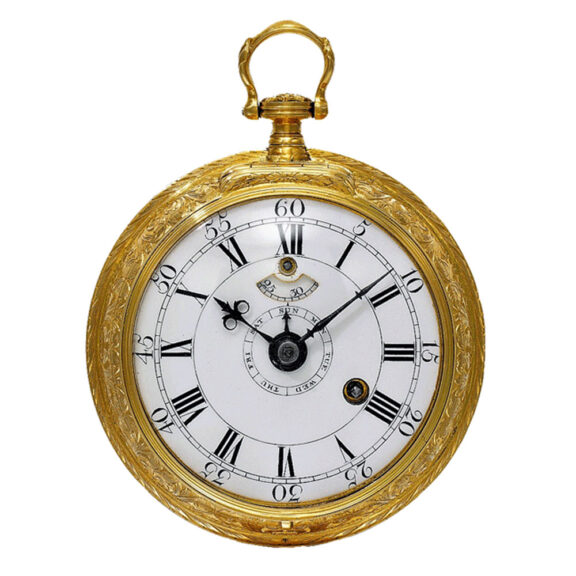
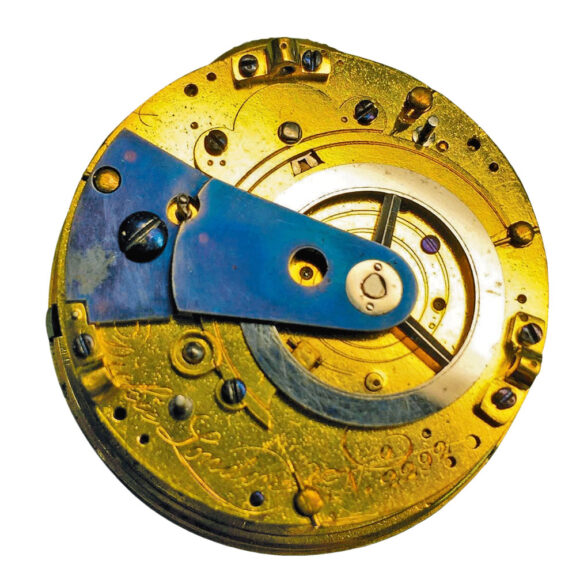
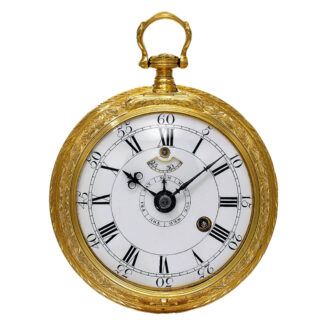
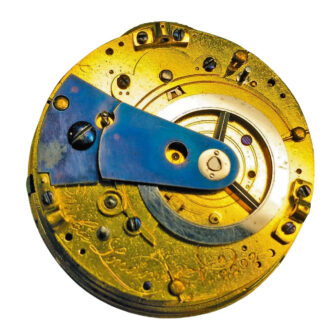
An English exceptional double dialled cylinder watch with day indication and radial annular calendar in a later gold case, circa 1760, movement with cylinder escapement, blued steel cock, flat diamond endstone, fusee and chain, cylindrical pillars, movement signed and numbered.
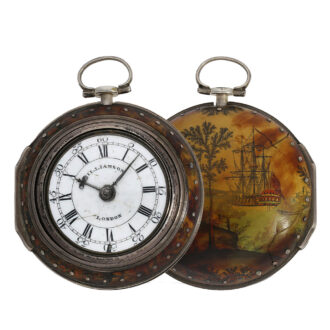
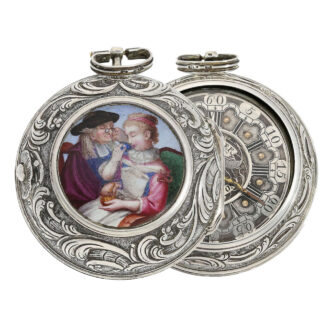
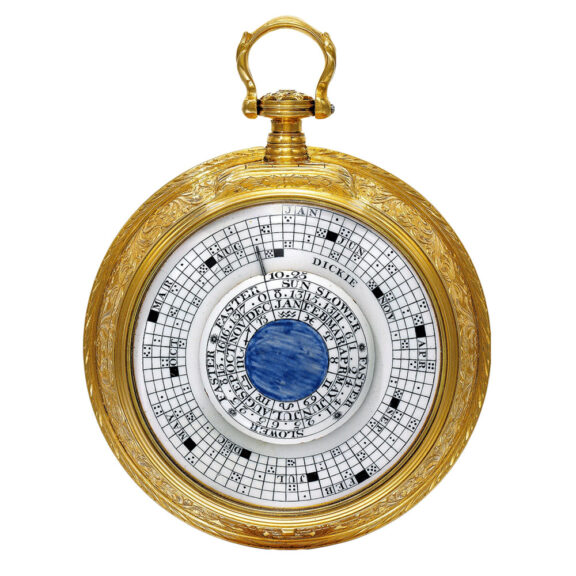
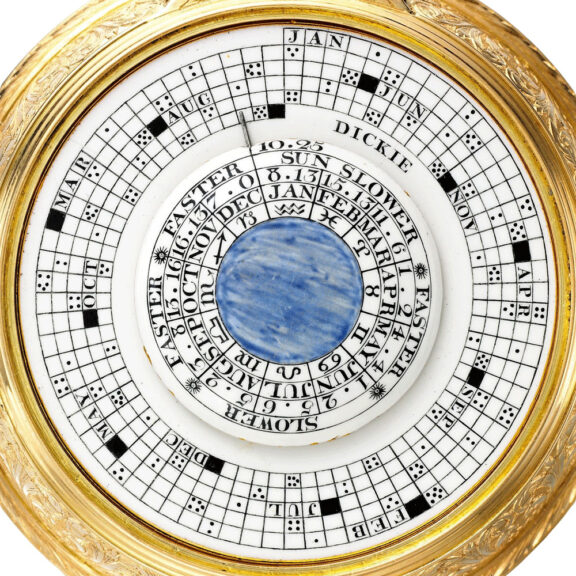
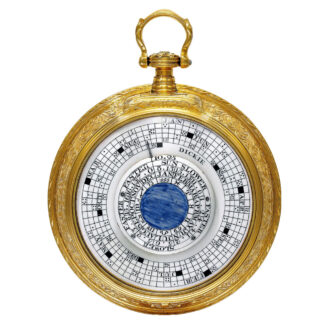
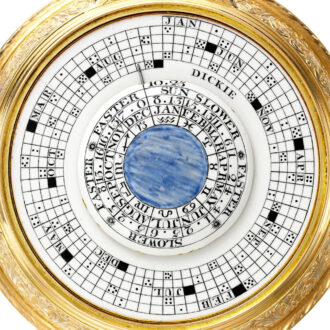
Dials, the front dial white enamel, Roman numerals, Arabic outer minute ring, inner ring for days of the week with a short blued steel hand, aperture for regulation beneath 12 o’clock, winding aperture at 4 o’clock, blued steel beetle and poker hands, the back dial with radial annual calendar arranged in a five-turn spiral, central dial with blue enamel centre carrying beneath it a calendar hand which expands and contracts as it indicates the days of the year, equation of time settings for 10th and 25th of the month, annual calendar dial signed Dickie.
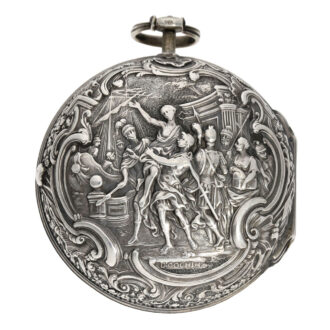
Later but stylistically complimentary gold case engraved with floral scrolls.
–
Diameter: 52 mm
–
Signed: Dickie
–
This extraordinary double dialled watch is signed by Andrew Dickie. Dickie was one of the five professional watchmakers on a committee of 11 appointed by an Act of Parliament to examine John Harrison’s H4 timepiece. The Act took effect on 31st March 1763. The other watchmakers on the committee were Alexander Cumming, Thomas Mudge, William Frodsham and James Green.
To its front, the watch displays conventional hours and minutes with the days of the week indicated in the centre. Such is the complexity of the movement and access to the escapement, the regulator is linked, remarkably, via a drive through the barrel arbour to a square and sector at 12 o’clock.
The back dial indicates the date throughout the year. A hand is set beneath the central enamel roundel and contracts as it follows the date spiral clockwise from January to December. For clarity’s sake, every five days throughout the month are indicated with a series of dots, one dot for the 5th day, two dots for the 10th day and so on. The black squares indicate the last day of each month. On 31st December, a stud fixed to the underside of the spring-loaded outer part of the hand is raised and automatically relocates to the outer end, which instantaneously expands the hand to indicate 1st January on the dial. The central raised enamel disc can be used to set the date and is calibrated with the equation of time settings for the 10th and 25th day of each month – the difference between the varying lengths of the solar day as recorded by a sundial and the meantime day as measured by a watch. The minutes difference between the mean and solar time for the 10th and 25th of each month are shown directly above each month on the central disc. Below the months are the signs of the Zodiac.
Sophisticated in construction, the movement’s calendar mechanism is extremely fine and consists of approximately 20 parts. To save space, the diamond endstone is flat and
its fixing screws are to the underside. Another double dialled watch with radial annual calendar is in the British Museum and it has been suggested that that watch was made by Thomas Mudge. Although both the movement and dial of the present watch are signed by Dickie, it is tempting to see much.
Signed: Dickie
Share this page: