English gold chronometer with Wright’s patent Circa 1784
- Kenmerk
- SA0139
- Diameter
- 63 mm
- Estimate
- € 150.000 - 300.000
- Price sold
- € 340.000
Chronometer with Earnshaw’s spring detend escapement
–
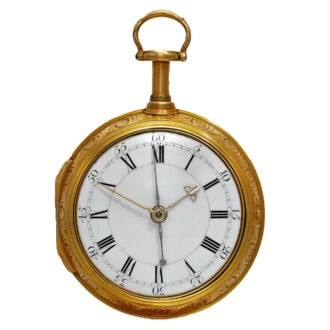
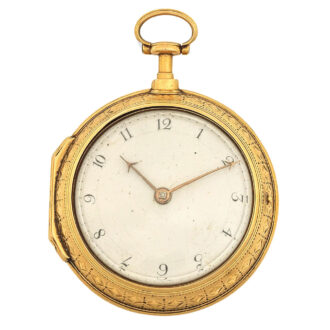
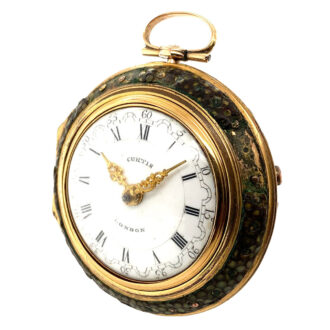
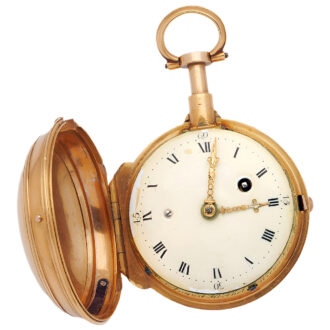
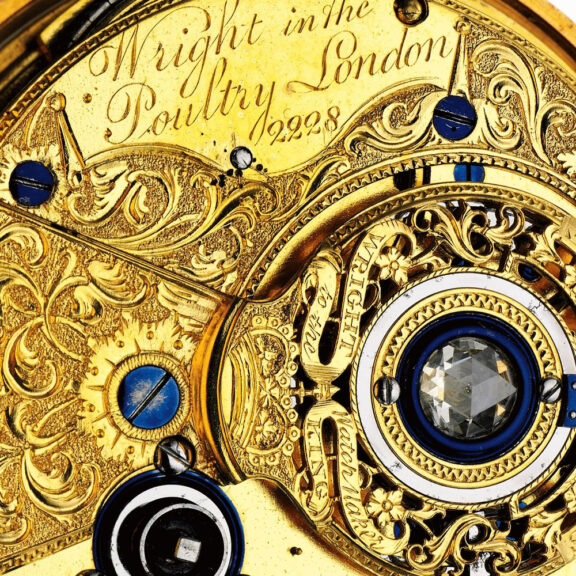
An important English gold pair cased pocket chronometer with Earnshaw’s spring detent escapement to Wright’s patent, circa 1784, gilt full plate movement, Earnshaw’s spring detent escapement, decoratively pierced and engraved balance cock engraved Wright Watch Maker to the King and with Royal coronet to the neck, large diamond endstone, wheel train fully jeweled to and including fusee, balance with cut bimetallic rims, each with semi-circular steel weights, small impulse roller gilt metal dust cap movement signed John Wright in the Poultry.
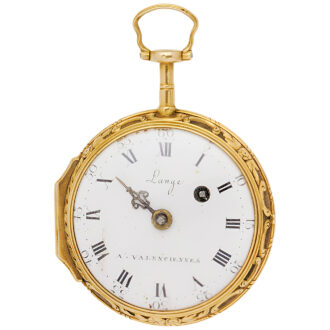
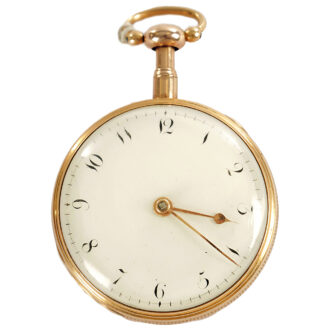
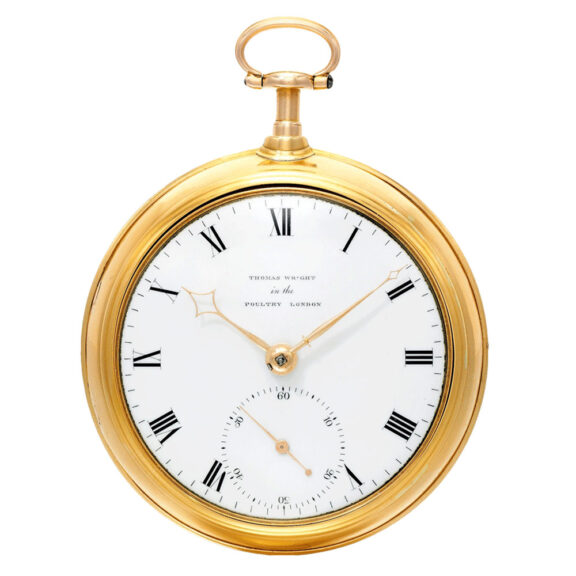
White enamel dial, Roman numerals, outer minute track, large subsidiary seconds, gold hands with diamond-shaped tips, dial signed Thomas Wright in the Poultry
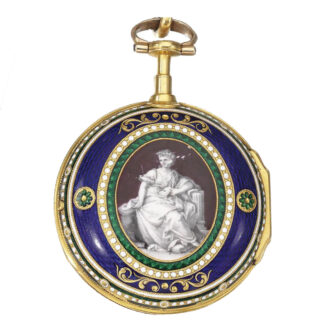
Plain gold cases with maker’s mark IW for John Wright, stop/start lever beneath bezel between 3 and 4 o’clock to activate whip on the balance, outer case with a concealed hinge and catch
–
Diameter: 63 mm
–
Signed: John Wright in the Poultry
–
Thomas Earnshaw claimed to have invented the spring detent escapement in 1781, after he discovered inherent issues with the oiled pivots of the pivoted detent escapement. Previously collaborating with Brockbanks in the construction of chronometers with the pivoted detent escapement, Earnshaw and Brockbanks had a disagreement and Earnshaw approached Thomas Wright with the designs of his new escapement. At the time, Thomas Wright was watchmaker to King George III, and as Earnshaw lacked funds to apply for the one hundred guinea patent for his invention. The pair entered an agreement whereby Wright would apply and pay for the patent in his name. Earnshaw would then make movements for any other watchmakers who ordered them, adding a one guinea fee payable to Wright to cover the patent cost. The patent, no. 1354, was filed in 1783. Earnshaw listed names of makers for whom watches were made under this agreement and these included: Barraud, Frodsham, Margetts and Vuillamy.
The present watch made by Earnshaw for the patentee is the only one recorded with the spring detent and according to the patent that is signed by Wright. Unlike later versions of the escapement, the spring detent has a single spring for locking and unlocking, exactly as shown in the original patent drawing. In addition to the hallmark date of the watch’s case, there is additional evidence to date the watch, discovered by Andrew Crisford upon his examination of the watch for his detailed and illustrated article on the present watch for Antiquarian Horology (No. 7, Vol. 9 June 1976). Crisford noted that the underside of the dial plate is scratch signed P x P Sept. 18th
1784, interestingly this is almost certainly the same signature of the watch finisher of a cylinder watch by Wright in the British Museum, No. 2679 which is signed P. Pine, Finish, 1786.
The finish of the movement is exceptional and the wheel train is fully jeweled to and including the fusee, one of the earliest movements so made. Indeed, the movement’s finish is so superior that as Crisford noted in his aforementioned article, even “the screw head against which the detent banks is sapphire faced”. The small impulse roller is original, which is especially notable since most, if not all the other early rollers were changed for a larger, safer one by Earnshaw. The adjustable unlocking roller is ingenious, consisting of a dovetailed slide with fixed cylindrical unlocking jewel advanced by the screw head – remarkably, the entire assembly measures just 3.3 mm. It is also important to note the compensated balance as, in 1784, Earnshaw claimed to have invented the compensated balance made of fused brass and steel which was to become the standard compensation balance used in almost every precision watch for the next
hundred years – the balance in the present watch certainly appears to substantiate Earnshaw’s claim.
Signed: John Wright in the Poultry
Share this page: