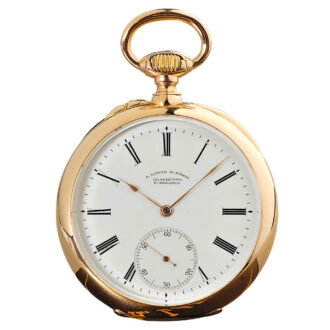
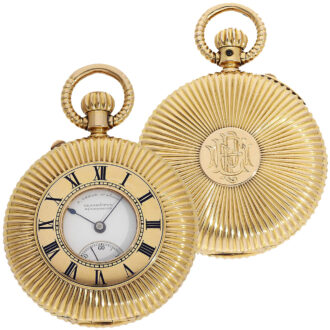
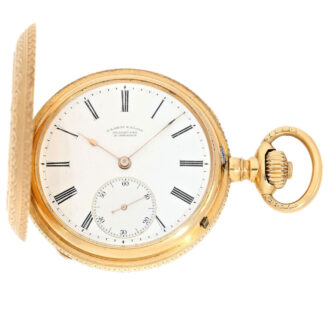
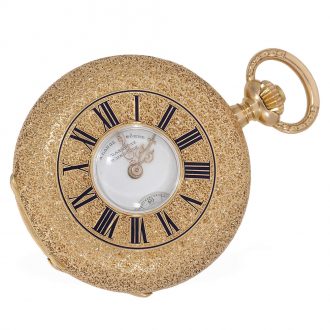
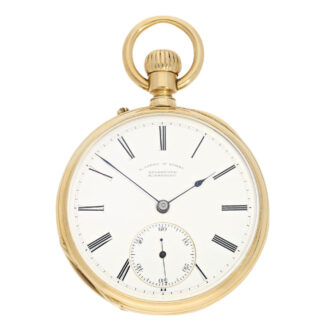
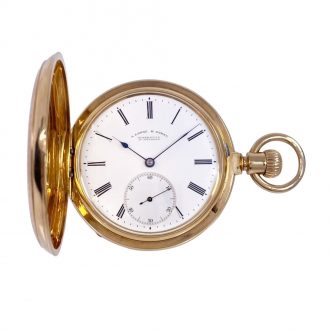
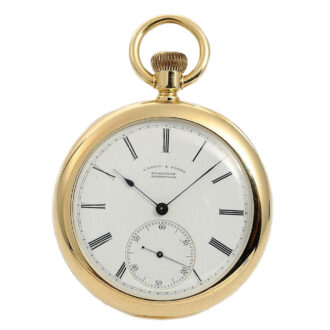
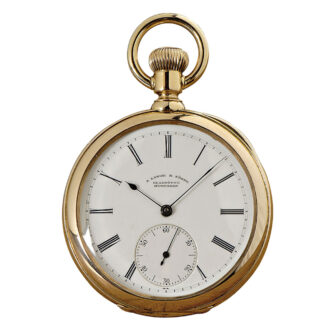
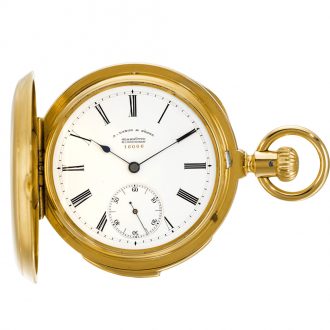
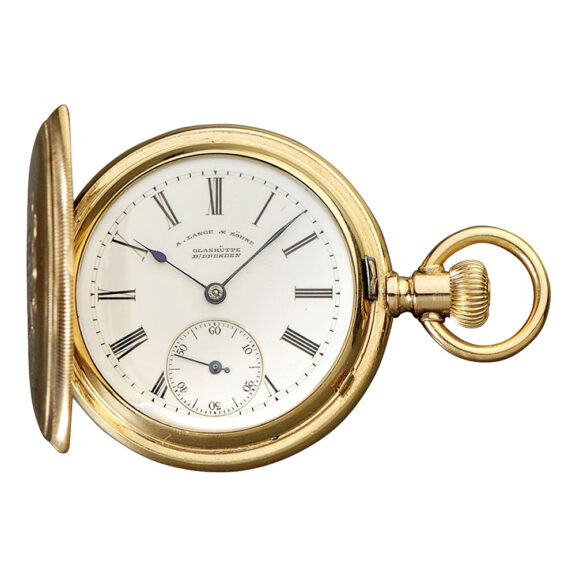
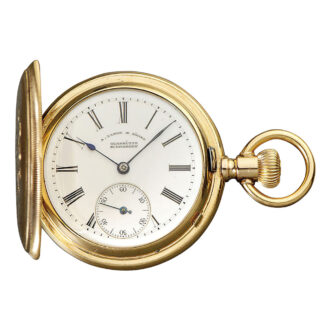
Small German 18K rose gold hunting cased lever watch Circa 1883
- Kenmerk
- DB0039
- Diameter
- 38 mm
- Estimate
- € 3.000 - 6.000
- Price sold
- -
Rose gold quality 1A lever watch by A. Lange & Söhne
–
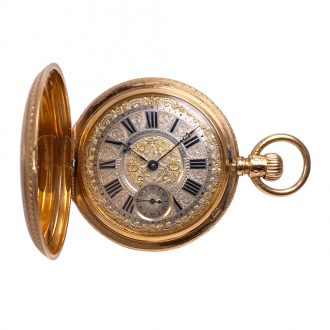
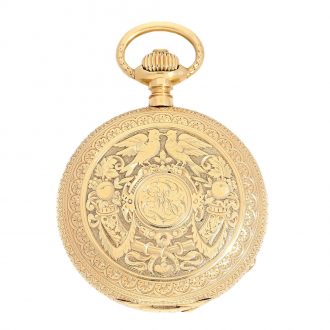
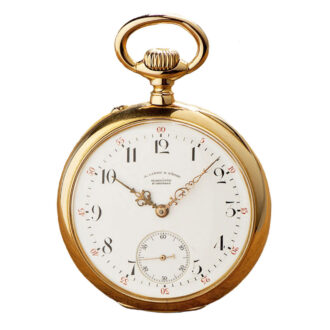
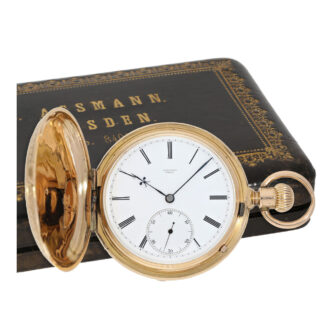
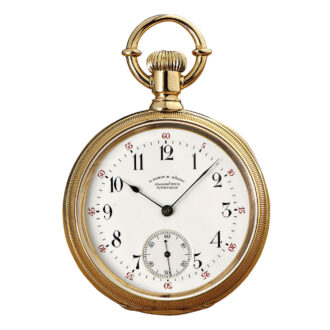
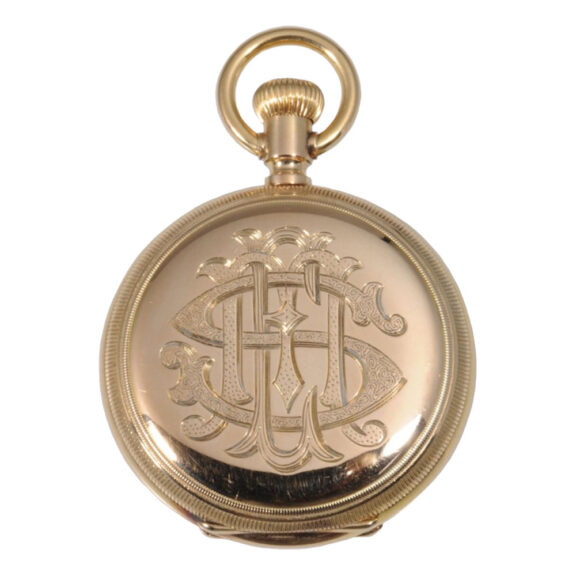
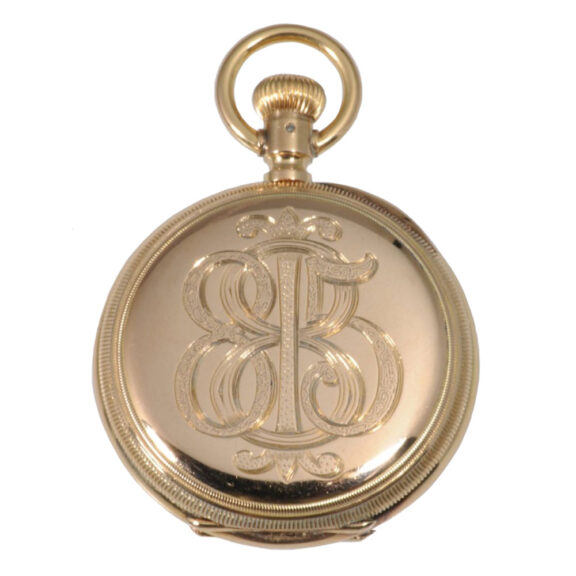
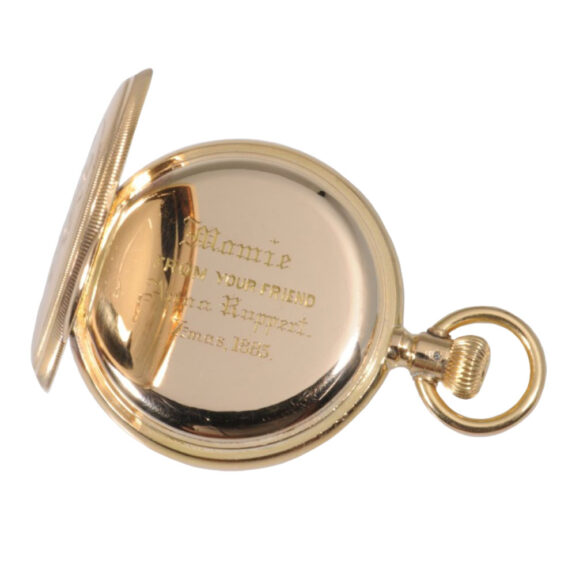
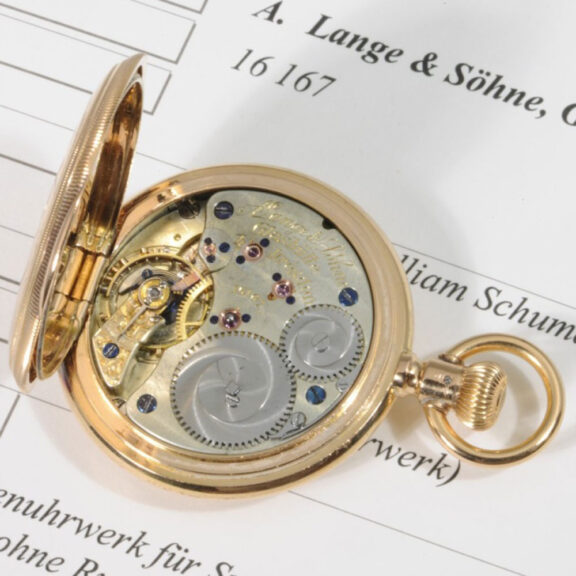
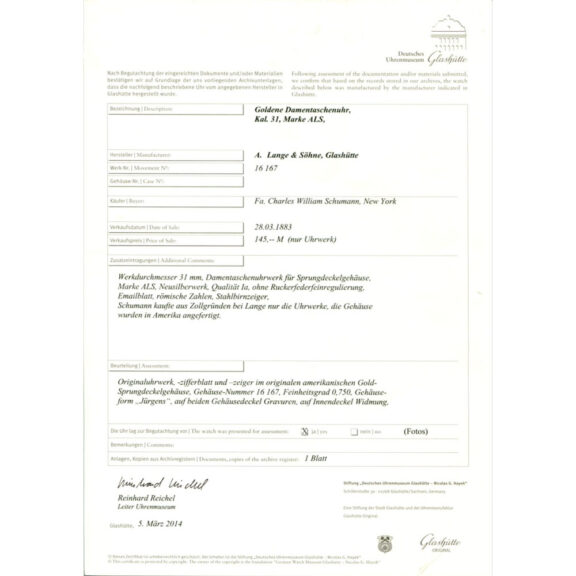
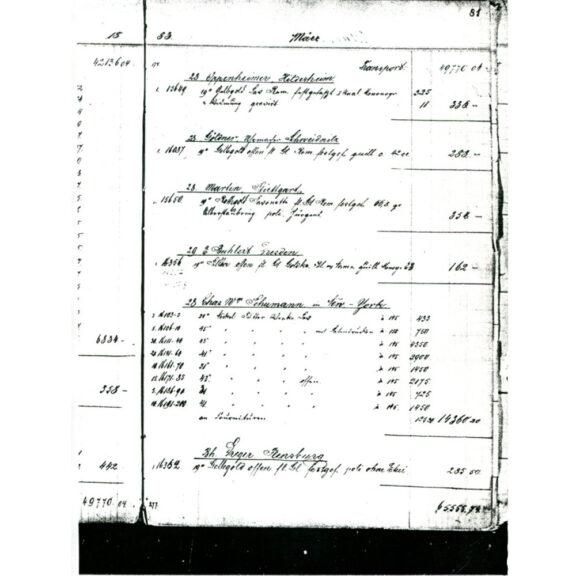
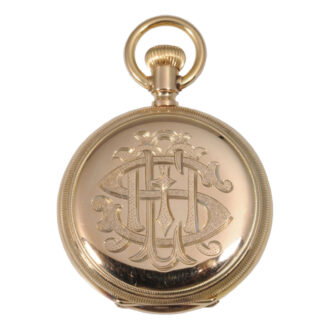
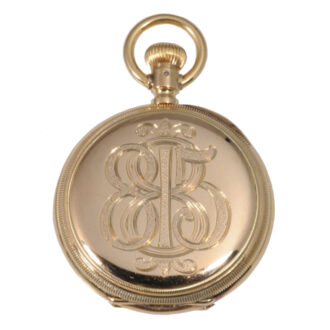
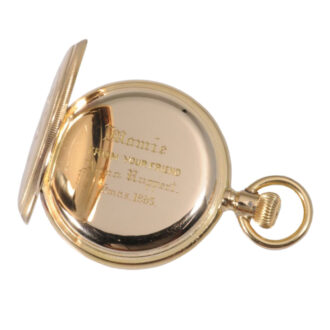
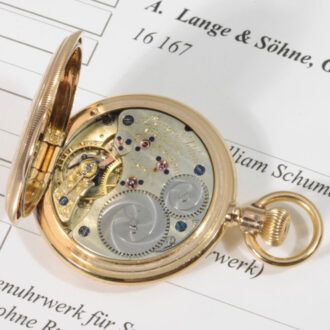
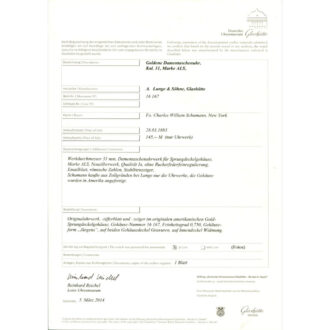
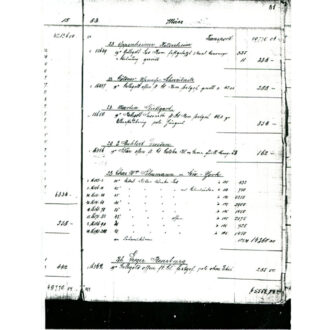
A small German 18 carat rose gold hunting cased quality 1A lever pocket watch, circa 1883. Sold on March 28th, 1883, to Charles William Schumann, New York for 145 DM. 3/4 Plate movement, lever escapement, gold screw compensation balance. The gold cuvette with a presentation engraving. White enamel dial with Roman hours, outer minute divisions and subsidiary seconds at 6 o’clock. The case is monogrammed on both sides, case maker’s mark CWS for Charles William Schuhmann. Dial signed, case numbered, movement signed and numbered. Comes with an Extract from the Archives.
–
Diameter: 38 mm
–
Weight: 53 g
–
Signed: A. Lange & Söhne Glashütte B/Dresden
–
On a dark November night in 1894, a box of chocolates was delivered to the leading lady at the Princess’s Theatre in London. After sampling the delicacies, the actress was taken ill the following day and not able to appear on stage. It was soon discovered that the chocolates had been tampered with and spiked with carbolic acid, the sender was never identified. The victim of this foul attack was, however, not unfamiliar with poisonous substances. When she was young, Anna Shelton obtained a home remedy from an unknown source to rid herself of a birthmark. Later she married Henry Ruppert and moved to New York, where she established a business as Mrs Anna Ruppert and supplied her face whitening product to a wide range of clients. It was a very successful enterprise and particularly popular with African-American ladies attempting to lighten their skin. Mrs Ruppert divorced her husband in the late 1880s but she kept her (brand) name and moved to London with her second husband. In London, she advertised her beauty products during lectures and in newspaper articles. In 1893 her column was cancelled because her bleaching agent was discovered to be the source of mercury poisoning. She was taken to court for violation of the Irish pharmacy regulation act and her star began to fade. In 1894 Anna Ruppert took up acting and appeared in plays she produced herself at the Princess’s Theatre. She was, however, not very successful in her new career and she felt that the Londoners were holding a grudge against her. She returned to Pleasant Hill, her home town in the US, where she died of tuberculosis in April 1896, at the age of only 32. In 1885, when business was running well in New York, Mrs Ruppert presented a friend with a lady’s Glashütte pocket watch in a case by C.W. Schumann for Christmas. The watch is a fine piece of jewellery and of supreme quality, with a dedication and an elaborately engraved date.
–
Ferdinand Adolph Lange was the founder of A. Lange & Söhne. He was born in 1815 as the son of Johann Samuel Lange. Early in life, his parents separated and he was adopted by a foster family. Luckily this family offered him a chance at proper education and in 1829, he joined the Technical University of Dresden. Lange’s master was Christian Friedrich Gutkaes, the maker of the famous five-minute clock in the Dresden Opera House and the court watchmaker later on. Lange finished his apprenticeship with honours and went on to work with Gutkaes as his assistant for more than two years. In 1837, Lange decided he wanted to learn the watchmaking craft from the best of the time and this decision took him to Paris, Switzerland and England. He spent four years with the master watchmaker Winnerl, a student of Breguet, in Paris. Lange returned to Dresden in 1841 and took over his now father-in-law Gutkaes’ business in 1842. He had the ambition to bring prosperity to the once rich, now unfortunate Erzgebirge region, Glashütte, he wanted to build a watchmaking industry and create jobs. He received funding from the high council of Saxony and on December 7th, 1845, Ferdinand Adolph Lange founded A. Lange & Cie. He started with fifteen young men who were obliged to work with him for at least five years and following Lange encouraged his apprentices to found their own specialized firms in Switzerland. He set up a watchmaking cluster in the region along with his colleagues Julius Assmann, Adolf Schneider and Moritz Grossmann. At the time, there was a specialist for every part, producing individual pieces of the highest quality. Ferdinand Adolph developed numerous mechanisms, from the remontoir to dead-seconds and repeaters and he introduced the metric system to watchmaking. Eventually, it took Glashütte watchmaking 20 years to develop. After two successful decades and as the mayor of Glashütte Ferdinand Adolph Lange retired in 1868. He enjoyed his spacious house built adjacent to the factory, which today serves as the headquarters of the modern A. Lange & Söhne. He gave the reigns of his legacy to his sons Richard and Emil Lange, subsequently, the company’s name was changed from A. Lange & Cie to A. Lange & Söhne. Under their management A. Lange & Söhne expanded tremendously. Ferdinand Adolph Lange died in 1875.
Signed: A. Lange & Söhne Glashütte B/Dresden
Share this page: