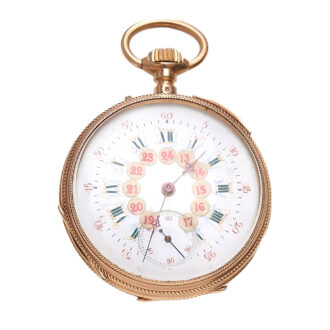
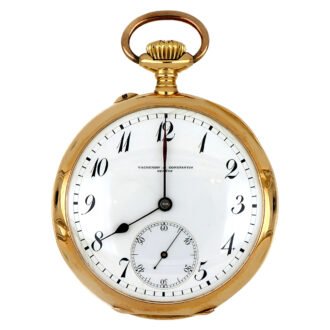
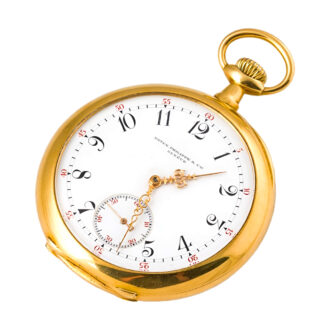
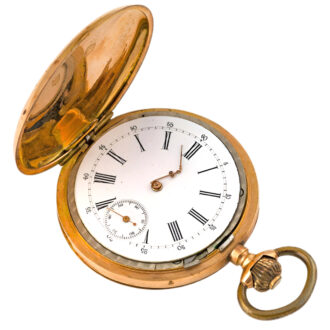
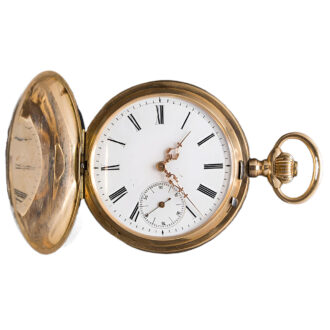
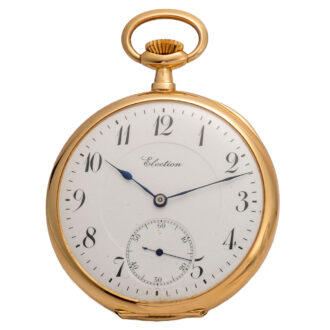
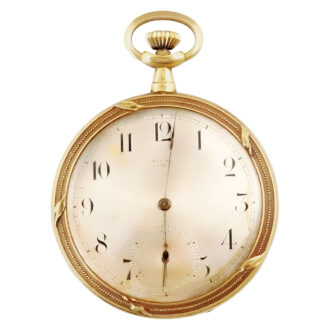
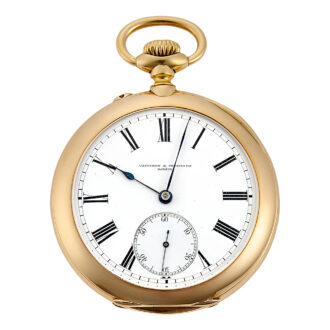
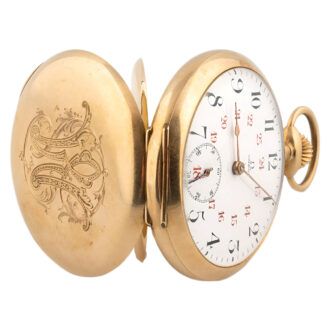
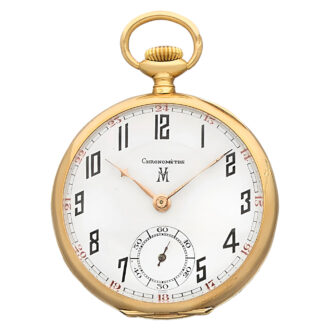
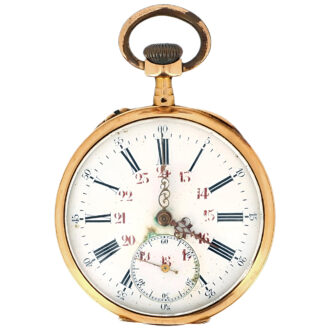
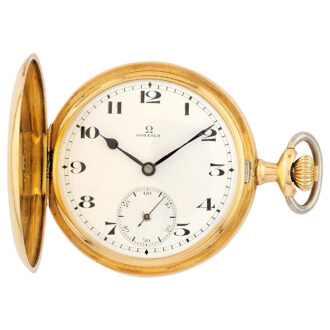
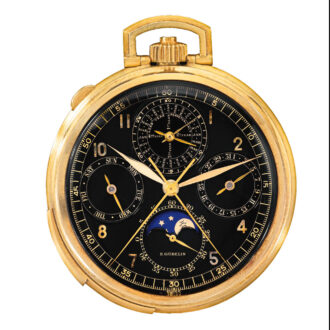
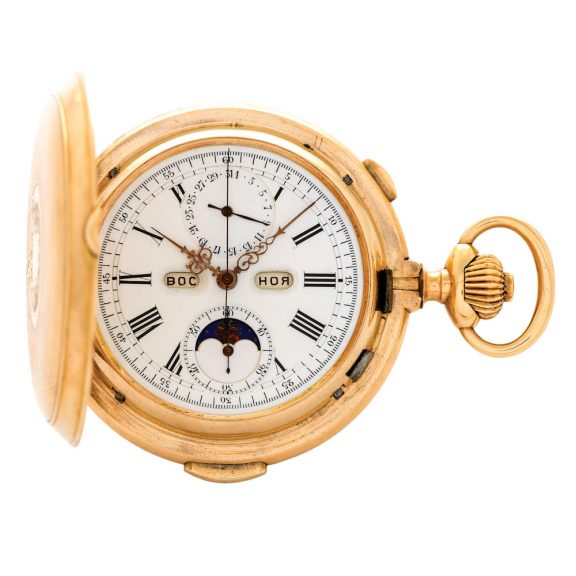
Swiss 14 carat rose gold complicated keyless lever watch Circa 1910
- Kenmerk
- BA3021
- Diameter
- 58 mm
- Estimate
- € 3.250 - 5.500
- Price sold
- € 3.550
Gold repeating triple calendar chronograph by Le Phare
–
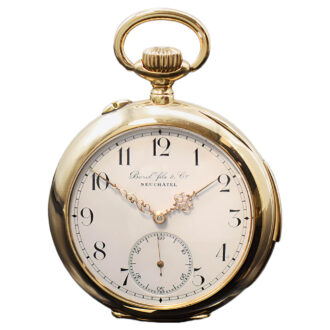
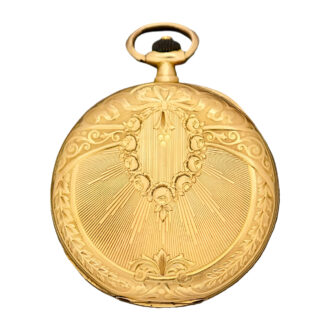
A fine and large Swiss 14 carat (56 zolotnik) rose gold hunting cased quarter repeating chronograph keyless lever pocket watch with triple calendar and moon phases made for the Russian market, circa 1910. Frosted gilt movement, 19 jewels, a straight line lever escapement, cut bimetallic compensation balance, blued steel Breguet balance spring, centrifugal governor, index regulator, repeating on gongs activated by a push button on the band. A hinged gold cuvette engraved with prize medals and technical details. White enamel dial with Roman hours, an outer minute track and outermost fifths of a second divisions, subsidiary seconds combined with the phases of the moon at 6 o’clock, a subsidiary dial for the date at 12, apertures for the days of the week and months in Cyrillic, gilt Louis XV hands. An engine turned case with polished borders. Case numbered, cuvette signed.
–
Diameter: 58 mm
–
Signed: Le Phare
–
A zolotnik was a small Russian unit of weight equal to 0.1505 avoirdupois ounces, or 4.2658 grams (about 65.83 grains). Used from the 10th to 20th centuries, its name is derived from the Russian word zoloto, meaning gold.
–
Le Phare. The company was originally founded by Charles Barbezat-Baillot (1847-1938) and Henry Guye (1838-1877) under the name Guye & Barbezat in Le Locle, Switzerland, high in the Neuchâtel mountains. In 1888, the firm’s name was changed to Le Phare, being the registered name of their complicated watches.
The company, which later launched the Jean d’Eve watch range, has left its mark on the story of Swiss watchmaking. Indeed, from 1889, its watches were rewarded by the most eminent prizes, a gold medal at the National Exhibition of 1896 in Geneva followed that of 1889 at the Great Universal Exhibition in Paris. In 1897 the silent regulator was invented. A veritable technological marvel that overcame the humming problems beset the repeater watches of the day. This brought another gold medal for Le Phare at the Paris Great Exhibition of 1900.
In 1900, the company advertised their brands that year as La Locloise, l’Esperanto, Le Phare, Tempora and La Volapuk. The company continued to develop and in 1970 was the second largest producer of chronograph watches in Switzerland. The management’s strategy is to maximise its remarkable know-how to develop new ways of measuring time.
Signed: Le Phare
Share this page: