Important Russian 18k rose gold complicated watch Circa 1900
- Kenmerk
- BA1152
- Diameter
- 60 mm
- Estimate
- € 35.000 - 60.000
- Price sold
- -
Rose gold, diamond set hunting cased repeater with complications
–
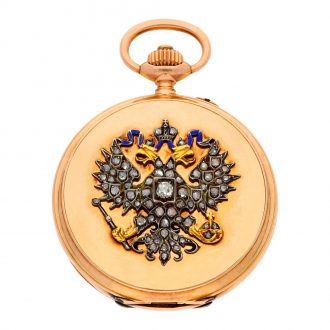
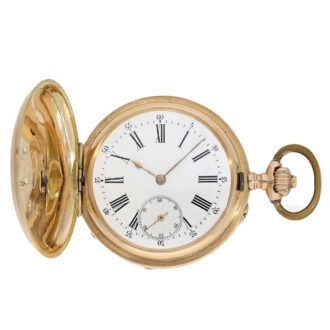
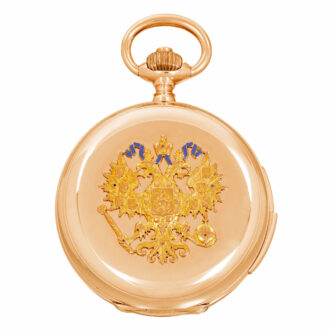
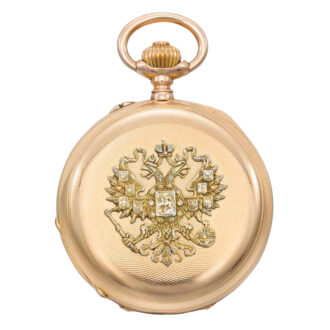
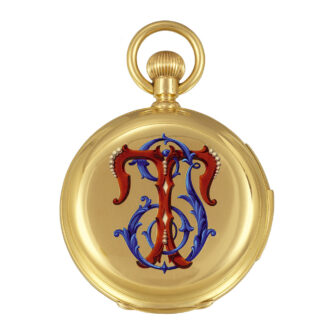
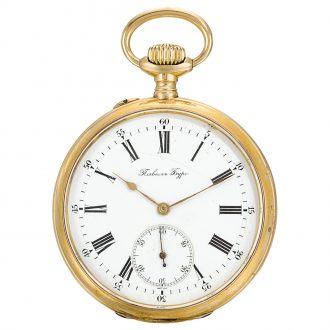
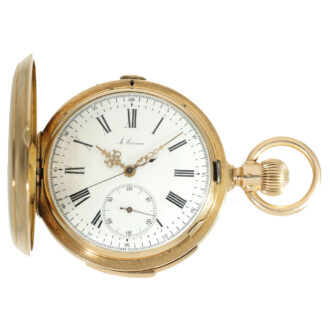
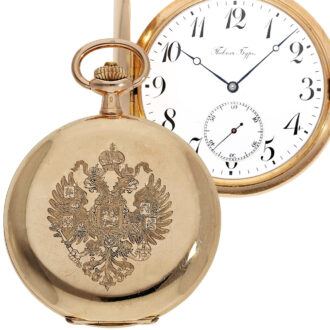
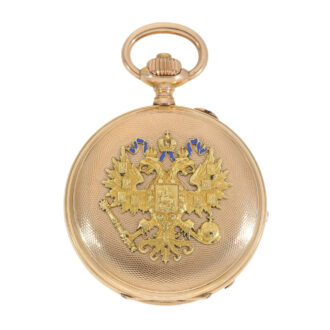
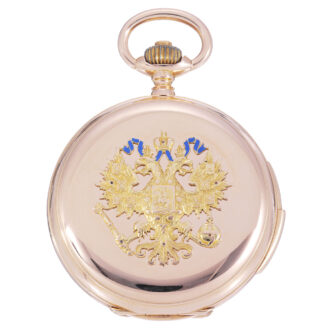
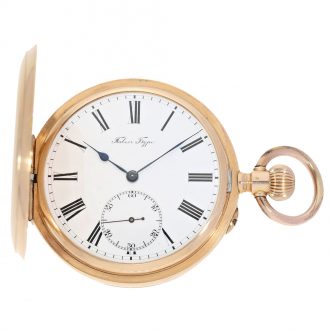
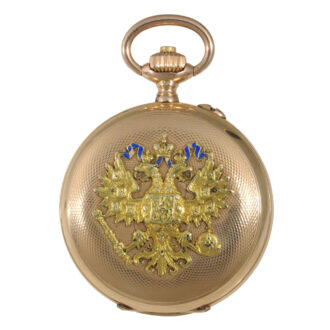
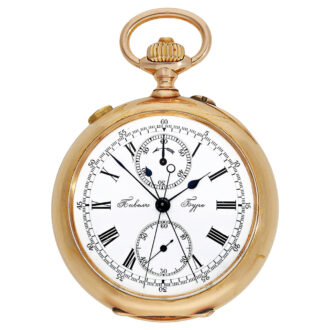
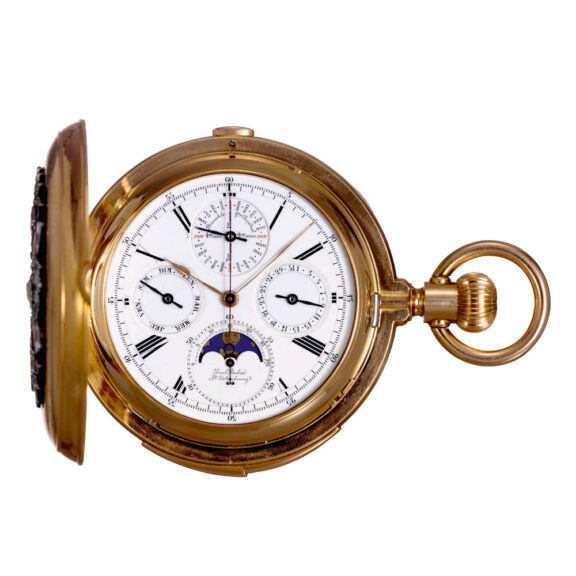
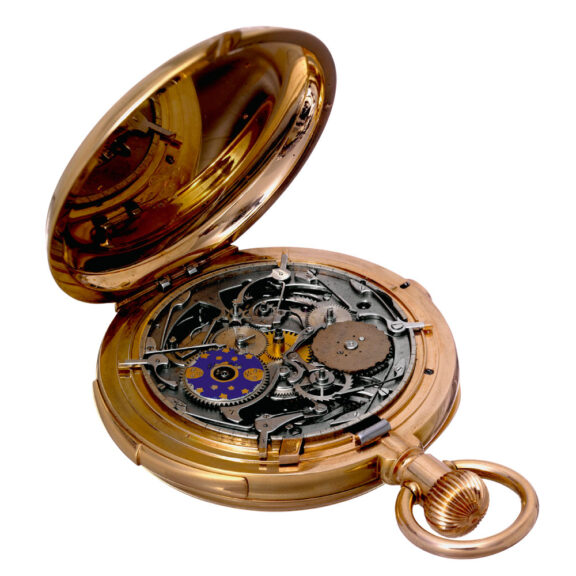
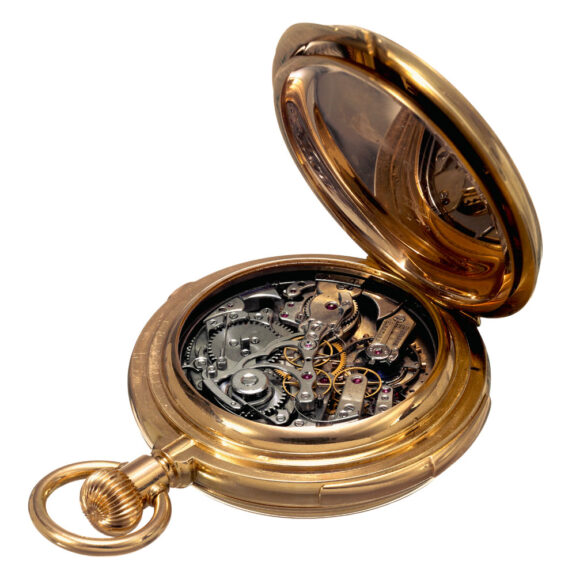
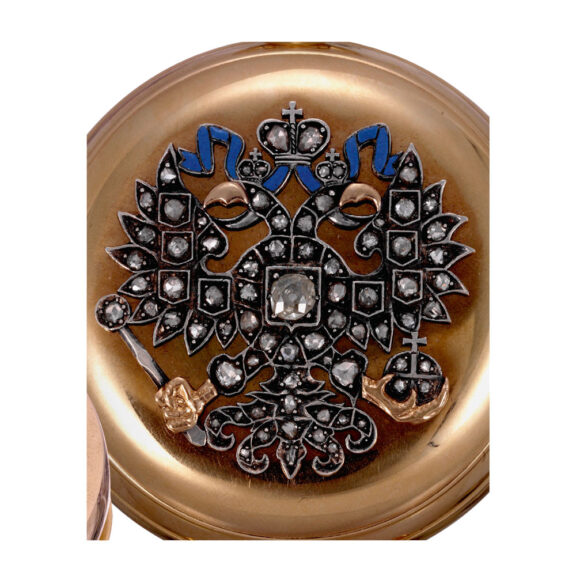
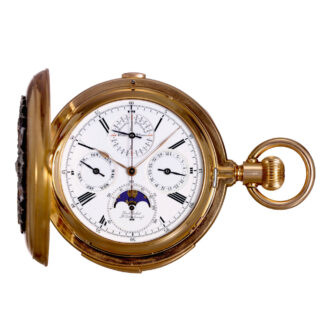
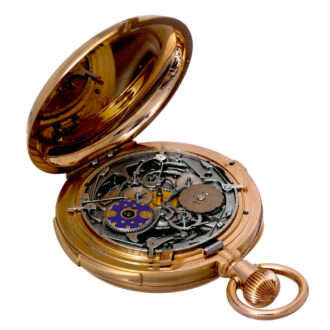
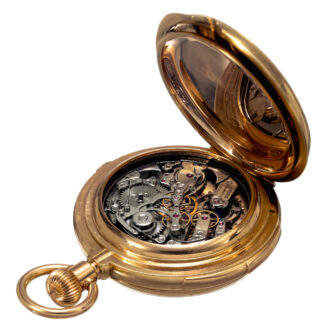
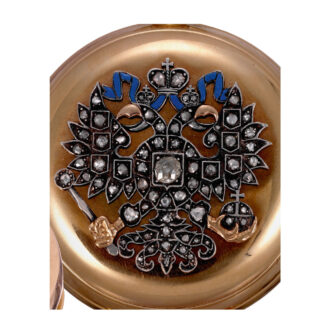
A very fine and important Russian 18 carat rose gold and diamond set hunting cased minute repeating chronograph keyless lever pocket watch with perpetual calendar, moon phases and lunar calendar, circa 1900. Rhodium plated movement, 31 jewels, counterpoised straight-line lever escapement, cut bimetallic compensation balance, blued steel Breguet balance spring with overcoil, index regulator, visible chronograph work, repeating on gongs activated by a slide on the band, the chronograph locked when the cover is closed. Gold hinged cuvette with engine turned border. Glazed gold rimmed cover to view the movement. White enamel dial with Roman numerals, outer minute track and concentric five seconds divisions with Arabic five seconds numerals, subsidiary dials for the date, days of the week, 4 year cycle and seconds, aperture for the moon phases with lunar calendar at the edge, original gold spade hands. Large, heavy and polished case, the front with a large applied silver and gold Russian Imperial eagle set with rose cut diamonds and blue enamel ribbon. Dial and cuvette signed, case numbered.
–
Diameter: 60 mm
–
Signed: Paul Buhre Horloger de la Marine Impériale St. Petersbourg
–
Paul Buhré. In 1815, Paul Leopold Buhré opened a shop in St. Petersburg, where a colony of Swiss watchmakers was established, attracted by Catherine II’s efforts to start a watch and clock factory there. Along with the firms of Courvoisier & Cie and Tissot, Paul Buhré introduced good horology to Eastern Europe. To ensure their supply, in 1815 the Buhrés founded a factory in Le Locle. Paul Buhré’s son, also named Paul, took over the Russian business and traveled to Switzerland to select watches, later taking over the factory in Le Locle. The firm became official purveyor to the Imperial Court, and expanded rapidly. From 1880 on, it was managed by Paul Girard-Gabus (1835-1902), whose brother in law George Pfund also worked with the firm. That same year, the company name was changed to Paul Girard-Gabus, and the firm still did considerable trade with Russia. Buhré watches were used on the Russian railways and were given by the Russian government as awards. These award watches, called ‘Russia’ watches, had a half length Figure of the Tsar on the dial. Buhré won a Silver Medal at the Paris Universal Exhibition in 1889, a Gold Medal at the Swiss National Exhibition in Geneva in 1896 and a Gold Medal at the Paris Exhibition of 1900. When Paul Girard-Gabus died in 1902, the company name became Paul Buhre once again. The company registered its name in 1909, for the manufacture of watches and watch parts and for the trademark name ‘Russia’, and again in 1912. In 1911 they registered a ratchet wheel with click. In 1916, they were granted Swiss patent No. 74144 for a chronograph mechanism. All Swiss firms that depended on trade with Russia were badly hit by the Russian Revolution in 1917, and had quickly to develop new products and markets. In 1915-1919, Paul Girard-Gabus’ son, Alexander Girard (1867-1940), was the Buhré representative in Le Locle. In 1930 the firm was listed as Paul Buhre & Henri Barbezat-Bole SA.
Signed: Paul Buhre Horloger de la Marine Impériale St. Petersbourg
Share this page: