Russian complicated Imperial presentation watch Circa 1910
- Kenmerk
- BA1668
- Diameter
- 53 mm
- Estimate
- € 25.000 - 40.000
- Price sold
- € 33.250
Gold decorative full hunter by Pavel Buhre
–
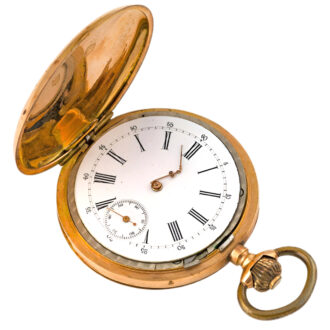
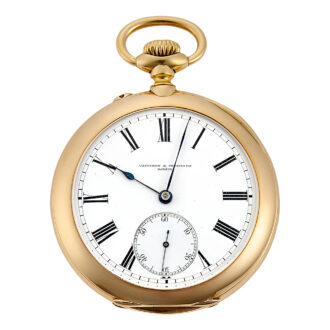
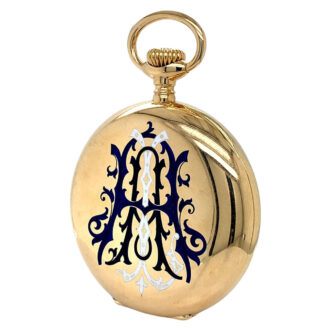
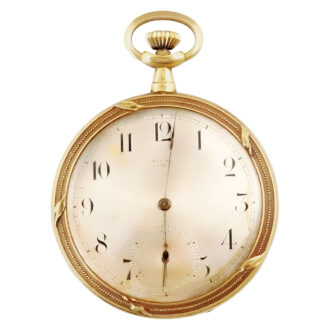
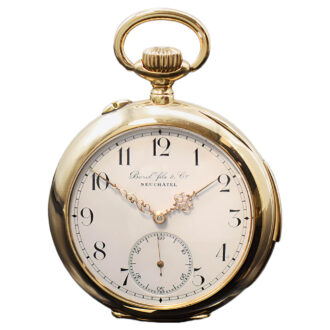
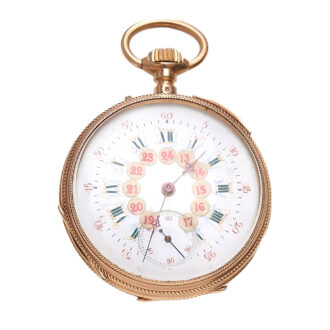
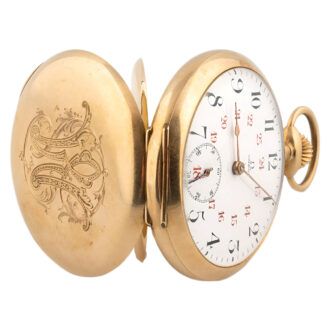
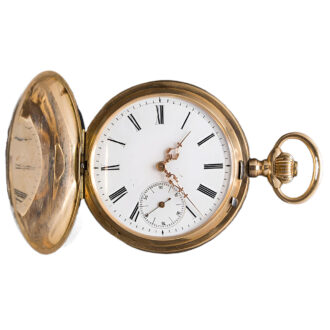
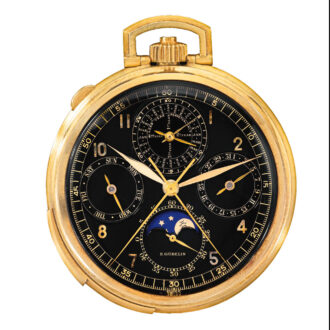
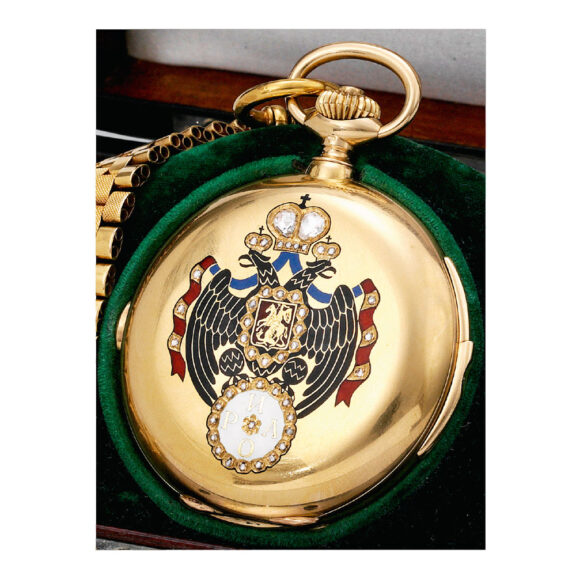
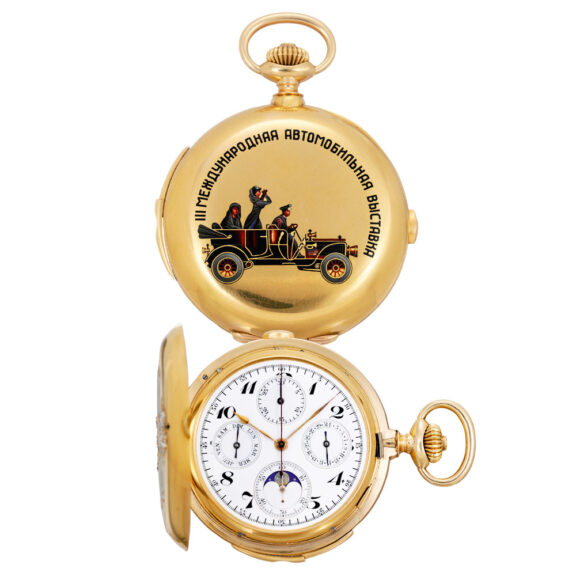
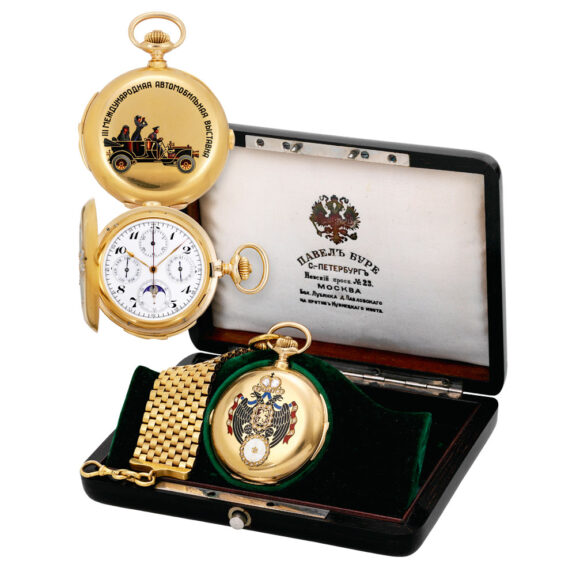
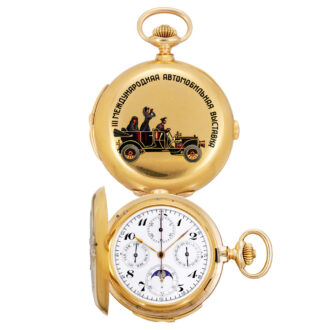
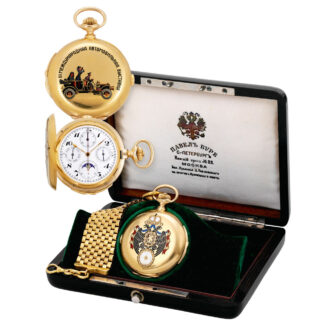
An extremely fine, historically important and large Russian 18 carat gold, champlevé and polychrome enamel, diamond-set hunting cased minute repeating keyless lever pocket watch with dual date calendar, chronograph, instantaneous 30-minute register and moon phases, circa 1910. Made for presentation by Czar Nicholas II at the 3rd International Exhibition of Automobiles, St. Petersburg in May 1910. Rhodium-plated movement, 36 jewels, wolf’s tooth winding, straight-line lever escapement, cut bimetallic compensation balance, blued steel Breguet balance spring, index regulator, repeating on gongs activated by a slide on the band, visible chronograph work. Hinged gold cuvette. White enamel dial with Breguet numerals, outer minute and fifths of a second divisions, Arabic five-second numerals, subsidiary dials for the date, days of the week, 30-minute register and seconds, aperture for the moon phases, original gold spade hands. Polished case, the front decorated with the Russian Imperial eagle in champlevé enamel and set with rose-cut diamonds, white champlevé enamel disc below with rose-cut diamond border and gold letters I.A.O.R (in Cyrillic), the back decorated with a fine champlevé and painted on enamel motor car with a chauffeur driving two ladies, inscribed around the border 3rd International Exhibition of Automobiles (in Cyrillic). Cuvette signed in Cyrillic. Accompanied by a Russian 14K (56 zolotnik) gold fob and the original fitted wooden presentation box.
–
Diameter: 53 mm
–
Signed: Pavel Buhre Maker to the Royal Family St. Petersburg
–
This watch was likely to have been the highest award at the 3rd International Exhibition of Automobiles held in St. Petersburg in May 1910. It is of significantly higher quality than the majority of the watches made for Imperial presentation and is particularly interesting in the history of the motor vehicle. The enamelled depiction of the motor car is beautifully rendered, as is the Imperial arms. The high quality and good design of the case coupled with minute-repeating, calendar and chronograph make this watch one of the most desirable of Imperial Russian presentation watches.
–
The 3rd International Exhibition of Automobiles was held at the Michael Manege Hall in St. Petersburg in May 1910. It was an important event and was commercially successful with 50 cars being sold. At the time there were 1056 cars in St. Petersburg, so this was seen as a significant advance in car ownership. It is quite likely that the Czar visited the exhibition and presented the present watch to one of the exhibitors.
–
A zolotnik was a small Russian unit of weight equal to 0.1505 avoirdupois ounces, or 4.2658 grams (about 65.83 grains). Used from the 10th to 20th centuries, its name is derived from the Russian word zoloto, meaning gold.
–
Montres Paul Buhré. The Buhré watch company was founded in 1815 in St. Petersburg by Karl Buhré, a Russian businessman of German descent. He moved from Revel together with his son Pavel Karlovich who grew up in the watch business of his father and eventually became his assistant and successor. His eldest son, Pavel Pavlovich Buhré, graduated from the Petropavlovsk Commercial College and became his father’s companion at the age of 26 in 1868. In 1874, he acquired a large watchmaking factory in the heart of the Swiss watchmaking industry in the town of Le Locle. In 1880 he was an appraiser under the Cabinet of His Imperial Majesty, a technician at the Imperial Hermitage, a supplier of the Supreme Court since 1879 and a Merchant of the First Guild since 1884. In the last 30 years before the revolution, Pavel Buhré became the firm without which it is inconceivable to talk about the history of Russian watchmaking. A store was opened in Moscow and then in Kiev to expand the business.
In 1899 the company was awarded the title of Supplier of the Imperial Court. Further, Buhré supplied watches to the railways and the army. Between 1881 and 1894, under the reign of Alexander III, watches were made in simple metal cases. These were prize army and railway watches and the world’s first real wristwatches. At a time when luxury accessory watches turned into a necessity, Pavel Buhré sold watches for everyone. Prices for their watches started from just two rubles. The company owned 50 per cent of the Russian market of inexpensive watches. For more wealthy buyers, the same mechanisms were inserted into the silver and gold cases. Complex mechanisms were ordered from the most authoritative Swiss watch companies. In 1916, Buhré obtained a Swiss patent No. 74144 for a chronograph mechanism of its own design. The company was awarded the highest awards at many national and international exhibitions, including at the World Exhibitions in Paris in 1889 a silver and in 1900 a gold medal.
The Revolution of 1917 put an end to business in Russia, but the firm did not cease to exist. The fact that the main production facilities were in Switzerland and the transfer of the headquarters from Petrograd (St. Petersburg) to Le Locle, Switzerland saved the company. Since the main market Russia was lost the first years were very difficult, but the company could not only survive it also significantly increased the geography of supply and became one of the leading watch companies in Switzerland. In order to be recognizable by consumers all over the world, the name was changed from Pavel Buhré to Paul Buhré. The brand returned to Russia in 2004 with the efforts of the trade house striving to revive the traditions of Pavel Karlovich Buhré, the watchmaker, and the following year, the year of the 190th anniversary of the firm.
Signed: Pavel Buhre Maker to the Royal Family St. Petersburg
Share this page: