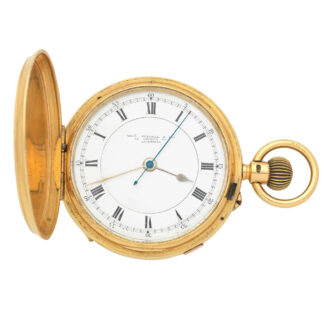
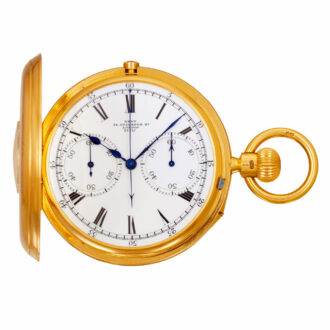
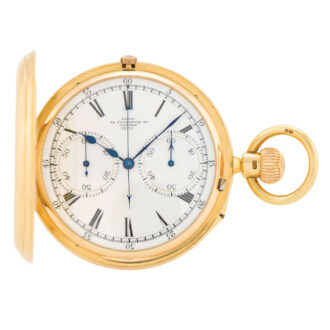
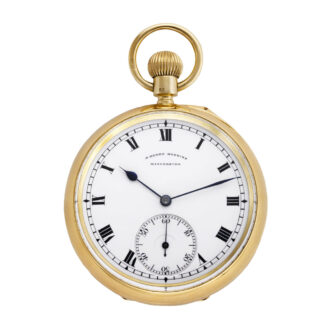
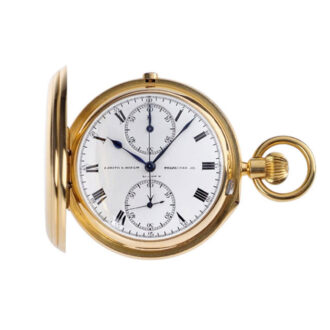
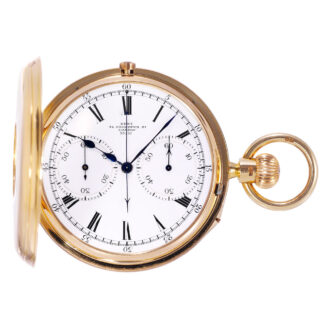
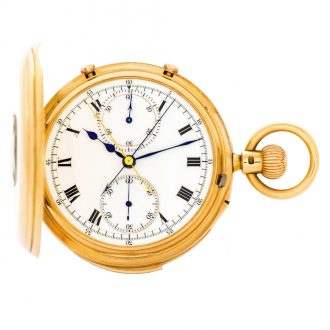
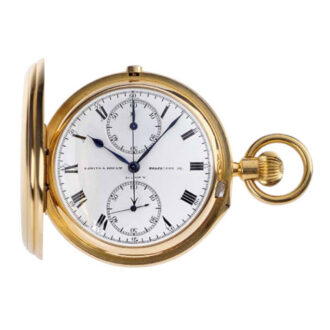
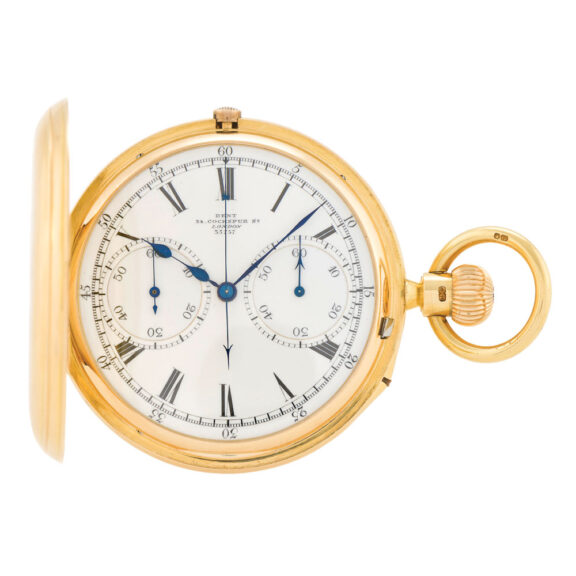
English gold half-hunting cased lever chronograph Circa 1911
- Kenmerk
- BA2710
- Diameter
- 54 mm
- Estimate
- € 4.000 - 7.000
- Price sold
- € 5.150
Gold chronograph with register by Dent
–
A very fine and rare, heavy English 18 carat gold half-hunting cased keyless lever pocket watch with chronograph and progressive 60-minute register, circa 1911. Frosted gilt ½ plate movement, Ø 43 mm, 15 jewels, going barrel, lateral English lever escapement, cut bimetallic compensation balance with gold timing and temperature adjustment screws, a blued steel Breguet balance spring, diamond endstone, index regulator and a Nicole Nielsen chronograph work mounted on the backplate activated by a button in the band. Hinged gold cuvette. White enamel dial with Roman hours, an outer minute track and concentric fifths of a second track, Arabic five minute/seconds numerals, subsidiary seconds at 9 o’clock, 60-minute register dial at 3, blued steel double spade hands. A polished case with London hallmarks for 1911, maker’s mark RN, the hinged and sprung front cover with a radial blue enamel Roman chapter ring and inner minute track, thief-proof swivel bow. Dial and movement signed and numbered.
–
Diameter: 54 mm
–
Signed: Dent Watchmaker to the King & Queen 34 Cockspur Street London
–
Dent. A celebrated watchmaking dynasty founded in 1814 by Edward John Dent, known for high-quality watches, clocks, chronometers and regulators. Dent was born on August 19th, 1790 in London and he died on March 8th, 1853 in London. After starting life as a tallow chandler, Dent switched to watchmaking. From 1815 to 1829, he was employed by the Vulliamys and the Barrauds. In 1830 Edward John entered into a partnership with John Roger Arnold. In 1840 he opened his own workshop at 33 Cockspur Street, London. The company embraced the Victorian fervour for technological innovation and created amongst others precision chronometers to navigate the Royal Navy. Dent also proved a key player in Victorian horological history by manufacturing the Standard Clock at the Royal Observatory in Greenwich, which was to keep ‘Greenwich Mean Time’, the time to which all others in the British Empire were referred (better known today as G.M.T.) and continued to do so until replaced by an electronic clock in 1946. Dent further made probably the most famous clock in the world, the Great Clock for the Houses of Parliament, commonly known as Big Ben. He was succeeded by his step-sons Frederick and Richard who assumed his name. In both the 19th and 20th centuries, the firm supplied marine chronometers and watches to the Royal Navy and also received Royal Warrants. It continued until relatively recently at 41 Pall Mall, London, as E. Dent & Co. Ltd.
Signed: Dent Watchmaker to the King & Queen 34 Cockspur Street London
Share this page: