Swiss two-train repeating musical watch with erotic scene Circa 1810
- Kenmerk
- BA3127
- Diameter
- 60 mm
- Estimate
- € 35.000 - 70.000
- Price sold
- € 64.350
Gold and enamel musical quarter repeater by Henry Capt
–
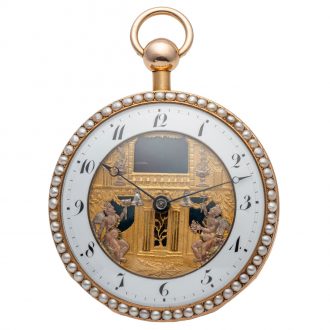
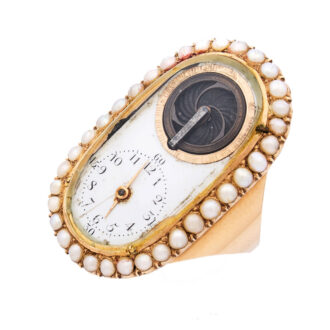
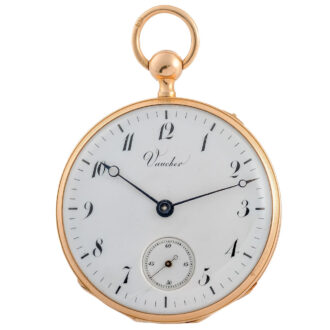
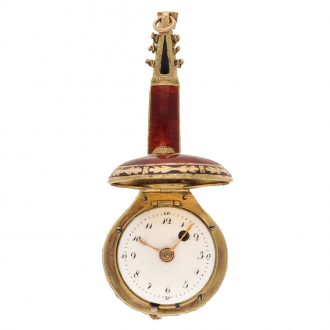
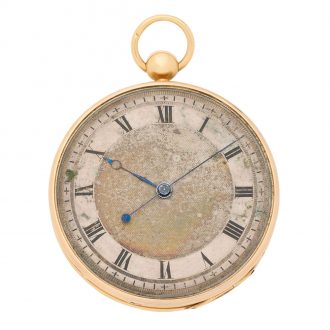
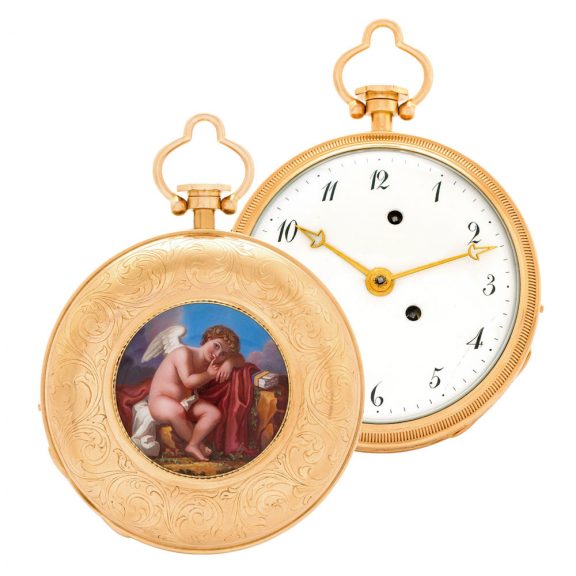
An extremely fine and rare Swiss 18 carat gold and enamel open faced two-train quarter repeating musical pocket watch with concealed erotic automaton scene, circa 1810. Gilt-brass full plate double train movement with cylindrical pillars, going barrel and cylinder escapement, plain brass three-arm balance, flat balance spring, polished steel end-piece, repeating on gongs activated by twisting the pendant, a regulator arm protruding from under the cuvette with engraved scale at the edge. The musical train with a pin-barrel and six individual blued steel blades mounted between the plates, playing the music at will.
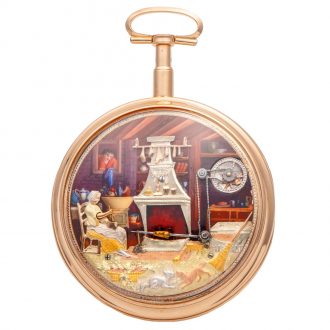
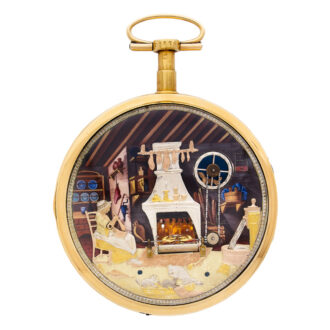
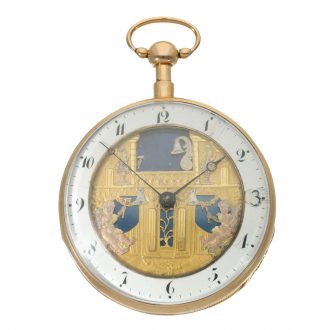
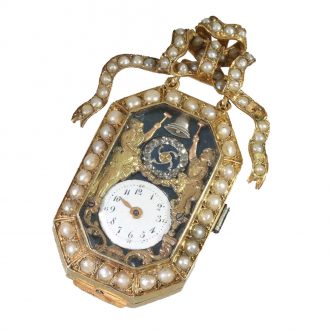
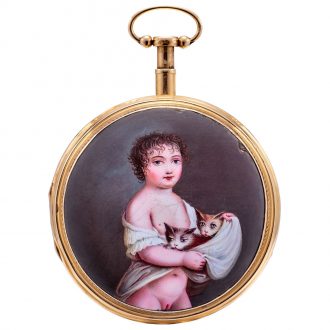
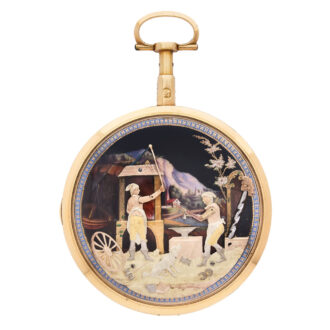
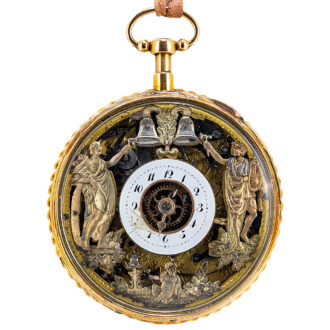
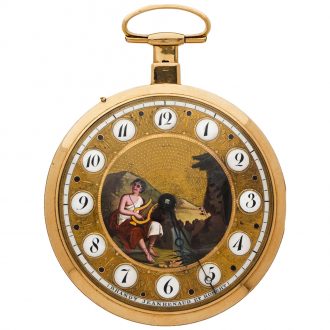
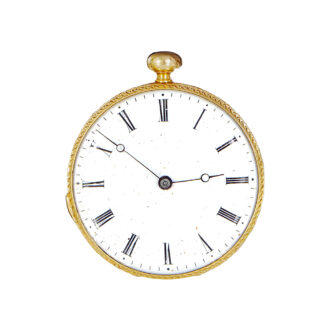
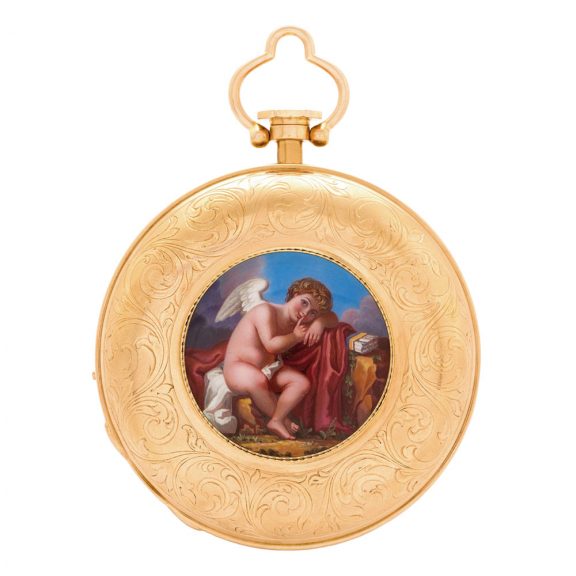
White enamel dial with Arabic hours, outer minute divisions, two winding apertures and gold hands with pierced tips. The Empire case with a reeded band, a central polychrome enamel scene of a winged Cupid seated in a landscape resting on a draped quiver on the back, an engraved foliate border. The gold and polychrome enamel concealed automaton scene depicts two gentlemen with a lady in a sumptuous interior enjoying the pleasures of the flesh whilst another man peers around the door, activated through a steel cam when the music plays. The movement ring is signed Hy Capt à Genève, the case and movement with corresponding numbers.
–
Diameter: 60 mm
–
Signed: Hy Capt à Genève
–
The present watch is the work of the exceptional Genevan watchmaker Henry Capt and is one of the few known watches by him to be fully signed (on the movement ring). This watch exhibits several unusual technical features. The musical movement is enclosed between the plates and is neither sur-plateau nor stacked but has a pinned barrel acting on individually placed steel teeth screwed to each interior side of the plates. The repeating mechanism is also highly unusual whereby it is activated by fully turning the crown clockwise which pulls a chain attached to the arbour and engages the repeating. This timepiece is also unusual in having a plain dial for the watch rather than a further decorated or automaton dial. The case which is punched with the same number as the movement is very substantially made with a fine enamel panel depicting Cupid indicating silence or hinting at the secret within.
–
Henry-Daniel Capt was born in Chenit in 1773, he married Henriette Piguet. He specialized in the production of complicated, musical and automaton watches. Among the first in Geneva to use the musical mechanism with pinned cylinder and tuned teeth comb, he was famous for his snuffboxes with music and automaton scenes. From March 7th, 1802 to 1811, he formed a partnership with Daniel Isaac Piguet, who was from the same village as him. Their signature was Piguet & Capt. In 1811, when Piguet broke off to join Meylan in a new partnership, Capt continued to work on his own until, in 1830, he went into partnership with Aubert & Son, Place Bel-Air. Their signature was Aubert & Capt. They were among the first Genevan makers to produce watches with a chronograph. In 1844 the workshop was at 108, Rue Neuve in Geneva. It was then managed by Capt’s son, Henry Capt Jr. After a short time it moved to 85, Rue de la Fusterie, and in 1851, to 177, Rue du Rhône.
In 1880, the firm was bought by Gallopin and its name became H. Capt Horloger, Maison Gallopin Successeurs, a trademark registered on November 1st, 1880, under the No. 44. This signature was only used for watches retailed in their own store, the watches supplied to other retailers being merely signed Henry Capt. Henry Capt, along with Isaac Piguet and Philippe Meylan, was the foremost maker of small musical automata in the late 18th and early 19th centuries. Most of his work is not signed, although he sometimes scratched his name on his movements.
Signed: Hy Capt à Genève
Share this page: