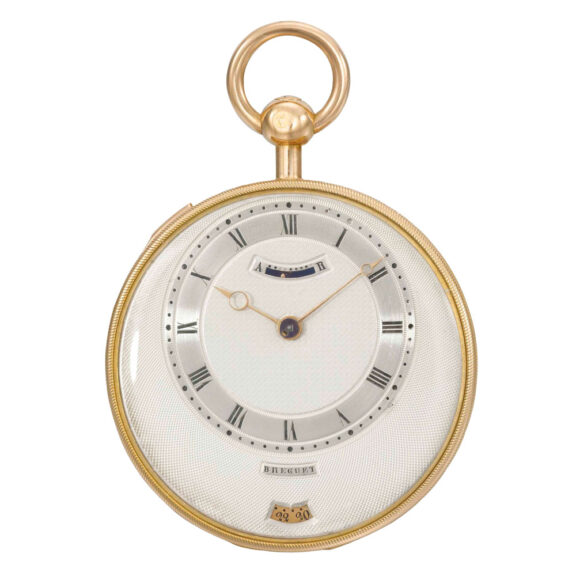
French half quarter repeating jump hour lever Circa 1829
- Kenmerk
- CH1585
- Diameter
- 40 mm
- Estimate
- € 50.000 - 90.000
- Price sold
- € 87.150
Gold pair cased repeating key-wound lever by Breguet
–
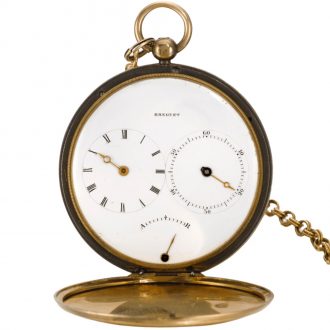
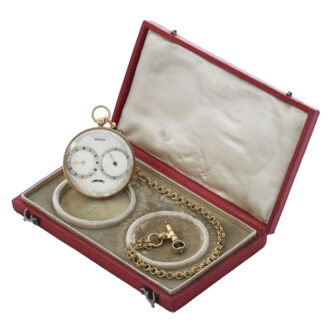
An extremely fine, rare and small French 18-carat gold pair cased open faced half quarter repeating key-wound lever jump hour watch with date, circa 1829. Très petite montre à répétition très plate sur les principes des chronomètres. Sold on 22 October 1829 to Count Ch. de l’Espine for the amount of 6,200 Francs. Gilded brass jewelled lever movement, three armed platinum and steel compensation balance, parachute suspension on the pivot, index regulator, half quarter repeating on one polished steel hammer onto a gong. Engine turned, silver dial, eccentric hour dial with Roman numerals on the blank chapter ring, secret signature Breguet No. 4602 to both sides of XII, outer dot minute divisions, gold Breguet hands, aperture for revolving date indication with Arabic numerals to 6 o’clock, movement advance/retard slide below 12 o’clock. Engine turned inner case, snap on back, small screwed securing the back, date corrector button and repeating slide in the engine turned band, engine turned étui d’or outer case, the inner case released by depressing a small button in the band, a short length of gold chain and gold ratchet key, one side for the male winding, one side for the setting of the hands. Cases No. 4601 and No. 4191 by the workshop of Pierre Benjamin Tavernier (later master’s mark MAB in a lozenge, used after 1820), dial signed Breguet and numbered. It comes with a gold chain, ratchet key, and red Morocco fitted box.
–
Diameter outer case: 39.5 mm
–
Signed: Breguet
–
A masterpiece from the workshop of the celebrated master watchmaker Abraham-Louis Breguet (1747-1823), ‘Watchmaker of the Kings, King of Watchmakers’. This piece is one of Breguet’s smallest repeating watches ever made; it is distinguished by a further rarity, a ‘étui d’or’ outer case of such outstandingly high quality that the inner case fits perfectly into it, leaving no visible or tangible clearance. It was sold to the house’s faithful client, Count Charles de l’Espine, in October 1829 for the extraordinary amount of 6,200 Francs.
Signed: Breguet
Share this page: