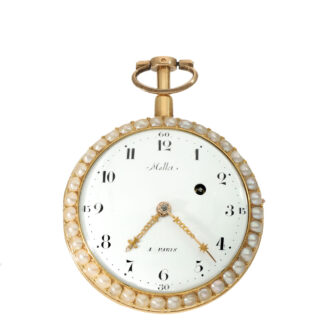
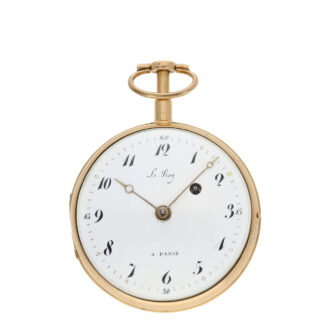
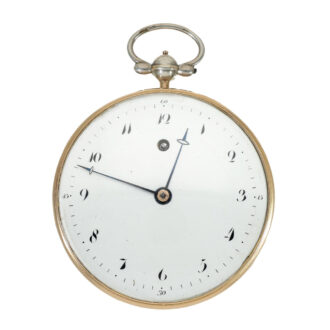
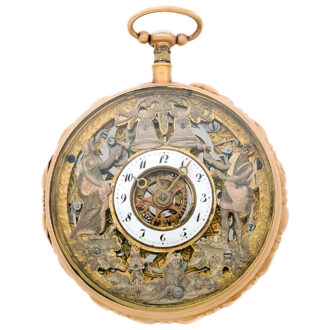
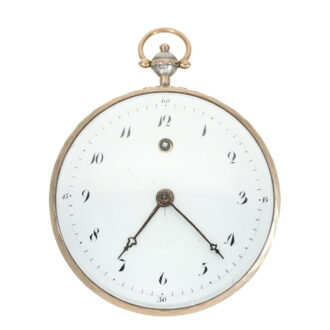
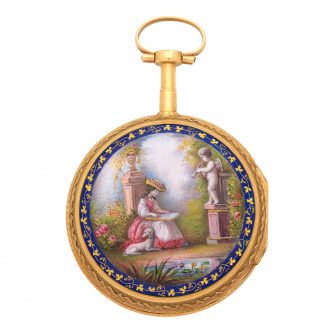
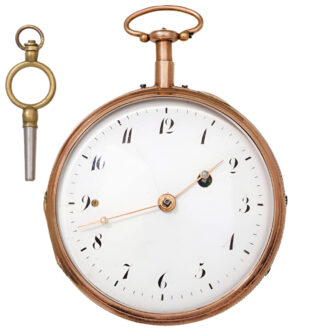
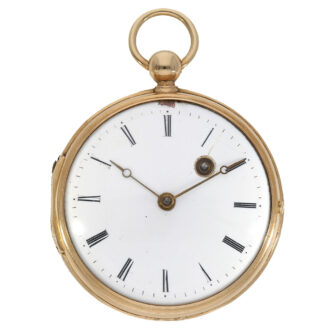
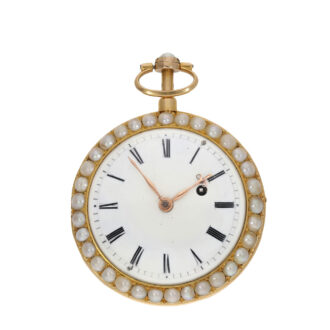
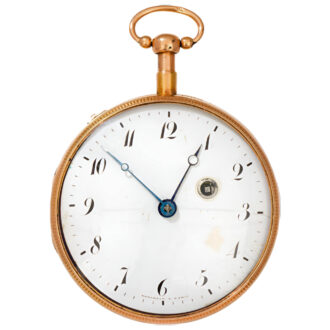
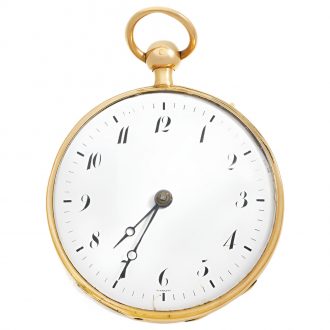
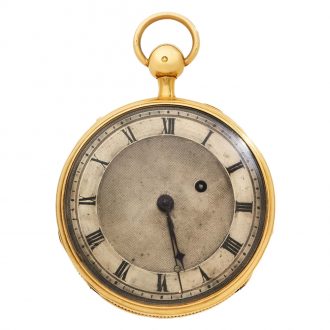
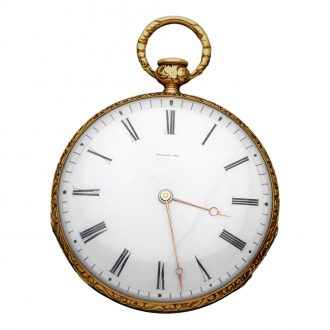
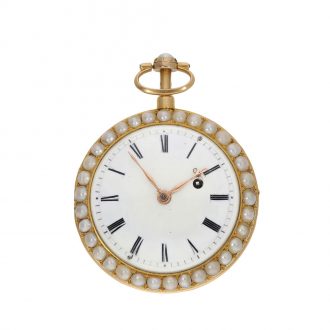
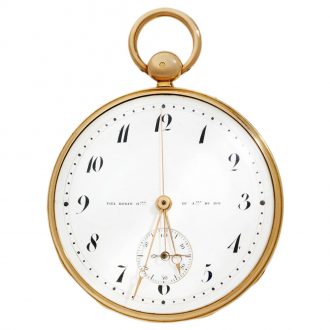
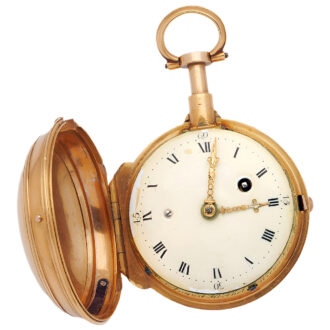
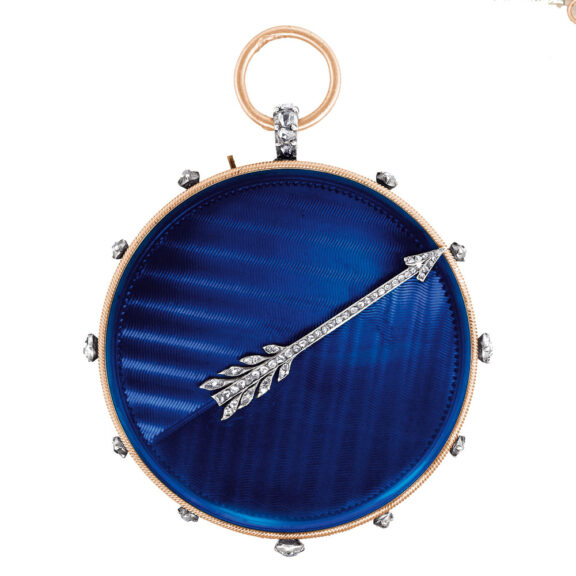
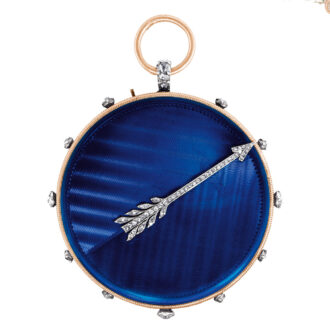
French gold médaillon montre à tact cylinder watch Circa 1800
- Kenmerk
- FA0285
- Diameter
- 42 mm
- Estimate
- € 40.000 - 75.000
- Price sold
- € 27.650
Attractive rose gold, enamel and diamond set watch by Breguet
–
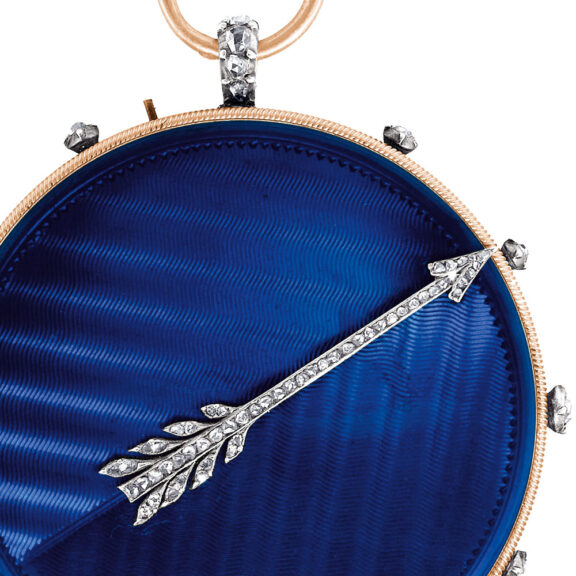
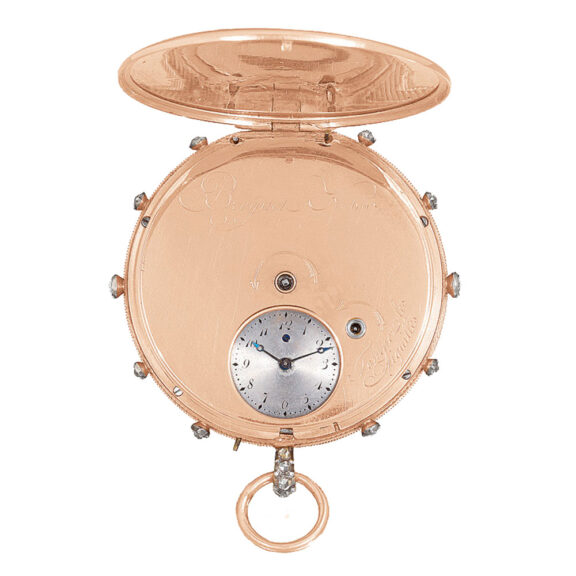
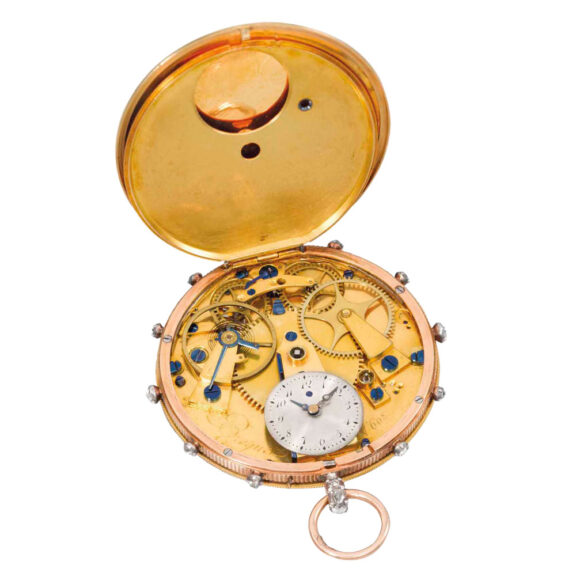
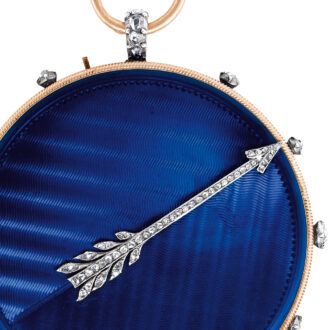
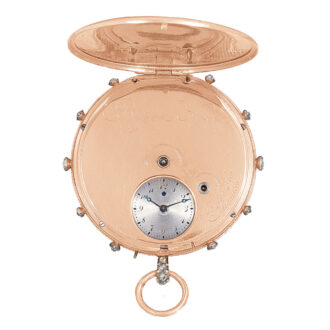
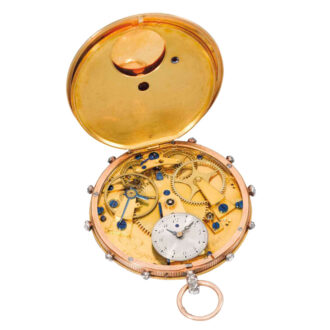
A very fine, rare and attractive French 18 carat rose gold, enamel and diamond set hunting cased médaillon montre à tact cylinder watch, circa 1800. Sold to Monsieur Bastreche on Germinal an 8 (21 March – 19 April 1800) for 3,000 Francs. Fire-gilded movement “Souscription” caliber with center barrel wound only from the front, five-wheel, 45-hour going train controlled by ruby cylinder escapement with brass three-arm balance with flat blued steel balance spring, index regulator. Gold cuvette. Eccentric silvered dial with Breguet numerals and blued steel Breguet hands. Case to the front with white gold and diamond set revolving arrow shaped hour pointer on translucent royal blue enamel over engine turned striped decoration, gold reeded band set with 11 rose cut diamonds, back cover with translucent royal blue enamel on engine turned sunburst background, rose cut diamond set pendant. Cuvette and movement signed and numbered.
–
Diameter: 42 mm
–
Signed: Breguet
–
Masterpieces from the workshops of Abraham-Louis Breguet The following five lots, 389 to 393, are superb examples of timepieces made by the workshops of Abraham-Louis Breguet (1747-1823) and his successors, widely acknowledged for having set the standard by which all fine watchmaking has been judged ever since. He was born in Neuchâtel, Switzerland, but it was in Paris that he spent most of his productive life. No aspect of watchmaking escaped his study, and his inventions were as fundamental to horology as they were varied. His career started with a series of breakthroughs: the development of the successful self-winding perpétuelle watches, the introduction of the gongs for repeating watches and the first shock-protection for balance pivots. Louis XVI and his Queen, Marie-Antoinette, were early enthusiasts of Breguet’s watchmaking. Each watch from his workshops demonstrated the latest horological improvements in an original movement, mostly fitted with lever or ruby-cylinder escapements that he perfected. Breguet took refuge in Switzerland from the excesses of the French Revolution. He returned to Paris overflowing with the ideas that produced the Breguet balance spring, his first carriage clock (sold to Bonaparte), the “sympathique” clock and its dependent watch, the tact watch, and finally the tourbillon, patented in 1801. Breguet became the indispensable watchmaker to the scientific, military, financial and diplomatic elites of the age. His timepieces ruled the courts of Europe. For his most celebrated clients, Breguet designed exceptional timepieces. For Caroline Murat, queen of Naples, he conceived in 1810 the world’s very first wristwatch. Honours saluted his enormous contribution to horology. Appointed to the Board of Longitude and as chronometer-maker to the navy, he entered the Academy of Sciences and received the Legion of Honour from the hands of Louis XVIII. When he died in 1823, all mourned the architect of the greatest revolution in the science and art of time-keeping.
Accompanied by a 1953 Breguet certificate and later fitted box and key.
Signed: Breguet
Share this page: