French gold cylinder watch with wolf’s tooth train Circa 1789
- Kenmerk
- CH1708
- Diameter
- 50 mm
- Estimate
- € 6.000 - 12.000
- Price sold
- € 5.040
Gold, enamel and pearl-set cylinder watch by Lépine
–
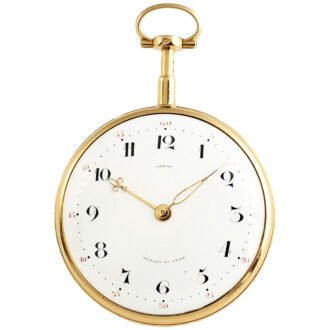
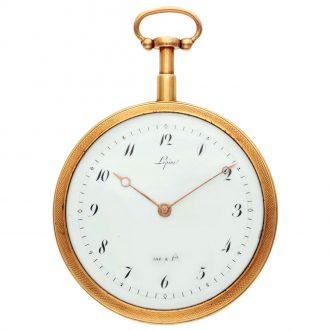
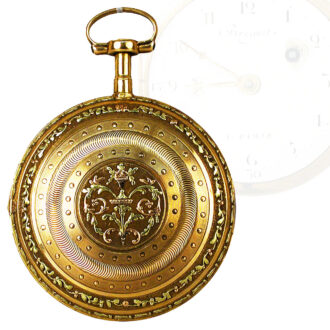
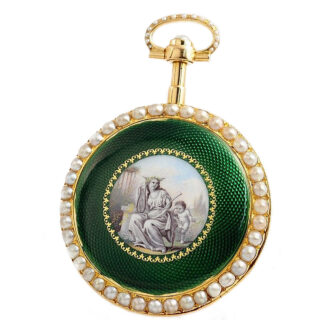
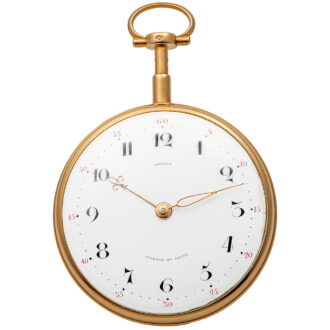
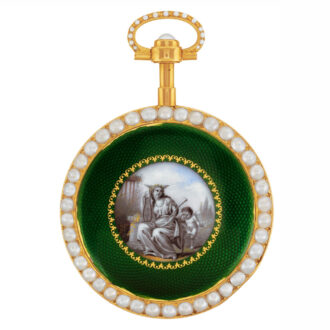
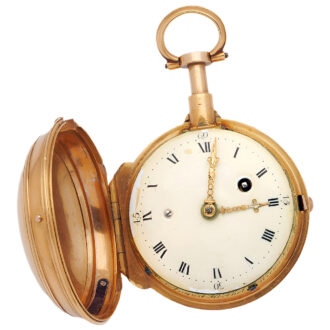
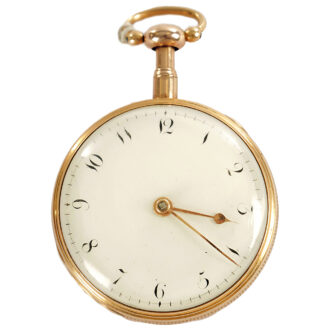
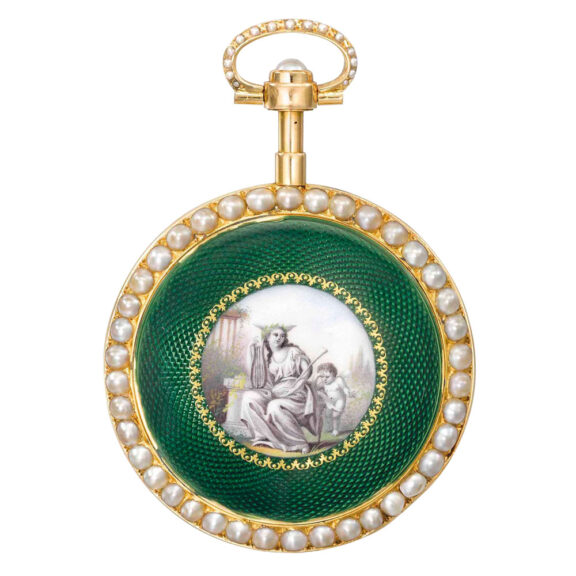
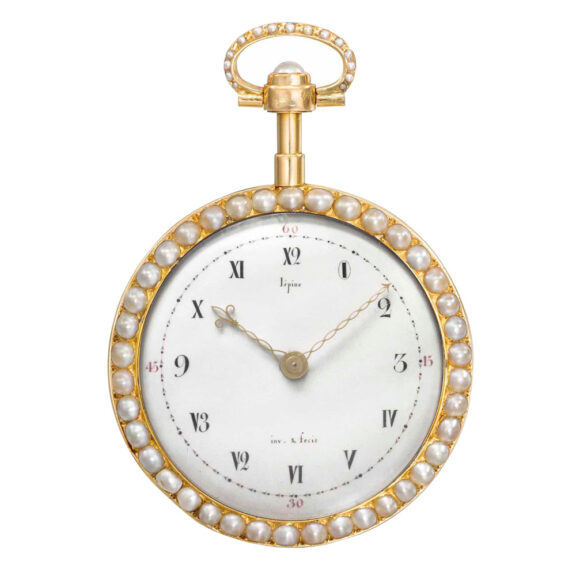
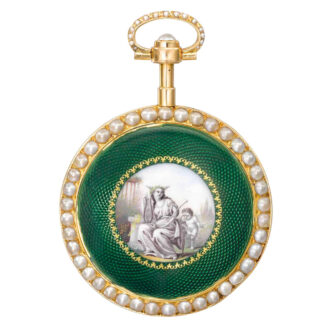
A very fine and rare French 18 carat gold, enamel and pearl-set open faced cylinder watch with wolf’s tooth train, circa 1789. Lépine calibre gilt finished cylinder movement with a free-standing barrel, wolf’s tooth winding. Gilt cuvette. Unusual white enamel dial with mixed black Roman and Arabic numerals, outer decorative line and red Arabic quarter hours, gold interlaced hands. Case with pearl-set bezel, rim, bow and pendant, hinged back decorated with translucent green enamel over an engine-turned ground, centred by a gold paillon framed, finely painted enamel miniature depicting Erato and a putto in a classical landscape. Case stamped with case maker’s initials GM for Guillaume Mermillod, dial and cuvette signed.
–
Diameter: 50 mm
–
Signed: Lépine inv. et fecit Horloger du Roi Paris
–
This watch is a very good example of Lépine’s production for a very short period between 1788 and 1790. Not only by the case with concealed hinge and fixed bezel but also by the movement with wolf’s tooth wheel train wound from the back through the cuvette, by the dial with mixed Roman and Arabic numerals, the numeral I being surrounded by a thin line. It is extremely rare to find a watch with such unusual features in such good condition. Together with the very elegant interlaced hands, these three features mark the ultimate development of the style introduced by Jean-Antoine Lépine.
–
According to A. Chapiro in his book Jean-Antoine Lépine Horloger (1720-1814), the mixed Roman and Arabic numerals were only used by Lépine for the dials of watches numbered between 5400 and 5700. Such watches were produced during a very short period, roughly 1788 to 1790. Among the unusual features of these dials, besides the combination of Roman and Arabic numerals. It is interesting to point out that the numeral I is framed in an oval and chapter 4, as opposed to the design used by all other makers, is marked “IV” instead of “IIII”. These dials are undoubtedly among the most original attempts ever made to improve the aesthetic of dials. The design served as a source of inspiration during the Art Deco period, being used by Rolex, in particular.
Signed: Lépine inv. et fecit Horloger du Roi Paris
Share this page: