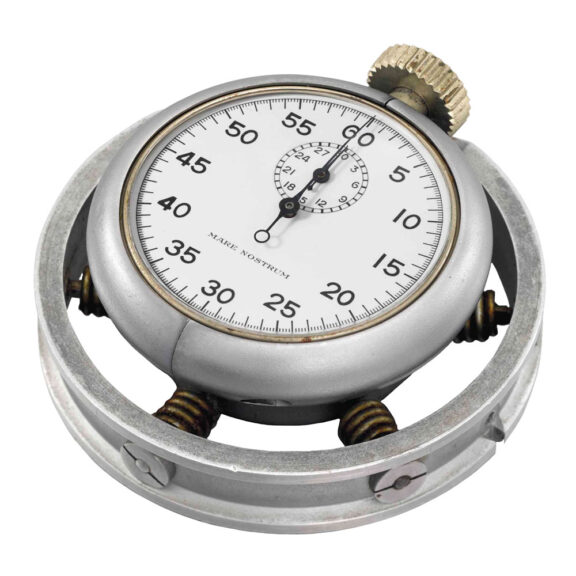
Italian aluminium and stainless steel chronograph Circa 1935
- Kenmerk
- CH1814
- Diameter
- 70 mm
- Estimate
- € 8.000 - 14.000
- Price sold
- € 9.300
Lever chronograph with anti magnetic and anti vibration appliance by Panerai
–
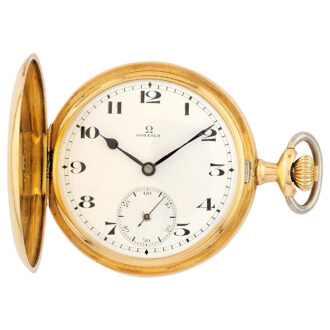
A rare and unusual Italian aluminium and stainless steel open faced keyless lever chronograph watch with anti magnetic and anti vibration appliance, circa 1935. Mechanical jewelled movement. White enamel dial with Arabic five minute divisions and fifths of a second divisions, subsidiary dial for 30 minutes register. Stainless steel case, hinged back, chronograph activated/stopped by sliding a lever in the band, hand and recorder reset by depressing the crown, set within an aluminium outer case suspended from an aluminium outer frame with six anti vibration springs. Case and movement numbered, dial signed.
–
Diameter watch: 55 mm
–
Diameter incl. frame: 70 mm
–
Signed: Mare Nostrum
–
This watch represents a highly attractive example of rare timepieces made by the celebrated Officine Panerai between 1935 and 1995. Officine Panerai was founded in 1860 by Giovanni Panerai (1825-1897) who opened the first watchmaker’s shop in Florence on the Ponte alle Grazie and became a retailer of Switzerland’s most prestigious watch manufacturers. At the turn of the century, the shop moved to Piazza San Giovanni where it is still today and the designation ‘Orologeria Svizzera’ was added. In the following years Giovanni Panerai’s grandson Guido Panerai (1873-1934) expanded the business by specializing in the production of high precision optical and mechanical instruments, thus becoming the official supplier to the Royal Italian Navy.
–
As from 1910, the innovative Guido began experimenting with luminous materials and developed a system rendering instrument dials, sighting and telescopic devices luminous. His invention, later known as ‘Radiomir’ and patented, consisted of a mix of sulphide and radium bromide to achieve luminescence. During both World Wars, the Royal Italian Navy used various Panerai precision instruments including timing mechanisms, depth gauges and mechanical calculators to launch torpedoes from high speed motor torpedo boats ‘M.A.S.’ or ‘Motorbarca Armata SVAN’, manufactured by the Societa Veneziana Automobili Navali or SVAN. These ‘human torpedoes’ were electrically propelled torpedoes with two crewmen equipped with diving suits riding astride. The torpedo was steered at slow speed to the enemy ship, the detachable warhead then used as a limpet mine before riding away. When Guido passed away in 1934, his children Giuseppe and Maria continued and further developed their father’s business. Maria took over the day-to-day running of the Orologeria Svizzera shop while Giuseppe devoted his entire time to the improvement of underwater instruments, torches, wrist compasses and wrist depth gauges for the Royal Italian Navy. From the launch of the first ‘Radiomir’ wristwatch until to date, Panerai designed the crown protecting device, allowing the watches to descend to a depth of 200 metres, a remarkable achievement for the time. It was also granted patent for ‘Luminor’, the luminous substance based on tritium, which replaced the previous ‘Radiomir’ mix and from which the names of the two models are derived. The firm supplied small series of diver’s watches to several Mediterranean Navies including a large Radiomir watch made upon request of the Egyptian Navy, fitted with an Angelus movement with eight day power reserve and five minute intervals to calculate immersion times. Today more than ever Panerai watches with their distinctive look enjoy an enormous popularity amongst collectors.
Signed: Mare Nostrum
Share this page: