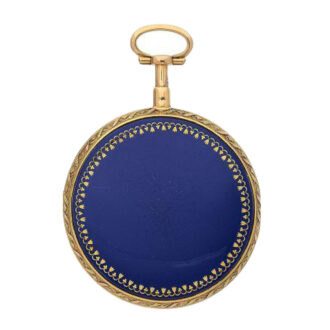
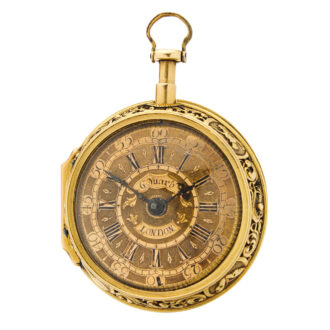
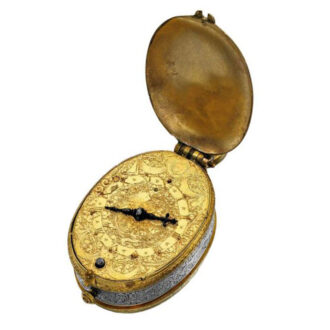
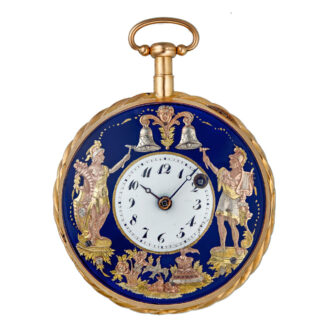
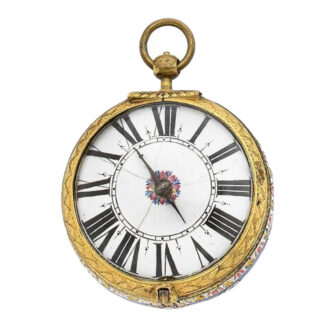
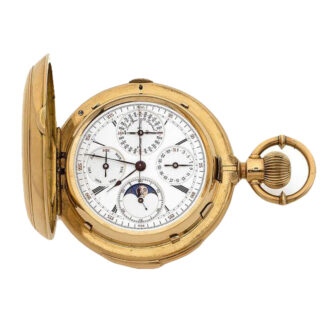
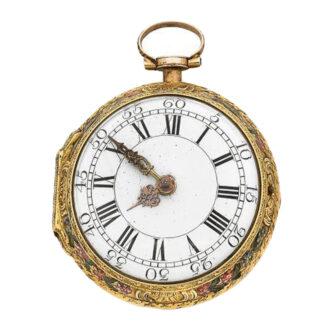
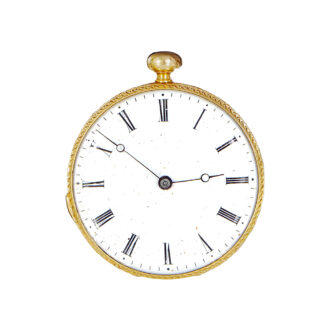
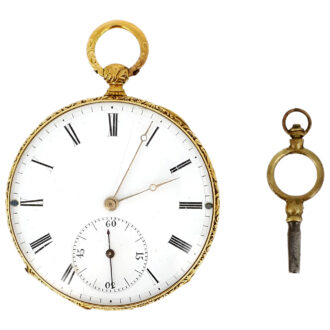
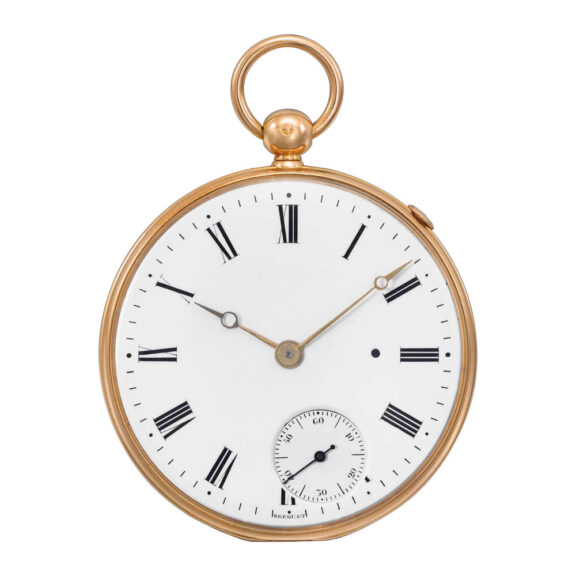
Gold half quarter repeating jumping hour watch Circa 1846
- Kenmerk
- CH1020
- Diameter
- 48 mm
- Estimate
- € 25.000 - 40.000
- Price sold
- € 36.500
Gold half quarter repeating lever watch by Breguet
–
An extremely fine and rare French 18 carat gold half quarter repeating watch with jumping hour hand, constructed on the principles of the garde-temps, circa 1846. Sold on 16 October 1846 to Lord Howden for the sum of 2,000 francs, resold on 6 April 1850 to the Comte d’Almeida for the sum of 3,550 Francs. Gilded brass movement, going barrel, jewelled to the centre wheel, straight line lever escapement with draw, three armed cut bimetallic compensation balance, gold and platinum adjustment screws, balance spring with terminal curve, repeating on a single gong with single hammer. Gold cuvette. White enamel dial, secured by a single screw, Roman numerals, eccentric subsidiary second and gold Breguet hands. Engine turned grains d’orge case, small central engraved monogram to the back, pull-twist piston for the repeating in the band. Cuvette signed and numbered, dial signed.
–
Diameter: 48 mm
–
Signed: Breguet – Breguet Paris No 590/3054 ‘montre répétition sur les principes des chronomètres’
–
Masterpieces from the workshops of Abraham-Louis Breguet
The present watch is an example made by on of the workshops of Abraham-Louis Breguet (1747-1823) and his successors, widely acknowledged for having set the standard by which all fine watchmaking has been judged ever since.
A repeating watch once owned by the English second husband of the notorious Russian Princess Bagration.
–
Abraham-Louis Breguet (1747-1823)
Breguet was born in Neuchâtel, Switzerland, but it was in Paris that he spent most of his productive life. No aspect of watchmaking escaped his study, and his inventions were as fundamental to horology as they were varied. His career started with a series of breakthroughs: the development of the successful self winding perpétuelle watches, the introduction of the gongs for repeating watches and the first shock protection for balance pivots.
Louis XVI and his Queen, Marie-Antoinette, were early enthusiasts of Breguet’s watchmaking. Each watch from his workshops demonstrated the latest horological improvements in an original movement, mostly fitted with lever or ruby cylinder escapements that he perfected. Breguet took refuge in Switzerland from the perils of the French Revolution. He returned to Paris overflowing with the ideas that produced the Breguet balance spring, his first carriage clock (sold to Bonaparte), the ‘sympathique’ clock and its dependent watch, the tact watch, and finally the tourbillon, patented in 1801.
Breguet became the indispensable watchmaker to the scientific, military, financial and diplomatic elites of the age. His timepieces ruled the courts of Europe. For his most celebrated clients, Breguet designed exceptional timepieces. For Caroline Murat, queen of Naples, he conceived in 1810 the world’s very first wristwatch. Honours saluted his enormous contribution to horology. Appointed to the Board of Longitude and as chronometer-maker to the navy, he entered the Academy of Sciences and received the Legion of Honour from the hands of Louis XVIII.
When he died in 1823, all mourned the architect of the greatest revolution in the science and art of time-keeping.
Signed: Breguet – Breguet Paris No 590/3054 ‘montre répétition sur les principes des chronomètres’
Share this page: