Exceptionally fine Swiss 18k gold complicated lever Circa 1898
- Kenmerk
- CH1252
- Diameter
- 59 mm
- Estimate
- € 1.000.000 - 2.000.000
- Price sold
- € 1.688.800
Highly important rose gold open faced complicated watch by Patek Philippe
–
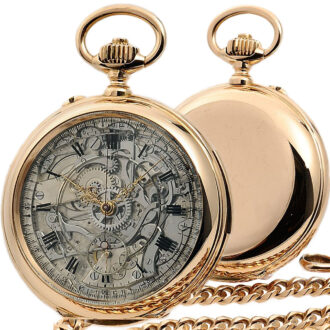
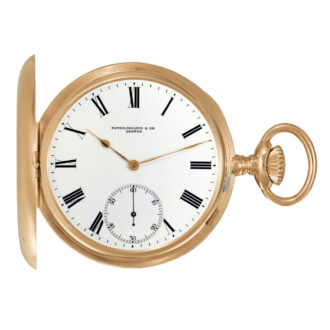
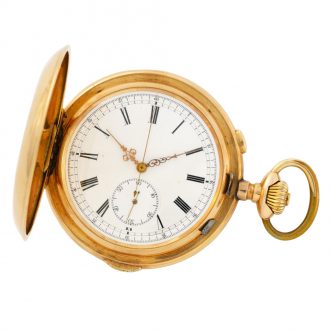
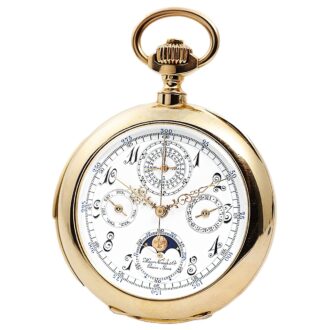
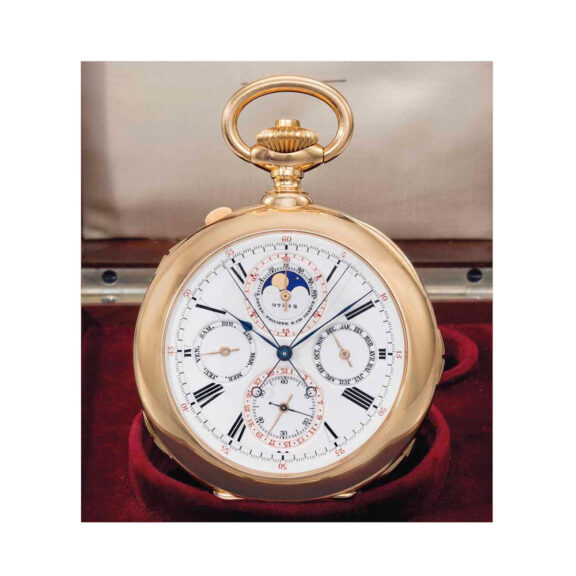
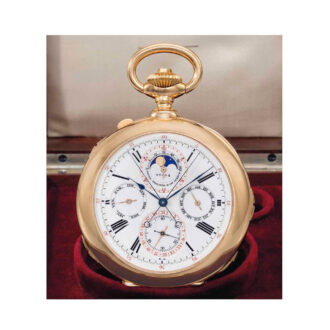
This exceptionally fine and highly important Swiss pocket watch in 18K rose gold was made by Patek Philippe and manufactured in 1898. It combines a trip minute repeater, grande and petite sonnerie, a perpetual calendar with moon phases, and a split-seconds chronograph. It was sold to Stephen S. Palmer on 3 October 1900.
–
The nickel-finished movement has two trains and a bimetallic compensation balance, and is wound by turning the crown in either direction. Two polished steel hammers strike the hours, quarters and minutes on two gongs. The case has a rose gold cuvette.
–
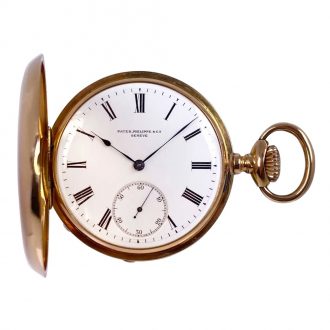
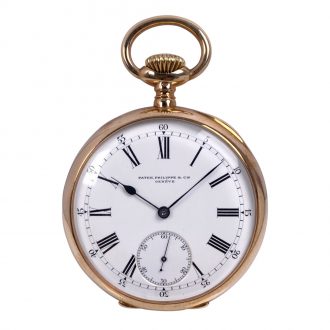
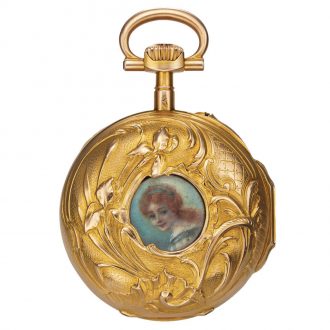
The white enamel dial has Roman numerals and blued steel hands. Four small dials show the running seconds, date, day, and month, plus a 30-minute chronograph register with the phase and age of the moon. The heavy polished case is engraved with the monogram SSP on the back.
–
The controls are around the band:
crown: starts, stops and resets the chronograph
between 3 and 4 o’clock: slide to choose grande or petite sonnerie
at 5 o’clock: slide for the minute repeater
between 8 and 9 o’clock: slide to switch the striking on or off
at 11 o’clock: split-seconds button, with a slide to lock the chronograph
–
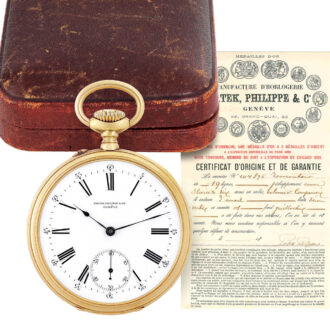
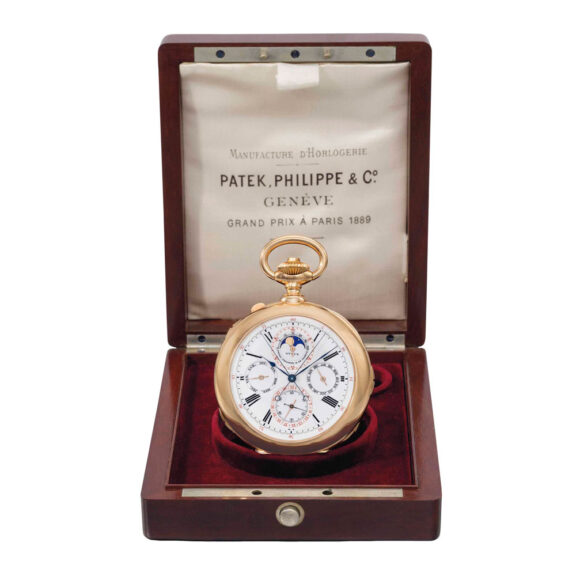
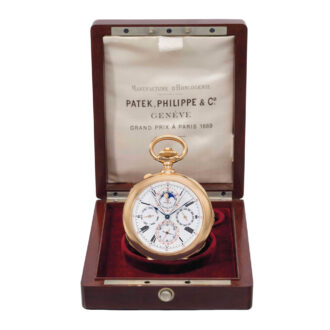
The case, cuvette, dial and movement are signed, and the case and movement are numbered. The watch comes with its original certificate, the 1900 invoice and its presentation box.
–
Diameter: 59 mm
–
Signed: Patek, Philippe & Cie Genève
–
Until the Palmer watch came to light, it was widely accepted that Patek Philippe made its first Grand Complication in 1910 and its second, for James W. Packard, in 1916. Stephen S. Palmer bought this watch on 3 October 1900 for the large sum of SFr. 6,500. Its discovery adds a remarkable new chapter to the history of Patek Philippe and of Grand Complications in general.
–
This watch is the only known example to have been cased in pink gold, whereas all following pieces were cased in yellow gold, in the style of the early 20th century.
–
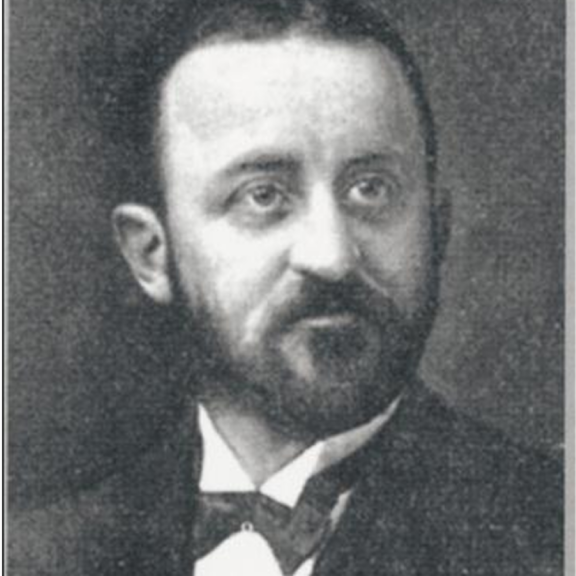
Stephen S. Palmer 1853–1913
Stephen S. Palmer was a leading industrialist who made his fortune in the Gilded Age, when America’s economy grew through factories, railways, mining, and new technology. In 1897, he became President of the New Jersey Zinc Company. He set up the Mutual Relief Association, which gave financial help to employees and their families in cases of illness or fatal accidents. He cared about education, helped build schools and encouraged his workers to keep learning.
–
Palmer received an award for distinguished service for supplying zinc to the U.S. government during the First World War. He and Cornelius Vanderbilt were directors of the Lackawanna Steel Company. He also played a key part in linking the Williamsburg Bridge with the Brooklyn Bridge and South Ferry. He was a Trustee of Princeton University from 1908 to 1913. He lived for most of his life at 12 East 81st Street, New York, and later retired to Princeton, New Jersey.
–
Mr Palmer, an avid watch connoisseur, was already a distinguished client of Patek Philippe when he travelled to the firm’s Geneva factory in October 1990. Research into Palmer’s trip, including the Beau Rivage Hotel guest books, shows he not only came to collect his treasured Grand Complication but also picked up two other complicated timepieces. This Grand Complication remained in a vault in Palmer’s home, virtually untouched and is accompanied by the original invoice and presentation box (pictured on page three). It anticipates all other Grand Complications by a decade, standing as the most complete and crispest example of all Grand Complications known today.
Signed: Patek, Philippe & Cie Genève
Share this page: