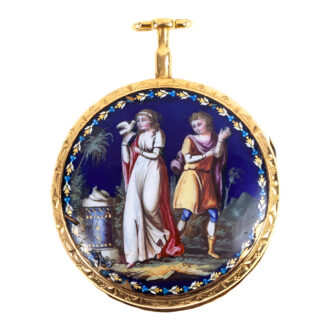
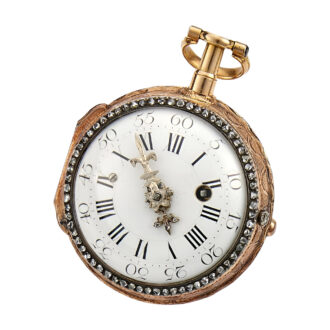
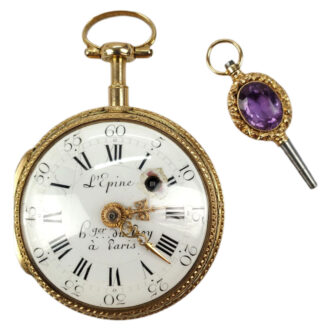
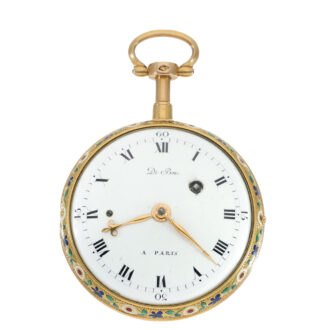
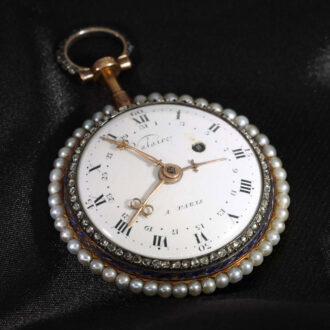
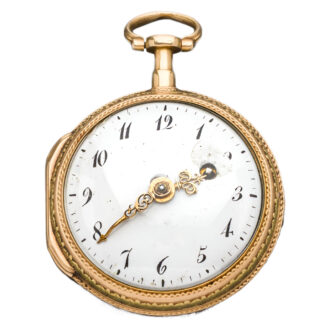
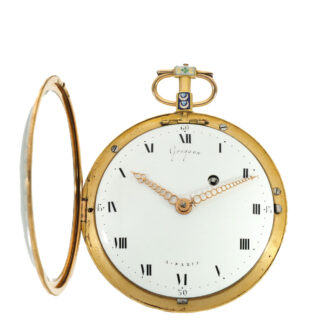
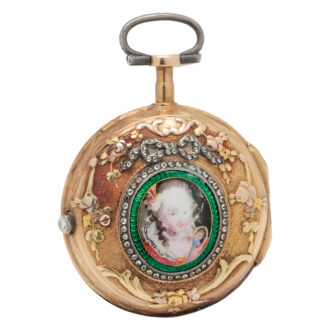
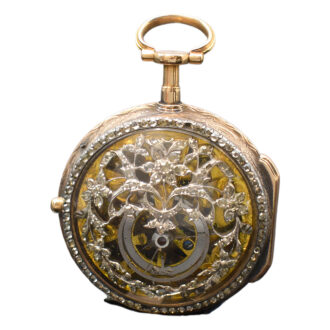
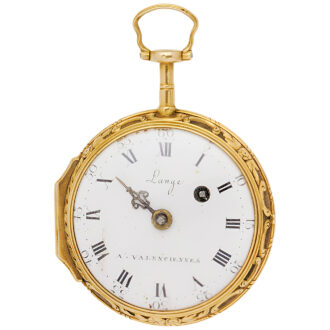
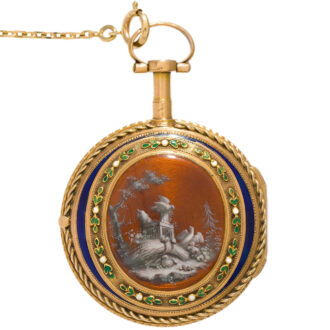
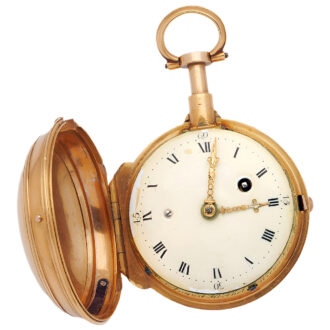
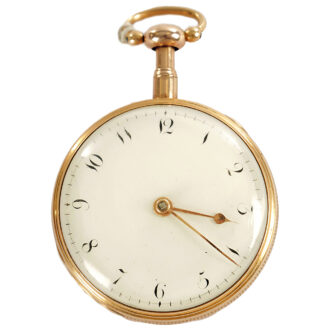
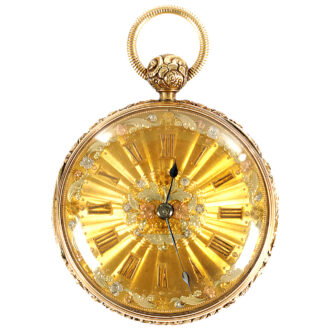
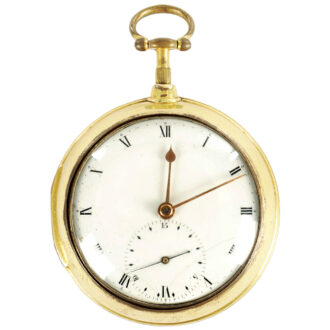
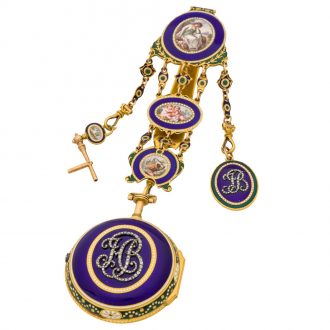
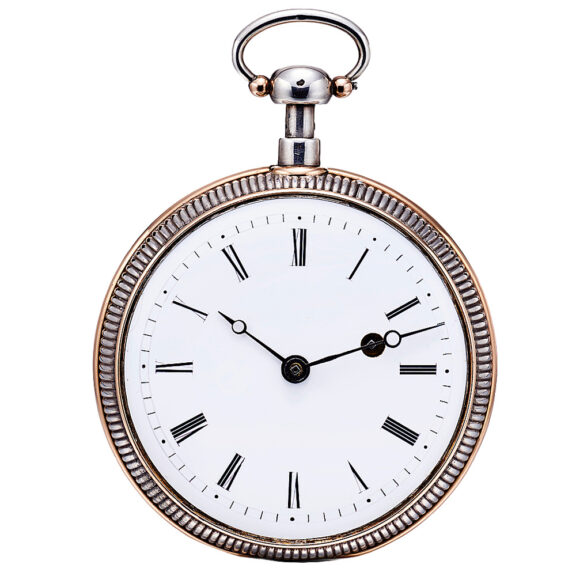
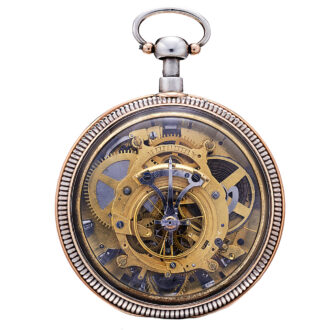
Eight day quarter repeater with skeleton movement Circa 1780
- Kenmerk
- AA0183
- Diameter
- 64 mm
- Estimate
- € 4.000 - 7.500
- Price sold
- -
Unsigned gold and silver pocket watch probably from France
–
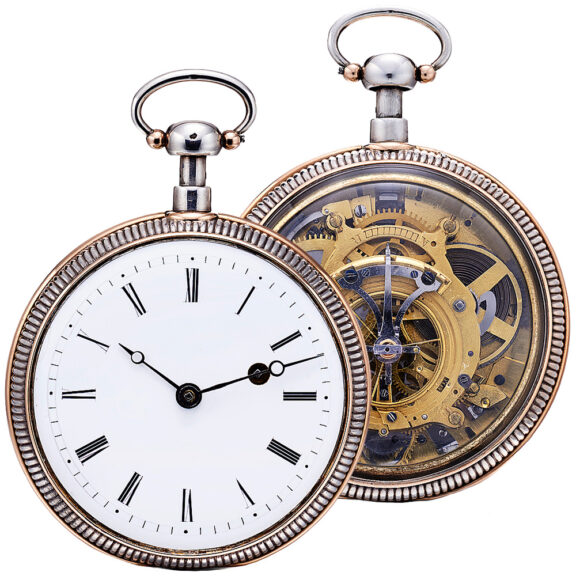
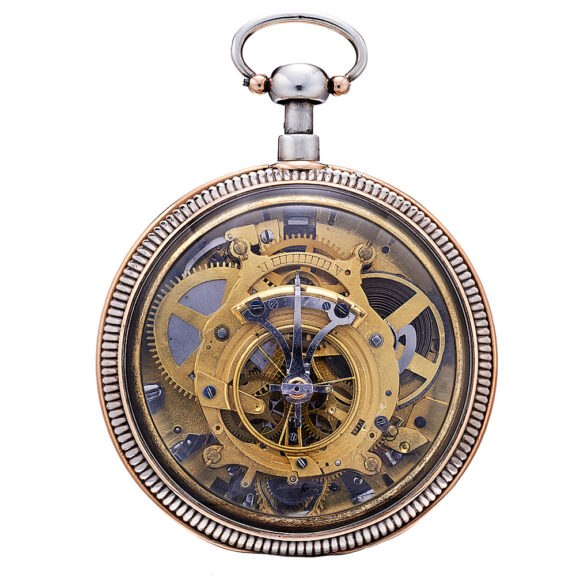
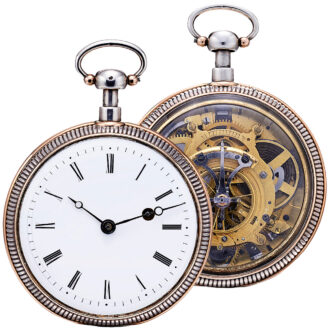
A silver and pink gold, key winding, quarter repeating, Consular eight day pocket watch with skeleton movement, reversed fusee and open face, circa 1780.
This unsigned, round shaped pocket watch with its silver and pink gold plain case has one horological complication: – Quarter repeater on two steel square gongs (activated by depressing the pendant. It has an enamel dial with Roman radial hours, outer minutes track, and Breguet hands. And a gilded brass movement with reversed fusee and chain, cylinder escapement, monometallic balance (gilded brass), and blued steel flat hairspring.
–
Diameter: 63.6 mm
–
Signed: No name
–
The movement of this watch probably dates from the last third of the 18th century. It works for eight days and is of unusual construction with a “renversée” (reversed) fusee; its skeleton calibre reveals a maximum of components. The case, the dial, and the hands date back to circa 1805. This case is closer to that of another double faced watch of the late 18th century ?? the first deck chronometer in the history of watchmaking ?? signed in 1772 by Pierre Le Roy (1717-1785), the father of modern chronometry. The movement of this watch was restored (“renovated”) by Henri Laresche in 1804 with two new dials and a new case of 66.4 mm. diameter.
–
The movement of the present watch is perhaps an experimental movement from the workshop of the Le Roy family. The « renversée » (reversed) fusee It’s an invention of Jean-Baptiste Le Roy (1720-1800), the second son of Julien Le Roy (1686-1759), the most important French watchmaker of the first part of the 18th century.
–
Jean-Baptiste Le Roy worked with his brother, elder Pierre Le Roy (1717-1785), until the age of 30 in the family workshop. His horology knowledge is extensive, and his work is far from negligible. He is the author of an article written in 1760 at the French Royal Academy of Sciences on a Nouvelle disposition du rouage dans les montres simples (new layout of the train of wheels in simple watches), known as the “fusée renversée” (reversed fusee). This is published with drawings in 1763 in the Histoire de l’Académie des sciences (History of the Academy of Sciences), pp. 127-130. In this device, the fusee-wheel is placed above the end of the small diameter of the cone, which has the effect of better balancing the forces on the two pivots of the fusee. Hence, the fusee chain crosses over between the barrel and fusee, near the centre wheel pinion, reducing the friction on the arbour bearings.
–
A few rare 18th-century watches featuring this invention are known; they are the works of Pierre Le Roy and the Goyffon brothers (active in Paris in the workshop of Le Roy, then at the direction of the Manufacture royale de montres (Royal Watch Factory) of Bourg-en- Bresse).
–
Chronometers, made circa 1800, notably by Louis Berthoud (1754-1813) and Abraham-Louis Breguet (1747-1823), use this same system. The reversed fusee as the regular fusee was less and less used in the 19th century because of the calibre with bridges and “toothed” going barrel (invented by Jean-Antoine Lépine, 1720-1814) was quickly imposed in the continental watchmaking industry.
–
Jean-Baptiste Le Roy was named in 1751 as a member of the French Royal Academy of Sciences as a mechanician, geometer and physicist. He is also a member of the French Royal Naval Academy, the English Royal Society of London, the American Philosophical Society and the Institut de France. In 1774, he was entrusted with the responsibility of the Physics Cabinet of the King, Louis XVI. Jean-Baptiste Le Roy participates in the writing of the Great Encyclopedia; he is the author of a hundred articles on the mechanical arts. He studies subjects as diverse as the best way to light the streets of Paris or the hygienic organization of hospitals. He became a close friend of Benjamin Franklin (1706-1790). He studied the use of lightning conductors on buildings and ships and the application of electricity to the study of the phenomena of Visio.
Share this page: