Magnificent Swiss gold dress watch with enamel scene Circa 1980
- Kenmerk
- TA3708
- Diameter
- 47 mm
- Estimate
- € 12.500 - 25.000
- Price sold
- € 25.000
Gold, diamond and enamel dress watch
–
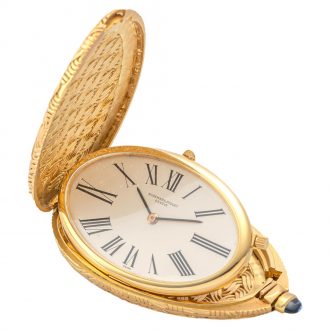
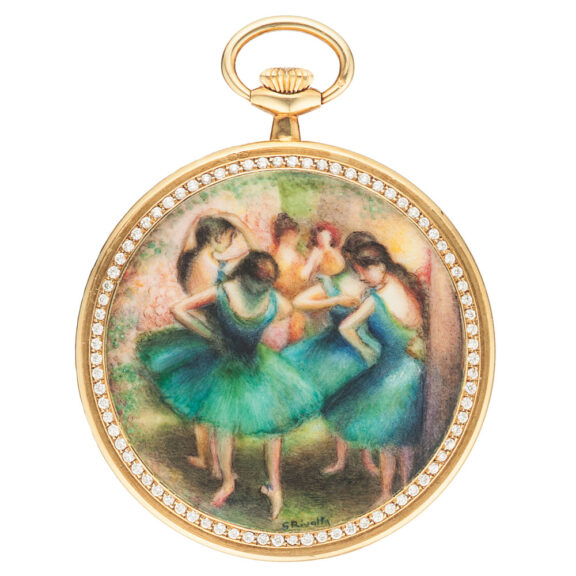
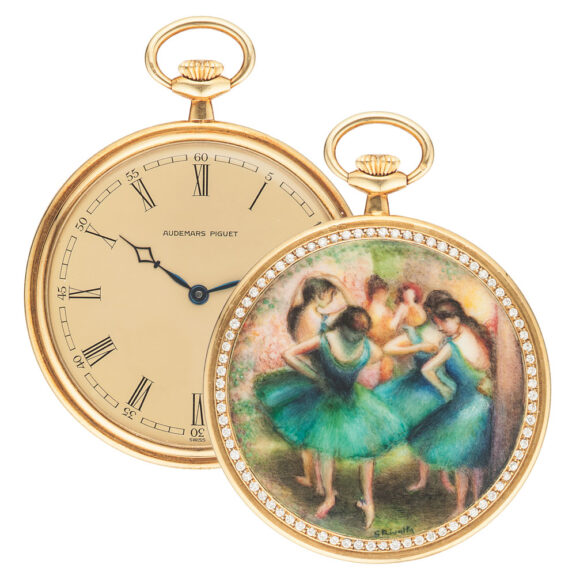
A magnificent Swiss 18 carat yellow gold, diamond and enamel keyless dress pocket watch, circa 1980. The enamel was inspired by Degas Les Danseuses, an enamel work by G. Rivalta. A polished bezel, polished curved band, the back with a painted on enamel scene of ballerinas getting ready based on the painting by Degas and surrounded by diamonds. Champagne dial with radial Roman numerals, outer minute divisions and Arabic five minutes and pierced blued steel hands. A rhodium plated movement, Geneva striping decoration, 20 jewels, adjusted to heat, cold, isochronism and five positions, mono metallic balance, self compensating balance.
Case, dial and movement signed.
–
Diameter: 47 mm
–
Signed: Audemars Piguet Swiss
–
Audemars Piguet – Jules Louis Audemars, born on March 28th, 1851 and died on October 15, 1918, and Edward Auguste Piguet born in 1853 and died in 1919 were two young and ambitious watchmakers who established their workshop in 1875 in their home village Le Brassus, Vallée de Joux, Switzerland. Audemars was in charge of production and technical aspects while Piguet focused on sales and management. Believing in the power of the Vallée de Joux’s network of artisanship and following their firm convictions, they set on crafting unique complicated mechanisms by hand at a time when serial production was looming with the rise of industrialisation. While the two entrepreneurs first produced complicated movements that were sold to Geneva-based firms, they soon orchestrated the production of complete watches in the region by coordinating the activities of a variety of craftsmen, buying in blanks, cases, dials, bracelets and sending out pieces for gem-setting and decorating. The miniaturisation, design, assembly and setting of movements were then done at Audemars Piguet’s workbenches. The company ledgers demonstrate that nearly 80% of the 1600 watches produced by Audemars Piguet between 1882 and 1892 included at least one, if not several complications. Refined chiming, chronograph and astronomical watches, assembled and finished by hand, have remained the beating heart of Audemars Piguet ever since.
A magnificent Swiss 18 carat yellow gold, diamond and enamel keyless dress pocket watch, circa 1980. The enamel was inspired by Degas Les Danseuses, an enamel work by G. Rivalta. A polished bezel, polished curved band, the back with a painted on enamel scene of ballerinas getting ready based on the painting by Degas and surrounded by diamonds. Champagne dial with radial Roman numerals, outer minute divisions and Arabic five minutes and pierced blued steel hands. A rhodium plated movement, Geneva striping decoration, 20 jewels, adjusted to heat, cold, isochronism and five positions, mono metallic balance, self compensating balance.
Case, dial and movement signed.
–
Diameter: 47 mm
–
Signed: Audemars Piguet Swiss
–
Audemars Piguet – Jules Louis Audemars, born on March 28th, 1851 and died on October 15, 1918, and Edward Auguste Piguet born in 1853 and died in 1919 were two young and ambitious watchmakers who established their workshop in 1875 in their home village Le Brassus, Vallée de Joux, Switzerland. Audemars was in charge of production and technical aspects while Piguet focused on sales and management. Believing in the power of the Vallée de Joux’s network of artisanship and following their firm convictions, they set on crafting unique complicated mechanisms by hand at a time when serial production was looming with the rise of industrialisation. While the two entrepreneurs first produced complicated movements that were sold to Geneva-based firms, they soon orchestrated the production of complete watches in the region by coordinating the activities of a variety of craftsmen, buying in blanks, cases, dials, bracelets and sending out pieces for gem-setting and decorating. The miniaturisation, design, assembly and setting of movements were then done at Audemars Piguet’s workbenches. The company ledgers demonstrate that nearly 80% of the 1600 watches produced by Audemars Piguet between 1882 and 1892 included at least one, if not several complications. Refined chiming, chronograph and astronomical watches, assembled and finished by hand, have remained the beating heart of Audemars Piguet ever since.
Signed: Audemars Piguet Swiss
Share this page: