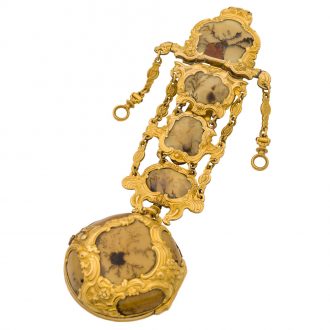
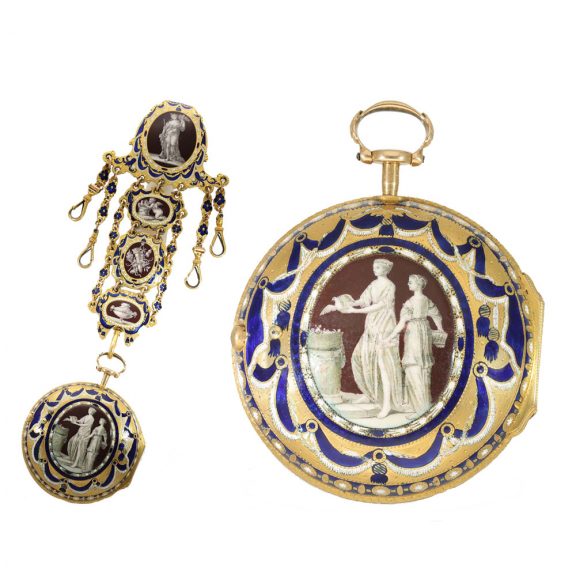
English 18 carat gold and enamel verge watch with chatelaine Circa 1775
- Kenmerk
- HC1799
- Diameter
- 48 mm
- Estimate
- € 10.000 - 20.000
- Price sold
- -
Gold enamelled chatelaine watch
–
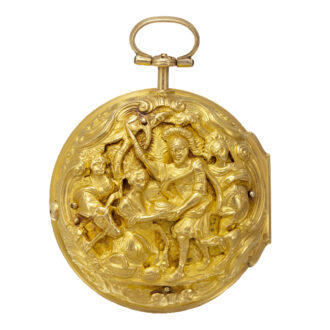
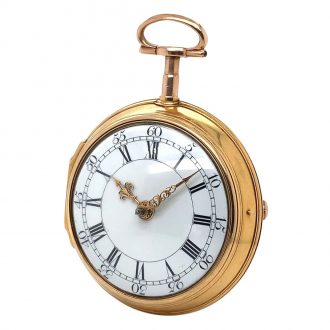
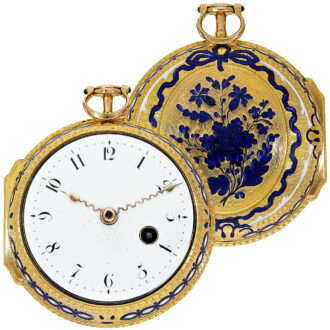
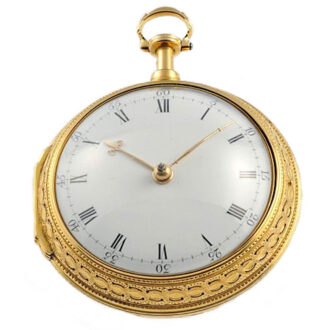
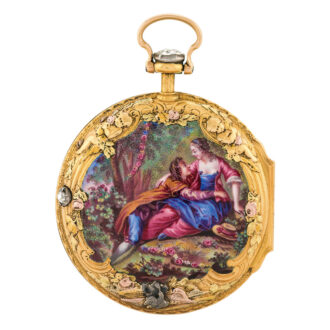
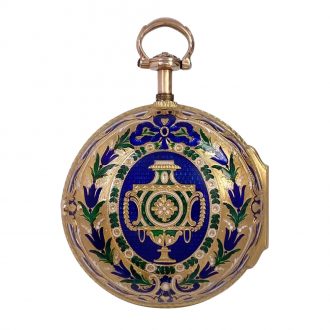
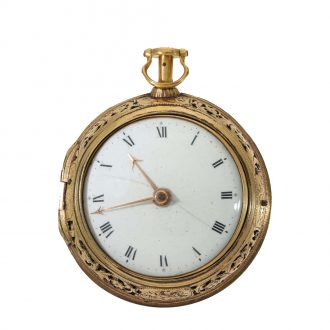
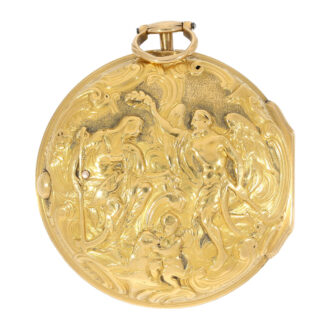
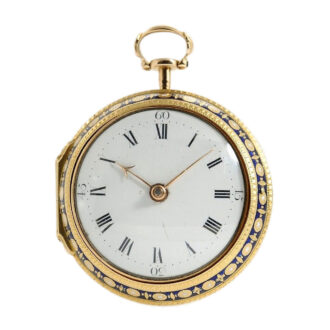
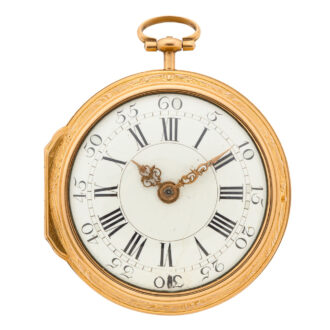
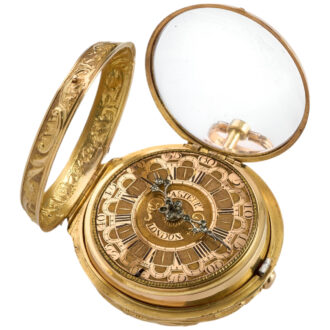
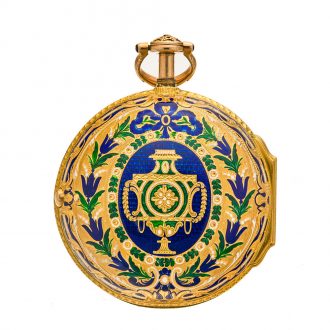
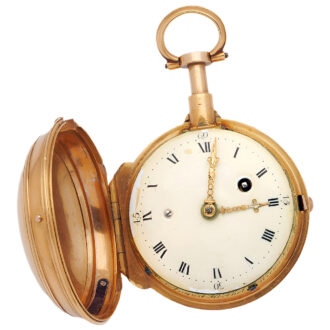
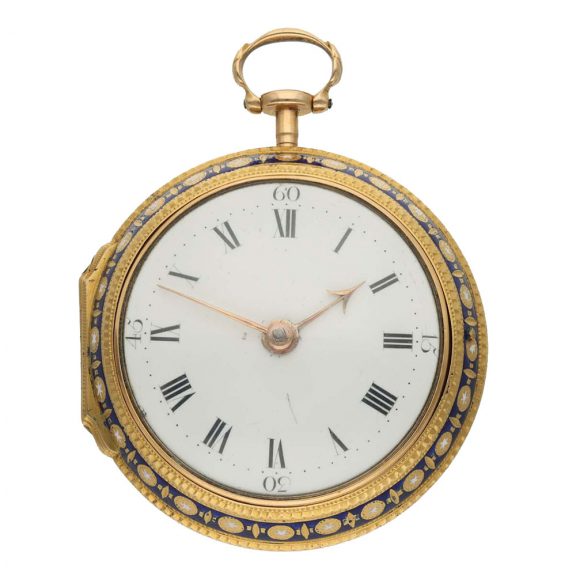
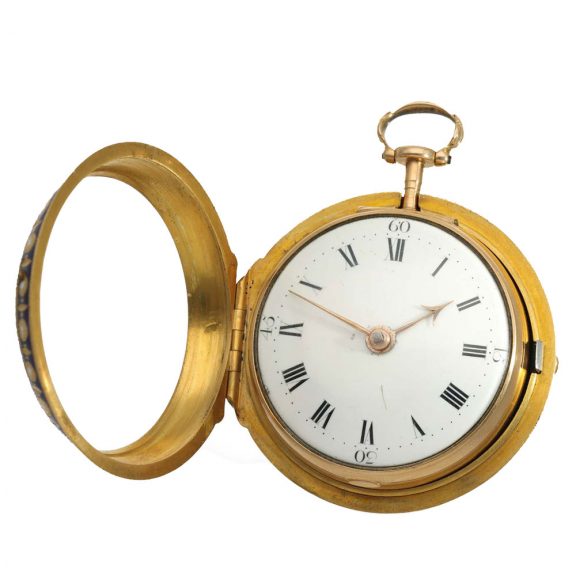
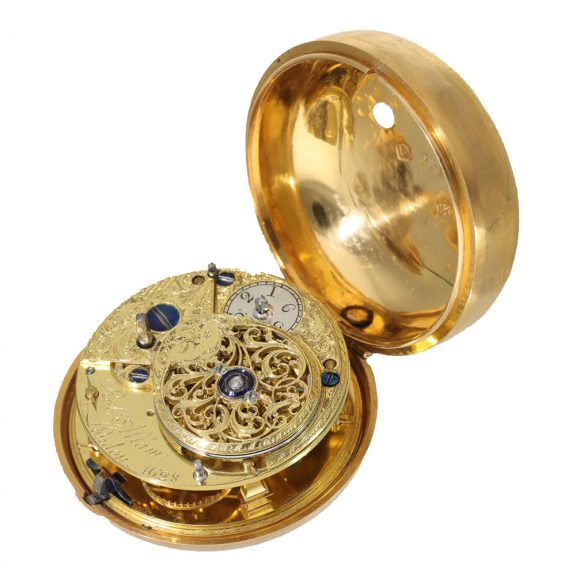
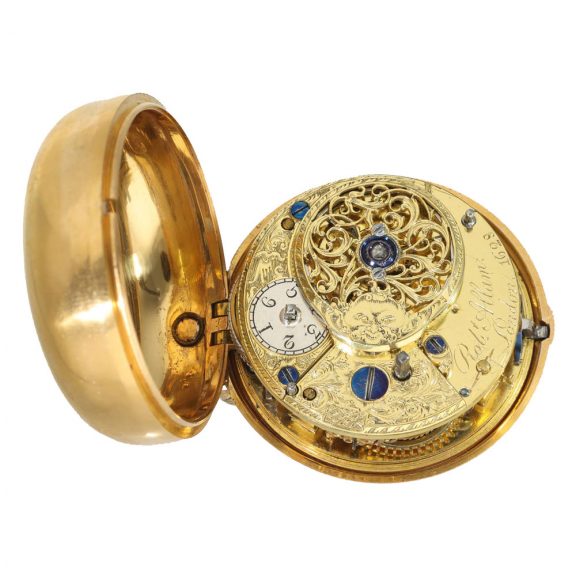
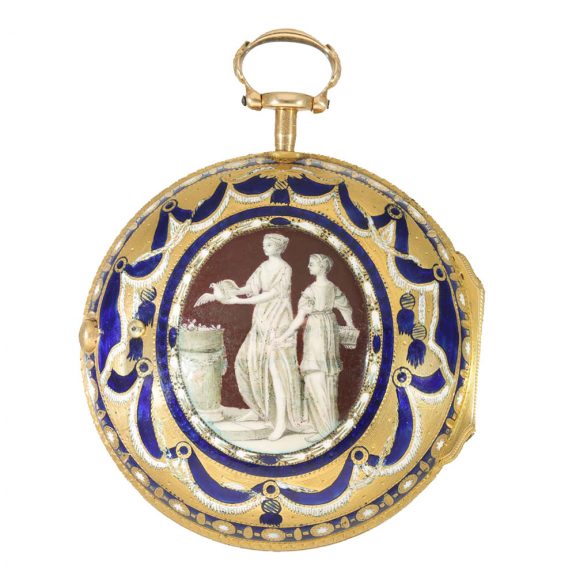
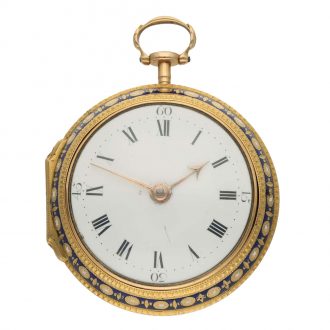
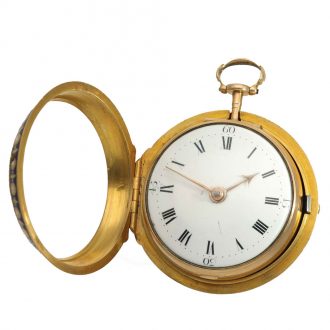
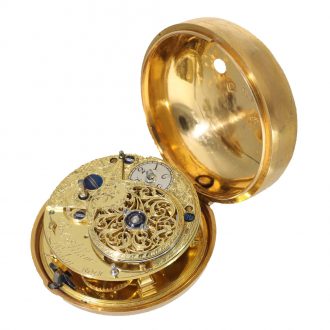
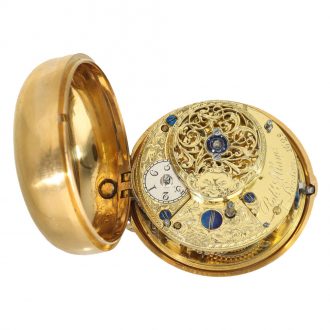
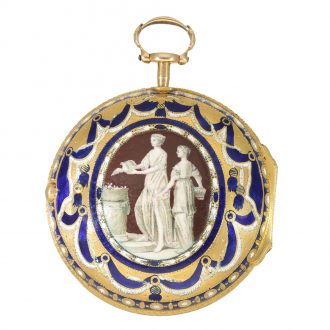
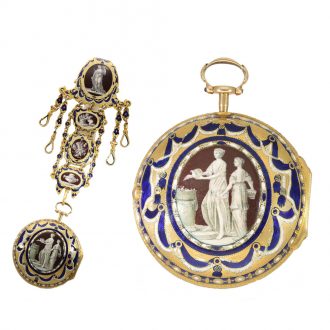
A large and important pair cased pocket watch with matching chatelaine made by Robert Allam in London, England, circa 1775. The exceptionally fine outer case of this watch was crafted from 18 carat gold and features a delicate en grisaille painting on the back in the manner of George Michael Moser and Augustin Toussaint. Both bezels are decorated with stylized white and gold floral motifs set against a translucent cobalt blue enamel ground. The back is further enriched with white and blue enamelled ornamentation, and a central oval enamel plaque depicting a classical scene rendered en grisaille on a brown ground. The numbered inner case is also made of 18 carat gold and bears the maker’s punch mark PM as well as London Hallmarks for 1875. The white enamel dial features Roman hours, outer minute divisions, Arabic 15 minute numerals and gold arrow hands. The numbered fire gilded full plate and key wound movement has a verge escapement, chain and fusee, baluster shaped pillars, a three arm steel balance, which is finely florally engraved, a pierced balance bridge with a mascaron and large diamond end stone.
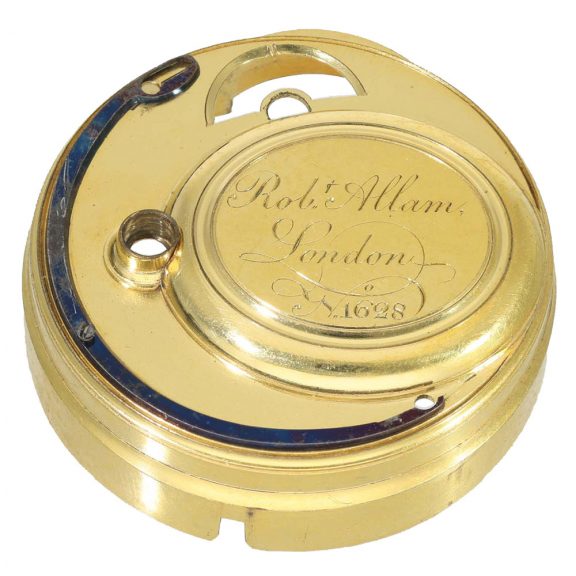
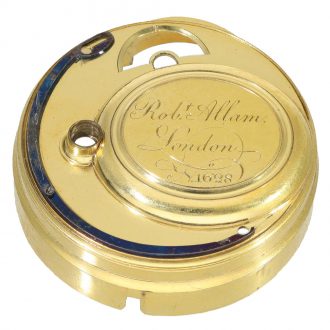
The dust cap and movement have matching numbers and are signed.
–
Diameter: 48 mm
–
Weight: 109 g
–
Length chatelaine: 11 cm
–
Signed: Robt Allam London
–
Toussaint
Louis Toussaint was a jeweller and enameller in London. His son Augustin began an apprenticeship with the famous enameller and chaser George Michael Moser in 1768 (for the enormous fee of 200 guineas). Augustin Toussaint’s work was exhibited at the Royal Academy from 1775 to 1788 and can be found on watches. The neoclassical en grisaille technique on a brown enamel background was particularly popular in London in the late 18th century.
–
Allam
Robert Allam was a respected clock and watchmaker who was active in London earlier than 1775. His main period of work was between approximately 1742 and 1765. He worked at an address located next to St. Dunstan’s Church on Fleet Street, an area renowned as a hub for the clockmaking trade in England.
–
By 1775, Robert Allam was likely deceased or no longer an active practising member of the Clockmakers’ Company, as records indicate his membership ran from 1742 to 1765. He began his apprenticeship on September 21, 1730, to Thomas Smith and was later turned over to Richard Lilly. He became a member of the Clockmakers’ Company in 1736 and remained active with the company until around 1765.
–
His workshop was located on Fleet Street, next to St. Dunstan’s Church and Allam’s work is described as being of “fine quality”. He produced both clocks (specifically notable for his bracket clocks and some longcase clocks) and watches. Many of his timepieces are now displayed in museums globally.
Signed: Robt Allam London
Share this page: