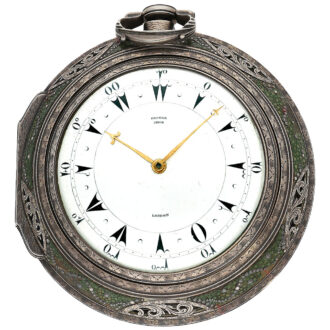
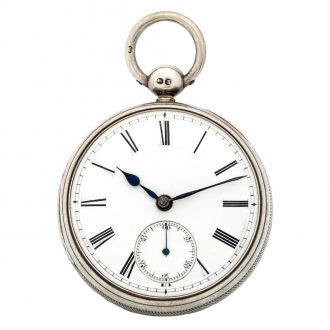
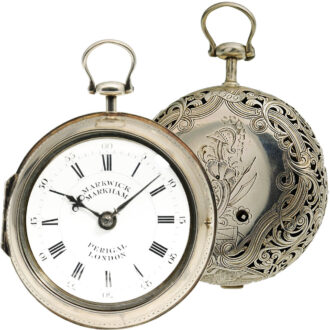
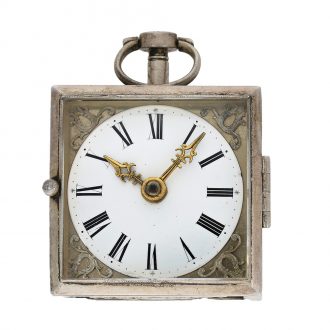
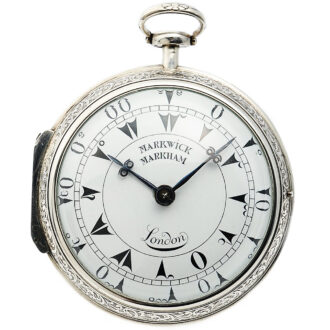
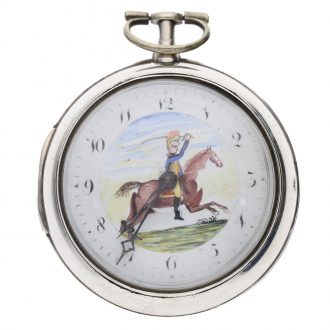
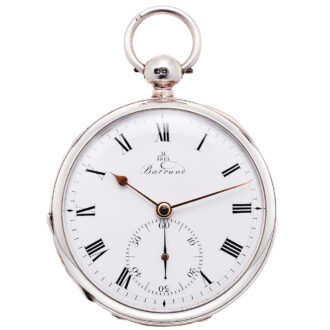
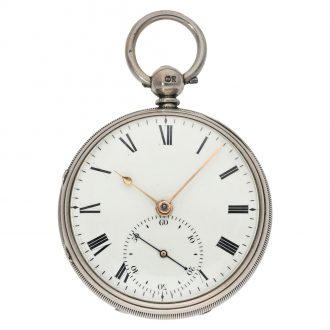
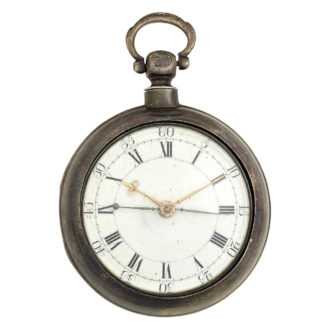
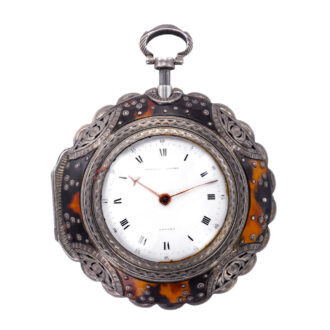
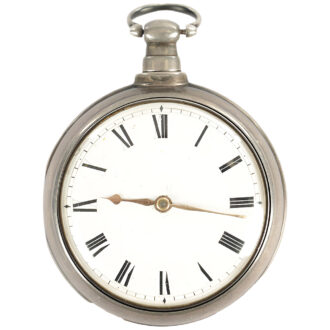
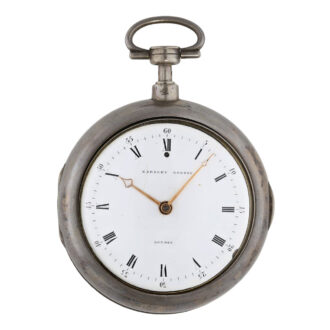
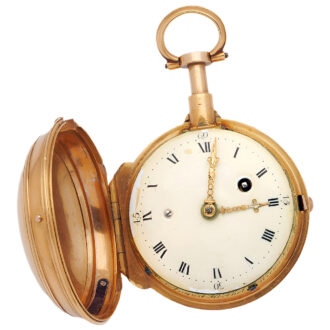
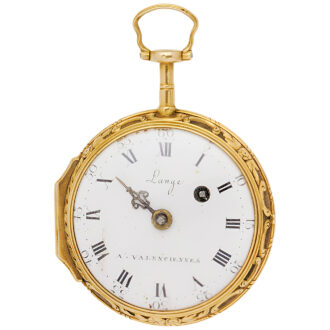
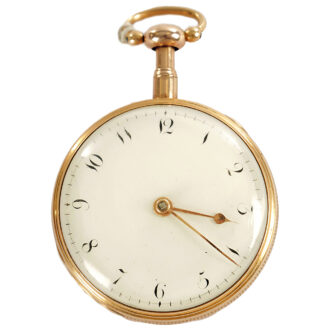
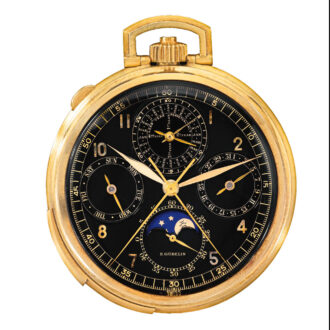
English early lever watch with regulator type dial Circa 1800
- Kenmerk
- SA0153
- Diameter
- 54 mm
- Estimate
- € 10.000 - 25.000
- Price sold
- -
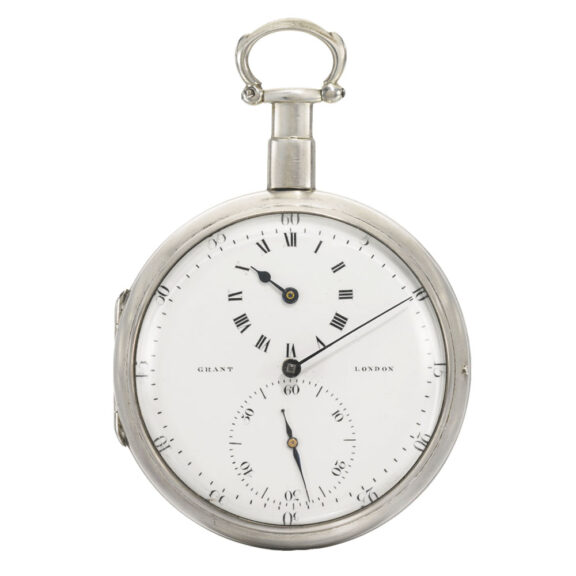
Early lever watch with regulator type dial
–
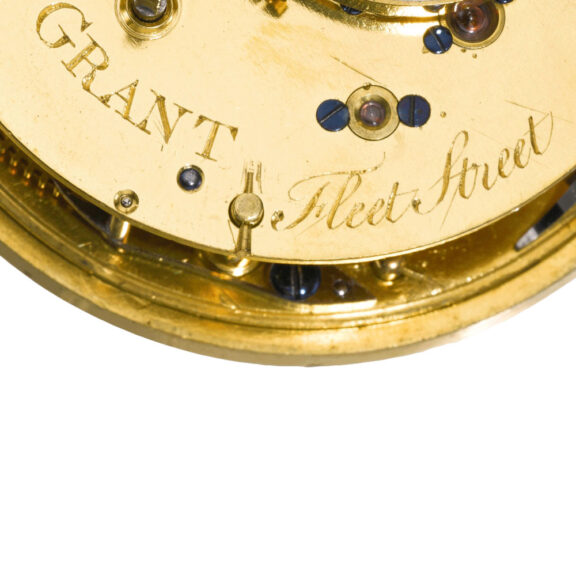
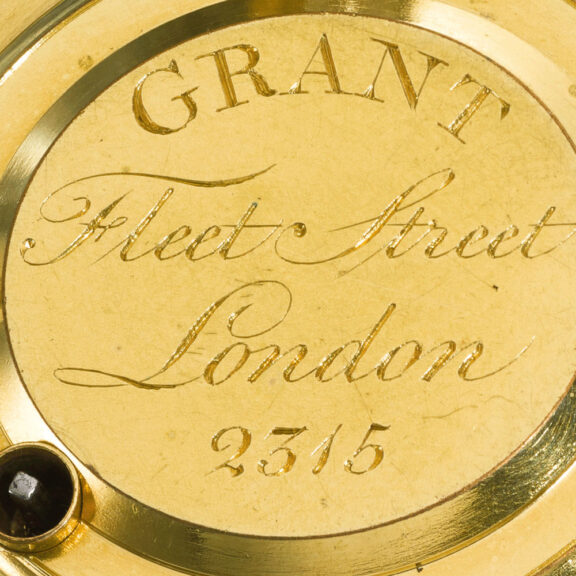
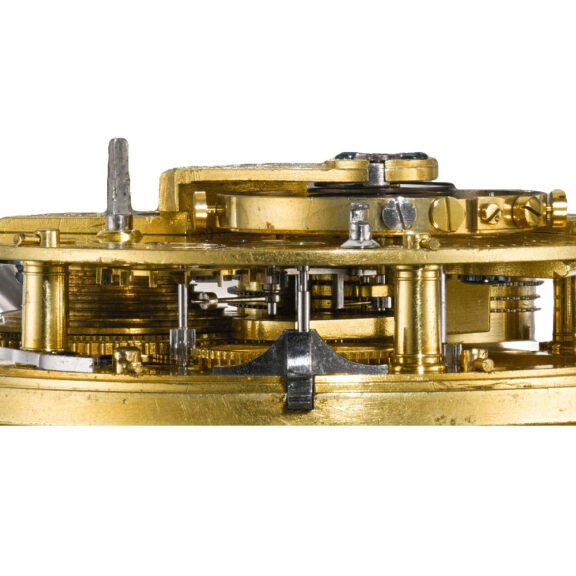
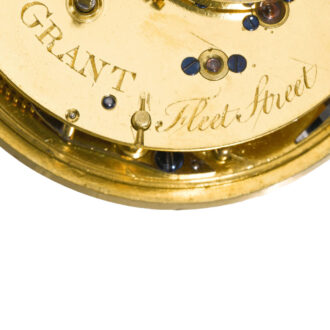
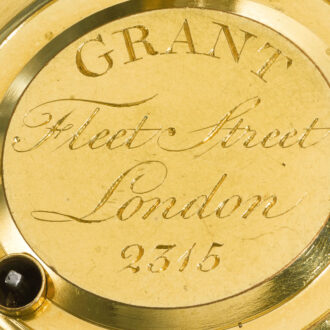
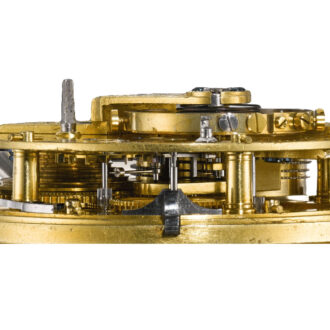
An important, early English lever watch with regulator type dial in a later case, circa 1800, gilded full plate jewelled movement, lever escapement, early ‘YCC’ brass balance with two bi metallic compensation affixes, free sprung blued steel helical spring, narrow balance cock with ruby end stone, cock and barrel plate with neo classical engraving, fusee and chain, cylindrical pillars, gilt metal dust cap, movement and dust cap signed Grant Fleet Street London and numbered.
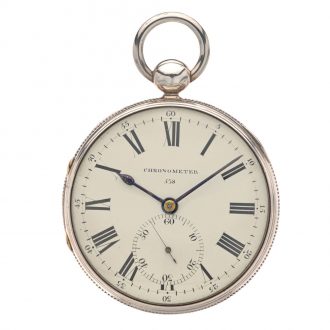
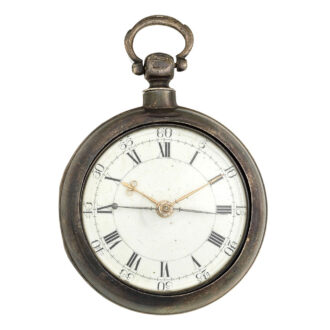
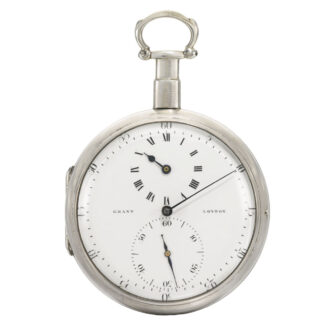
White enamel regulator type dial, hour dial with Roman numerals above and subsidiary seconds below, outer Arabic minute ring, blued steel hands, dial signed Grant, London
Later high quality plain unsigned case.
–
Diameter: 54 mm
–
Signed: Grant Fleet Street London
–
Only eight watches by Grant are known to survive with early lever escapements.
The present watch and its escapement are examined and illustrated in detail in Watches by Clutton and Daniels, an extract from their discussion is as follows:
“Grant exhibited in his escapement a lightness and delicacy of construction that ensured its success from the beginning…With such lightness of components the action is very vigorous and enables the use of a longer lever; this lessens the unlocking force at the roller and, for a given displacement of the lever, reduces the lifting angle of the pallets, thus further minimizing the friction…The action of the escapement is scintillating and shows what can happen when a clever mechanic is left to play with a good idea”. Clutton and Daniels, Watches.
The dial’s layout is typical of those used by Grant, Emery, Pendleton, and others for their watches with lever escapements. The early ‘YCC’ balance appears to be the first of four types accredited to Robert Pennington (see lot 54). Whilst Grant continued to use a straight-line lever, by this date, his pallet arms embraced four, rather than five teeth of the escape wheel. With shorter arms, inertia was reduced and the lift was more efficient; moreover the shorter impulse faces had less friction, see Camerer Cuss, The English Watch, p. 324.
John Grant was apprenticed to his uncle, the eminent watchmaker Alexander Cumming, and became a Freeman of the Clockmakers’ Company in 1781. In 1810, Grant became Junior Warden and died in office. Grant remains best known for his experimentation with the lever escapement. A number of English makers, including Grant, worked on the improvement of the lever movement after its invention by Thomas Mudge. He was succeeded by his son, also called John, who was Master of the Clockmakers’ Company five times between 1838 and 1867. John Grant is famous for his experimentation with the lever escapement. Today, only eight watches by Grant are known to survive with early lever escapements and, of these, the present watch is the earliest and most important. The watch has an impeccable provenance, its first owner being Dr John Ridout (who qualified in 1779) worked at Blackfriars and died in Sherborne in 1823.. The extremely fine movement is one of the first to be jeweled up to and including the fusee, and the movement’s fork and roller action is similar to Mudge’s in the “Queen’s Watch”. There is some conjecture as to why Grant counter-sprung this watch (with one spiral spring above the balance and the other beneath) rather than using a helical spring as Emery and others were doing. It has been suggested that Grant used this method in order to keep his watches slim but it may simply be due to the difficulty of achieving the best configuration for the helical spring.
Signed: Grant Fleet Street London
Share this page: