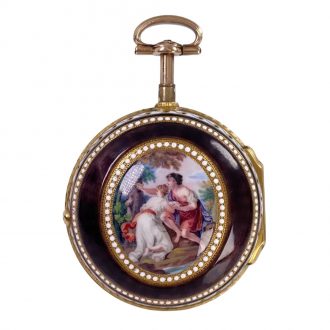
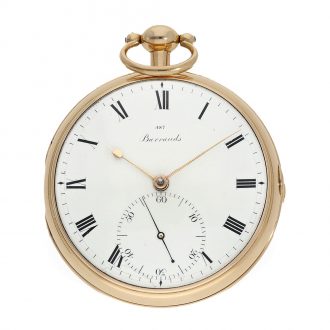
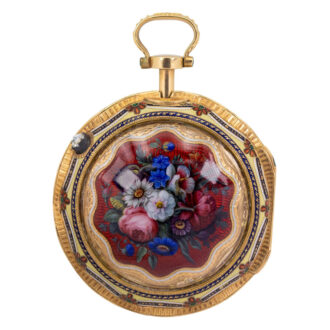
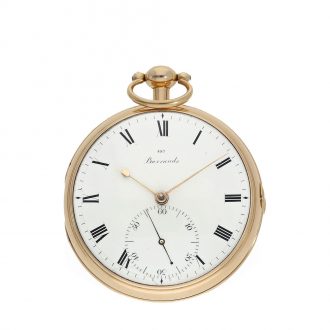
English gold and enamel form watch of museum quality Circa 1810
- Kenmerk
- AD9804
- Diameter
- -
- Estimate
- € 150.000 - 300.000
- Price sold
- € 239.300
Gold, enamel and pearl set peach form watch by William Ilbery
–
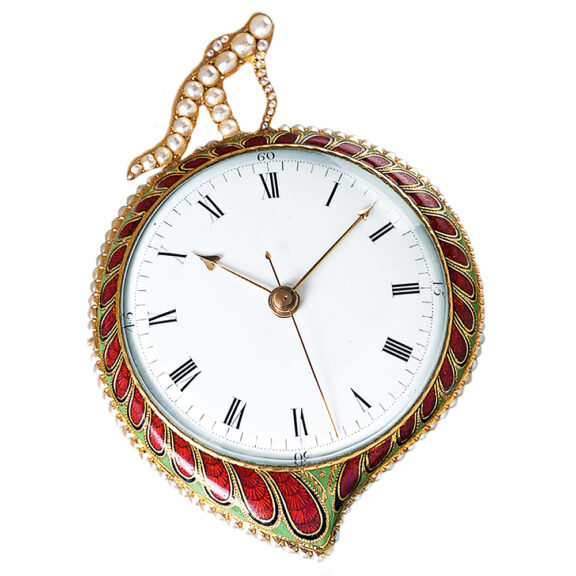
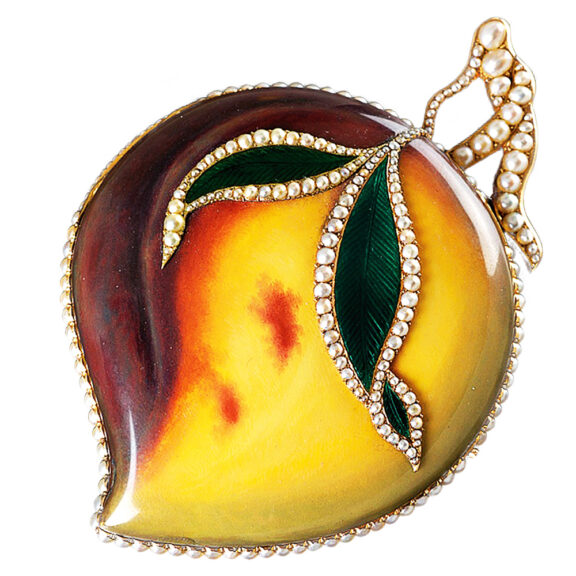
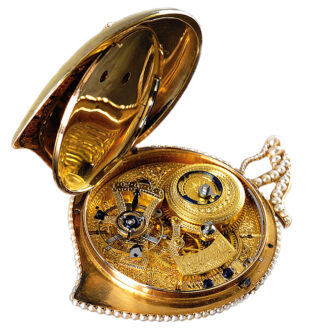
An English 18 Carat gold and enamel watch of museum quality studded with half pearls made for the Chinese market, The Peach, circa 1810.
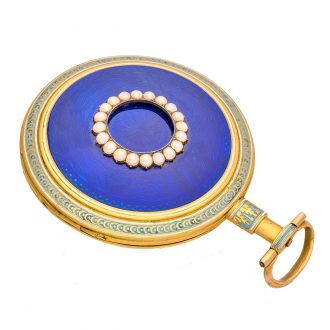
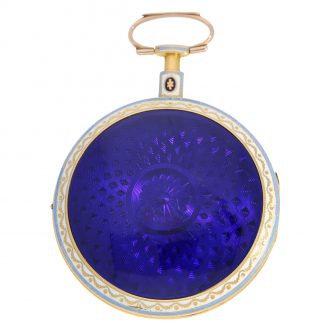
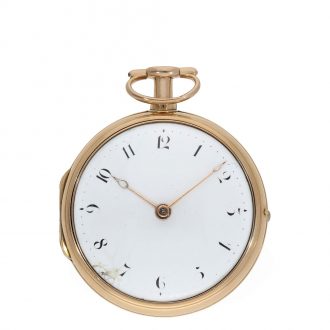
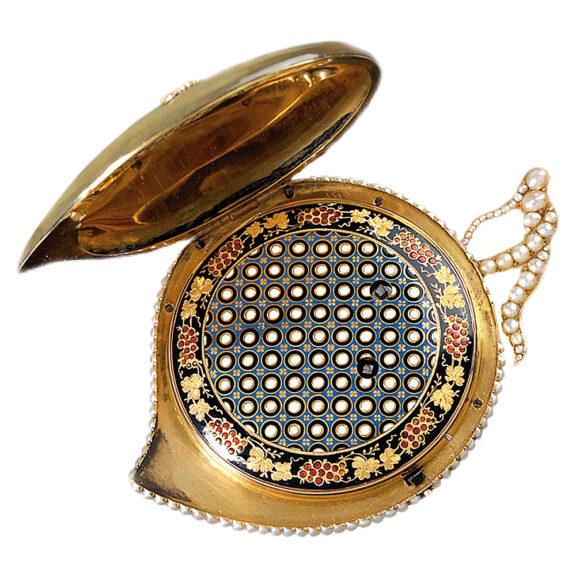
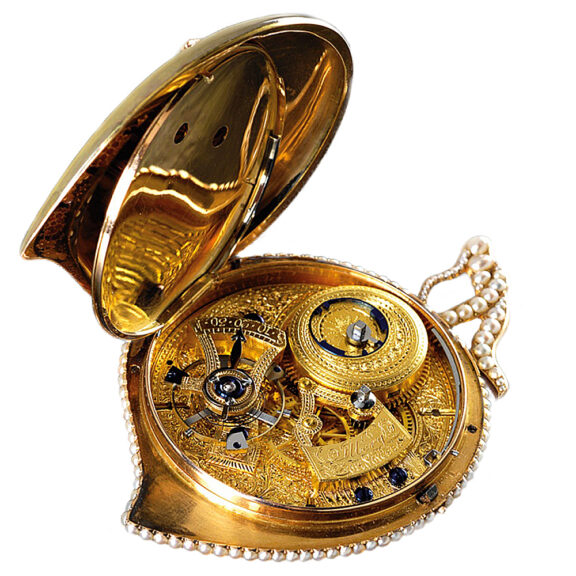
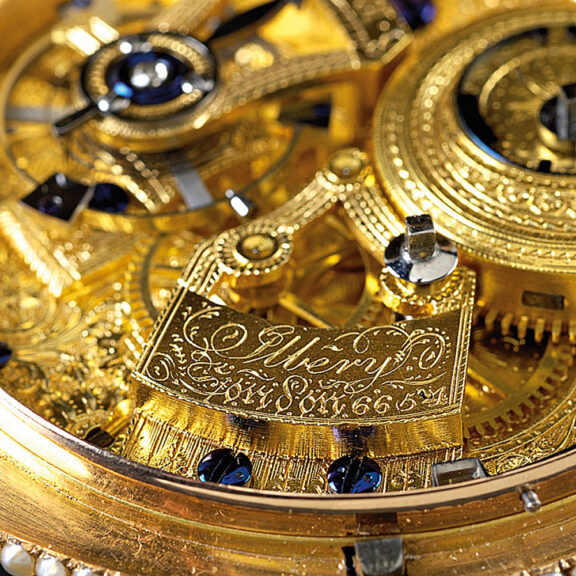
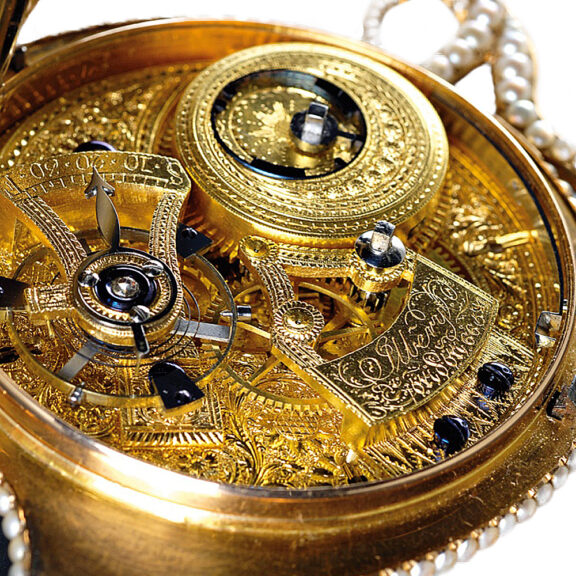
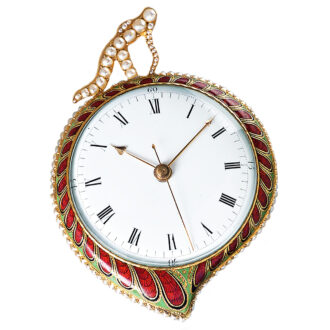
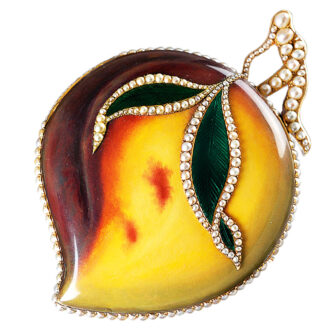
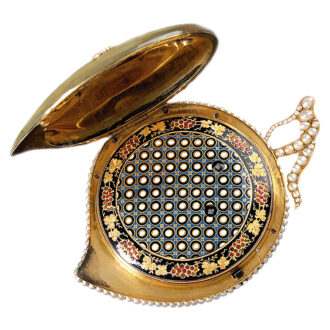
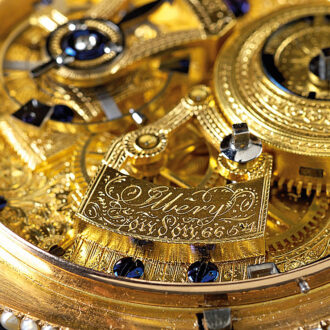
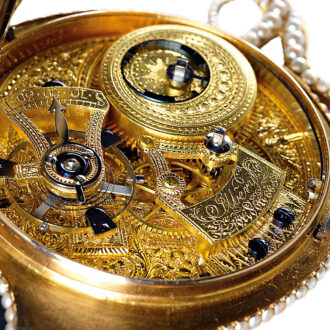
The case back is covered with polychrome enamel in subtle fading hues to resemble the fruit, two translucent green enamel leaves rise from the pendant and are set with half pearls, the stem, also studded with half pearls of different sizes and shapes, forms a loop for the pendant, the band is ornamented with a border of small half pearls. Pushing a small button opens the case back revealing the richly decorated translucent and opaque enamel gold dome with a blue and white geometrical pattern in the centre within a border of black enamelling with golden foliage of wine and translucent enamel grapes. The white enamel dial is framed by a light green border with drop-shaped translucent red enamel ornaments, Roman numerals, centre seconds and heart shaped gold hands. The gilt movement with its Chinese duplex escapement and the lavish floral engravings is typical for Ilbery’s workshop, the bridge movement according to Lépine, key wind, the going barrel is also lavishly florally engraved, three arm steel balance with screws and trapezoid weights, open-worked balance cock with finely floral engravings, chatoned diamond endstone on balance. Movement signed by the watchmaker and numbered.
–
Dimensions: 62 x 88 mm
–
Weight: 159 g
–
Signed: Ilbery London
–
This highly important timepiece is a so-called fantasy watch and one of only eight remaining pieces in the world that have this form of a peach. Six of them were created as mirror pairs and are held by important museums and collections, although sometimes they are regarded as mango fruits. An early pair of peaches is held today in a private collection but is unsigned. The present watch used to be part of the Sandberg Collection (described and illustrated in Terence Camerer Cuss’, The Sandberg Watch Collection, pages 432-433). Another pair of watches formed like peaches are in the Hans Wilsdorf Collection/Rolex. That pair is signed by Ilbery and numbered 6494 and 6495 (described and illustrated in Alfred Chapuis, Montres et Émaux de Genève, Collection H. Wilsdorf, Lausanne 1944, pages 138-139). The third pair known is held by the Patek Philippe Museum in Geneva and is signed by Ilbery as well. These three pairs of gold enamel peaches were on loan to the exhibition Le Miroir de la Séduction – Prestigieuses paires de montres “chinoise” held at the Patek Philippe Museum in Geneva from May 15 to October 16, 2010 (see the exhibition catalogue pages 82-83, 90-91 and 92-93). Most of the peaches were manufactured as pairs of mirror image gold and enamel pocket watches to ensure that the contemporary taste was met as well as the Chinese penchant for duality, which symbolizes cosmic wholeness. Inspired by nature and everyday objects, these fantasy watches were produced for the Chinese market in Geneva at the end of the 18th and in the early 19th century. Imaginative shapes and decorative motifs were popular and the artists were incredibly creative in their work. This led to a great variety of new decorative subjects such as heavenly bodies, hats, shoes, musical instruments, animals, plants and various fruit. In addition to being a highly decorative subject the peach has an important status in Chinese tradition. Among humans the peach symbolizes long life, among gods it symbolizes immortality.
–
William Ilbery, circa 1760-1839, was active in London from 1780 in Goswell Street, he moved to Duncan Terrace towards the end of the 18th century. After James Cox in London and Jaquet-Droz in Switzerland, he also specialized in producing luxury watches for the Chinese market. His early production was very much in the English style, featuring a full plate movement and an English-type single-wheel duplex escapement. However, for his highest-quality watches, he incorporated a spring detent escapement. Later, the watch movements he produced were much inspired by the Lépine calibre with a free-standing barrel, as were Jaquet-Droz’s Swiss production signed in London and that of William Anthony, who worked in London. The cases of his watches were sumptuously decorated by the best Genevan enamellers, such as Jean-Francois-Victor Dupont, who usually signed his work, and Jean-Louis Richter, who signed rarely. He organized the production in Switzerland, mainly in Fleurier, of profusely engraved movements for the Asian market. He was followed in this by makers such as Bovet and Juvet who also worked in Fleurier (Val de Travers). Ilbery can therefore be considered one of the most representative makers of ‘Chinese’ watches. He seems to have maintained close contacts with the continental trade since a watch signed ‘Ilbery Paris’ is known while Ilbery & Son are recorded in London and Fleurier, as well as in Canton.
–
Provenance: This watch has been in a Dutch-Finnish well-known collector and musician family, Van Gilse Van der Pals, beginning with the Dutch consul Hendrik (1856 – 1928) and further on inherited within this family until now. Hendrik van Gilse van der Pals, from a merchant family of Rotterdam, was a rubber manufacturer and honorary consul for the Netherlands in St. Petersburg until he (temporarily) settled on his estates in Finland because of the Russian Revolution. The wealthy industrialist household participated actively in the musical life of St. Petersburg. At their ‘palace’ they organized concerts with composer Anton Arensky and pianist and conductor Willem Mengelberg. Van der Pals met people like Gustav Mahler and Alexander Glazunov. His oldest son Leopold van Gilse van der Pals (1884-1966) was a composer and moved to Berlin and Switzerland where he worked primarily with Rudolf Steiner. His second son Maximilian Hendrik van Gilse van der Pals (1885-1966) became an agriculturalist on the Laakspohja estate near Lohja in Finland. He married Sara Stjernvall, daughter of the Russian Railway Minister Knut Stjernvall (Nikolaev Railway).
Signed: Ilbery London
Share this page: