English gold duplex watch made for Chinese market Circa 1815
- Kenmerk
- TA1574
- Diameter
- 59 mm
- Estimate
- € 80.000 - 160.000
- Price sold
- € 201.000
Gold, enamel and pearl-set pocket watch
–
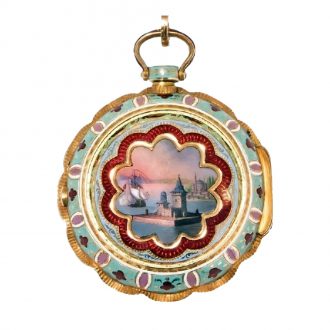
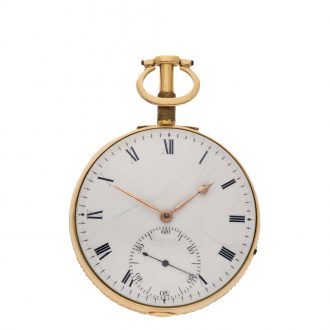
An extremely fine, rare and unusual English pocket watch in 18K gold, enamel and pearls, made for the Chinese market by Ilbery around 1815. It is known as Prosperity for the Journey. It has a centre seconds hand and a duplex escapement.
–
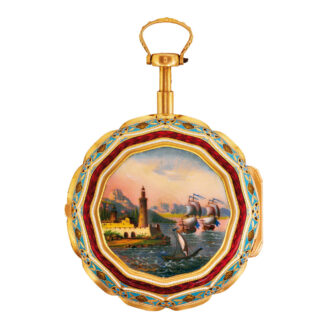
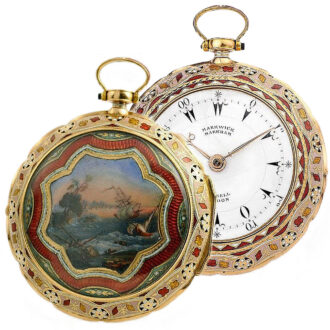
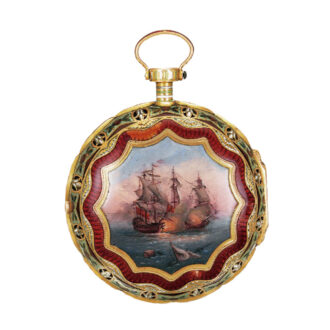
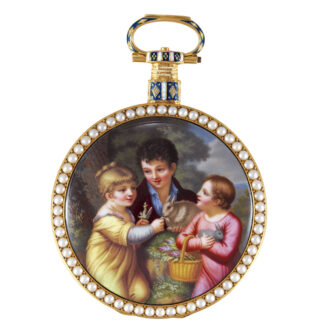
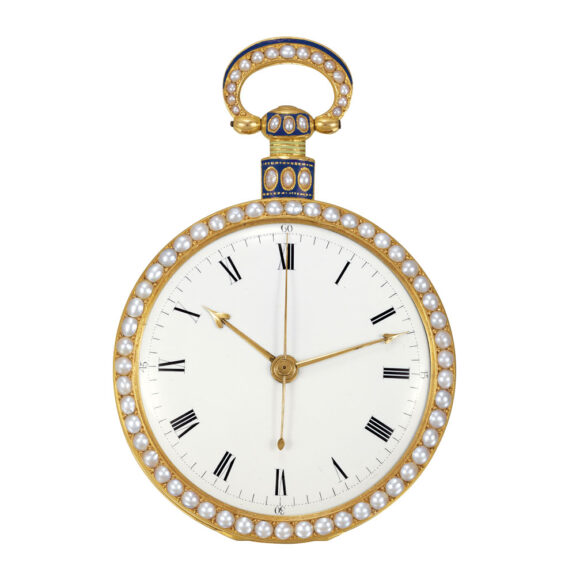
The Empire-style case has a pendant and bow decorated with royal blue enamel and split pearls. The band is decorated with lozenges and flower heads in royal blue, pale green and pale blue enamel, edged with translucent red enamel. The bezel and the border of the back are set with split pearls.
–
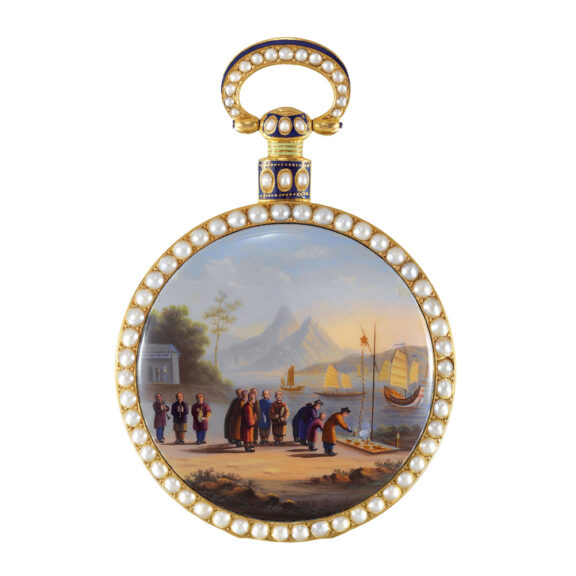
The back cover has a finely painted enamel scene of a harbour at Canton, with Chinese junks on the water and mountains behind. In the foreground, musicians and a group of gentlemen in 17th-century Chinese dress perform a ceremony for good luck, with burning incense and a string of firecrackers.
–
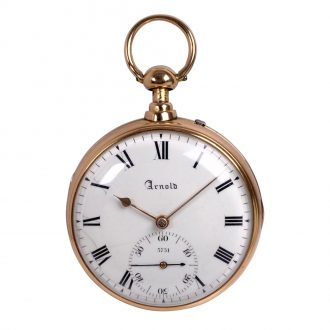
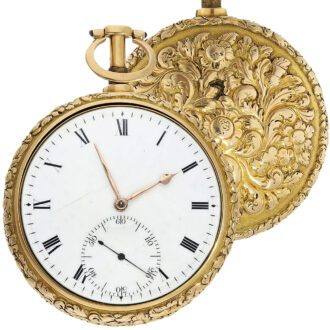
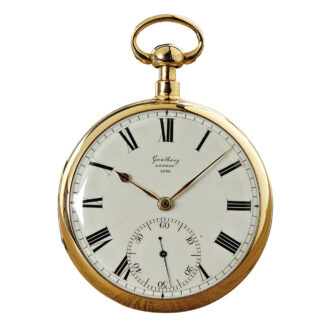
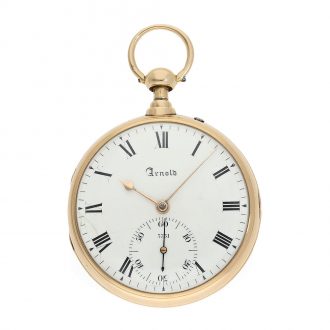
Inside, a spring-loaded gilt metal inner cover (cuvette) is hinged to the movement ring. The white enamel dial has radial Roman numerals for the hours, outer minute and seconds divisions, and Arabic numerals every 15 minutes. The hands are gold and heart-shaped.
–
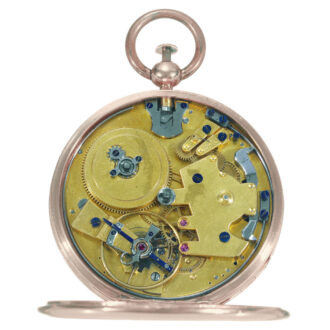
The frosted gilt movement is of the Chinese calibre, the type made specially for the Chinese market. The standing barrel and the cocks are engraved with foliage. It has a duplex escapement and a bimetallic compensation balance with blued steel weights and temperature-adjustment screws. There is also a flat blued steel balance spring, a diamond endstone and an index regulator. The movement is signed.
–
Diameter: 59 mm
–
Signed: Ilbery London
–
The watch is of a very special type made for the Chinese market, showing a genuine Chinese scene. Such scenes are particularly rare. Watches for the Chinese market were usually decorated with images taken from Western art, often English engravings and scenes from mythology.
–
This scene shows a ceremony to bring good luck to a ship before its journey, probably in the harbour at Canton. The figures wear 17th-century dress, so the enameller probably based the design on a 17th-century Chinese painting that had been brought to Europe. Four watches painted in a similar way are in the Patek Philippe Museum in Geneva.
–
William Ilbery (circa 1760–1839
William Ilbery worked in London from 1780, first in Goswell Street and then, towards the end of the 18th century, in Duncan Terrace. Following James Cox in London and Jaquet Droz in Switzerland, he specialised in luxury watches for the Chinese market.
–
His early watches were very English in style, with a full-plate movement and an English single-wheel duplex escapement. For his finest watches, he used a spring detent escapement. His later movements were strongly influenced by the Lépine calibre, with a free-standing barrel. So were the Swiss-made watches that Jaquet Droz signed with a London address, and those of William Anthony, who worked in London.
–
The cases of Ilbery’s watches were lavishly decorated by the best Geneva enamellers. Among them were Jean-François-Victor Dupont, who usually signed his work, and Jean-Louis Richter, who rarely did. Ilbery also organised the making of richly engraved movements for the Asian market in Switzerland, mainly in Fleurier. Other makers in Fleurier (Val de Travers), such as Bovet and Juvet, later followed his lead. Ilbery can therefore be seen as one of the most representative makers of “Chinese” watches.
–
He seems to have kept close ties with the trade on the Continent. A watch signed “Ilbery Paris” is known, and Ilbery & Son are recorded in London, Fleurier and Canton.
–
Signed: Ilbery London
–
The watch is of a very special type made for the Chinese market, showing a genuine Chinese scene. Such scenes are particularly rare. Watches for the Chinese market were usually decorated with images taken from Western art, often English engravings and scenes from mythology.
–
This scene shows a ceremony to bring good luck to a ship before its journey, probably in the harbour at Canton. The figures wear 17th-century dress, so the enameller probably based the design on a 17th-century Chinese painting that had been brought to Europe. Four watches painted in a similar way are in the Patek Philippe Museum in Geneva.
–
William Ilbery (circa 1760–1839
William Ilbery worked in London from 1780, first in Goswell Street and then, towards the end of the 18th century, in Duncan Terrace. Following James Cox in London and Jaquet Droz in Switzerland, he specialised in luxury watches for the Chinese market.
–
His early watches were very English in style, with a full-plate movement and an English single-wheel duplex escapement. For his finest watches, he used a spring detent escapement. His later movements were strongly influenced by the Lépine calibre, with a free-standing barrel. So were the Swiss-made watches that Jaquet Droz signed with a London address, and those of William Anthony, who worked in London.
–
The cases of Ilbery’s watches were lavishly decorated by the best Geneva enamellers. Among them were Jean-François-Victor Dupont, who usually signed his work, and Jean-Louis Richter, who rarely did. Ilbery also organised the making of richly engraved movements for the Asian market in Switzerland, mainly in Fleurier. Other makers in Fleurier (Val de Travers), such as Bovet and Juvet, later followed his lead. Ilbery can therefore be seen as one of the most representative makers of “Chinese” watches.
–
He seems to have kept close ties with the trade on the Continent. A watch signed “Ilbery Paris” is known, and Ilbery & Son are recorded in London, Fleurier and Canton.
Signed: Ilbery London
Share this page: