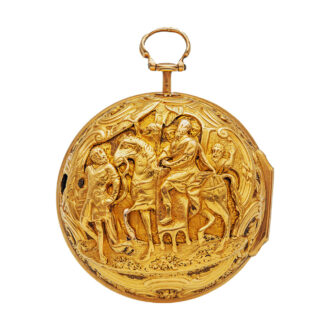
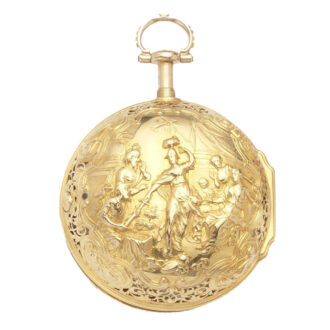
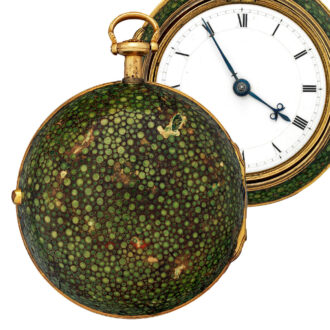
English gold enamel pocket watch with automaton Circa 1770
- Kenmerk
- AM0130
- Diameter
- 64 mm
- Estimate
- € 20.000 - 35.000
- Price sold
- -
Rare pair cased gold automaton watch by James Cox
–
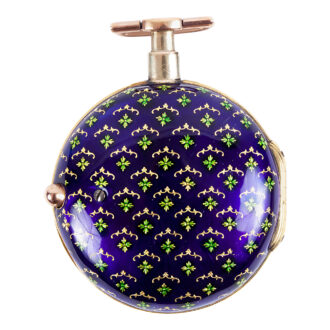
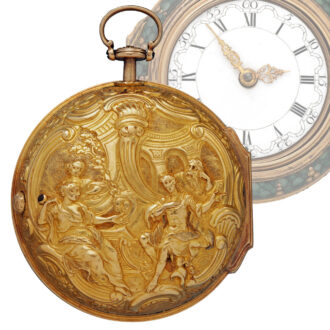
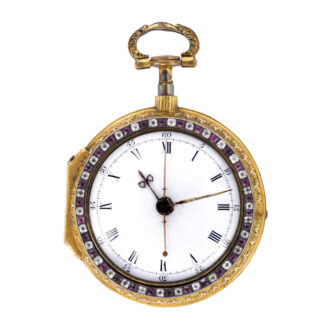
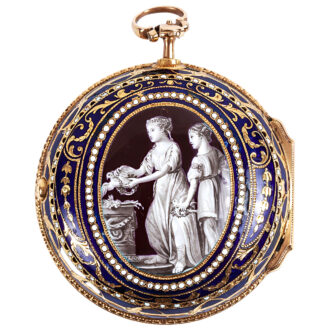
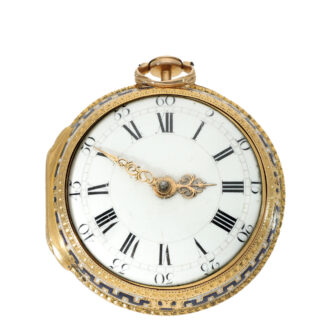
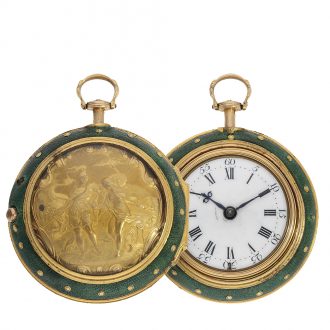
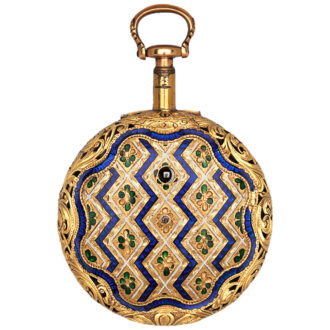
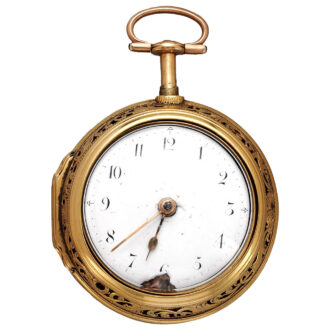
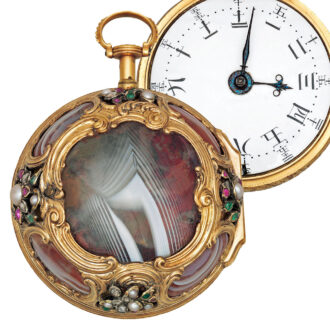
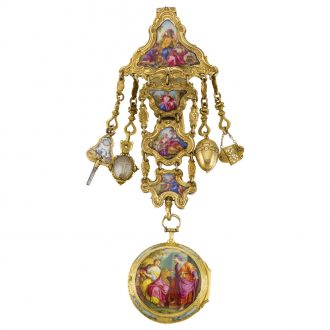
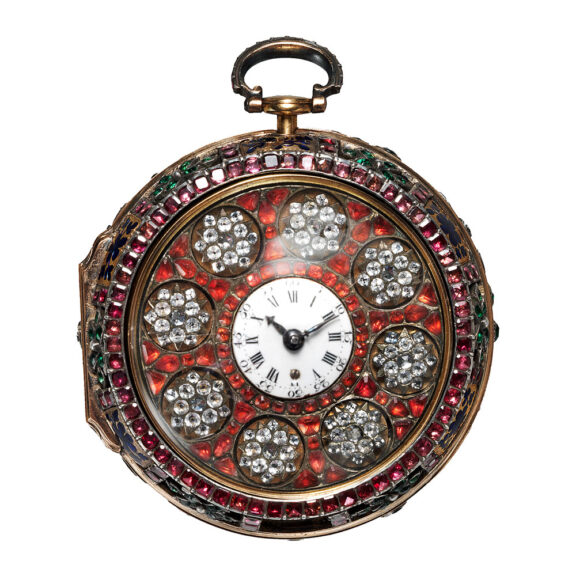
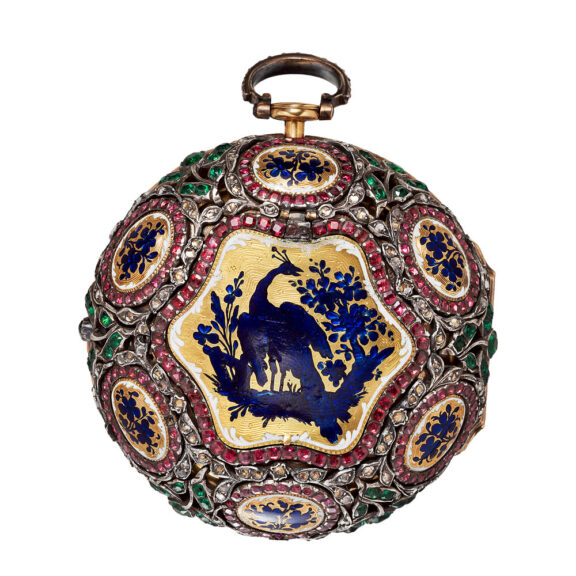
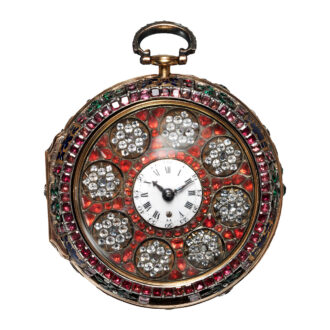
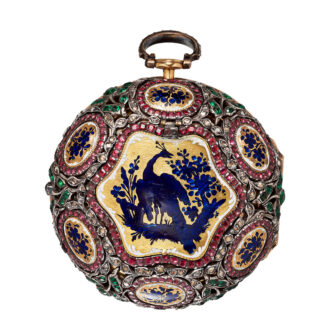
Rare English, gold, enamel, automaton watch set with gemstones and paste jewels, Circa 1770.
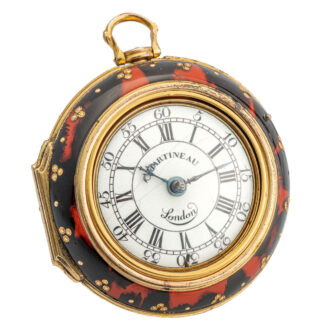
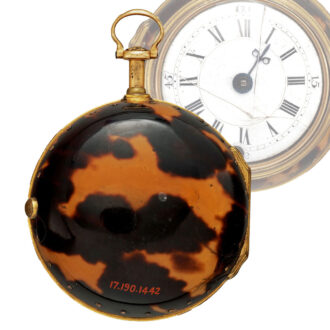
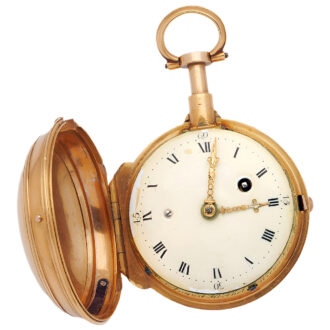
This watch features a very fine verge movement with a diamond endstone. Its white enamel dial has Roman radial hours, an outer minutes track with Arabic five-minute numerals, and blued steel hands. When activated, the eight rosettes or stars spin within the rotating frame of the pavé-set paste jewels on the dial. It has two cases: the outer one is partly enamelled and set with gemstones and paste jewels, while the inner one is polished plain gold. The entrepreneur behind this creation is James Cox, a British individual who lived from around 1723 to 1800. The case maker for this watch is Peter Mounier, who was active from 1761-73. The movement bears the signature James Cox / 1393 London on the back plate. The inner rim of the faceplate has an inscription of XIIII, while the inner case is marked with PM, which is the casemaker’s mark for Peter Mounier.
–
Diameter: 64 mm
–
Signed: James Cox, London
–
There are still some of these machines that exist today. They were put into items that were likely meant to be sent to China and India, but they could have also been made for English buyers. Many of these items were part of Cox’s lottery in 1773, and more were sold in London after he went bankrupt in 1778. Because of this, some of these entertaining “toys” may have ended up in the possession of Europeans by chance.
–
James Cox was a successful British jeweller, goldsmith and entrepreneur who operated from Schoe Lane in London. He is most renowned for inventing the mechanical clock known as Cox’s timepiece, which was powered by atmospheric pressure (similar to the Atmospheric clock). Although the clock still exists today, it has been deactivated since it was moved to the Victoria and Albert Museum. Cox collaborated with Jean-Joseph Merlin in the creation of this clock. One of his most famous works is The Peacock, an automatic clock found in the State Hermitage Museum in Saint Petersburg. Cox worked with various other clockmakers and was one of the main providers of clocks to Emperor Qianlong of China, who ruled officially from October 18, 1735, to February 9, 1796, and unofficially until his death in 1799. Many of these clocks are still part of Beijing’s Forbidden City’s clock collection. Due to problems with exports to China and the American Revolution, Cox faced major economic challenges, which led to his bankruptcy in 1778. However, he continued delivering watches to China through his two sons, one based in London and the other in Canton, mostly from Jaquet-Drozand Leschot. Some of his clocks are also displayed at the Metropolitan Museum of Art.
Signed: James Cox London
Share this page: