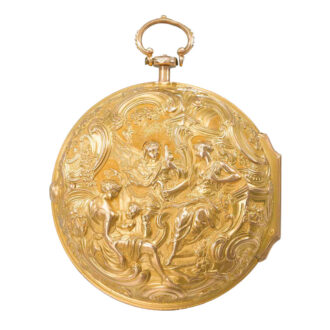
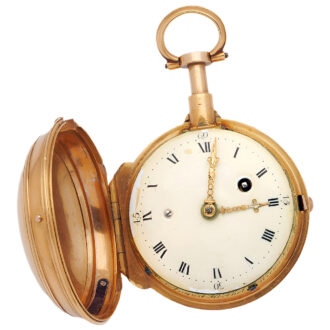
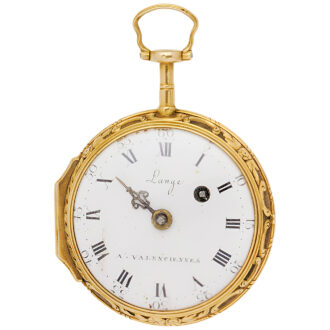
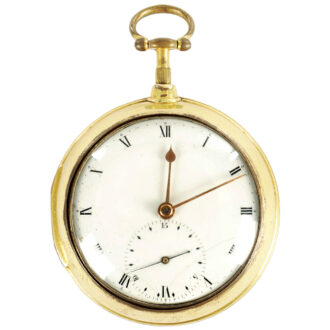
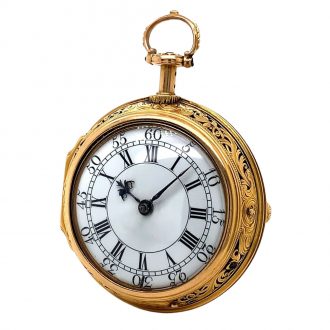
English gold pair cased quarter repeating cylinder watch Circa 1755
- Kenmerk
- DB0732
- Diameter
- 49 mm
- Estimate
- € 8.000 - 20.000
- Price sold
- € 7.500
Gold repoussé watch by John Ellicott
–
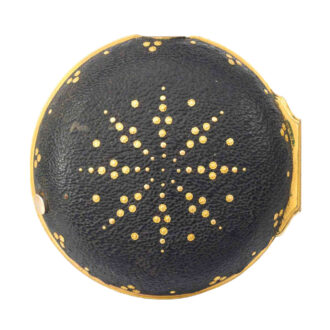
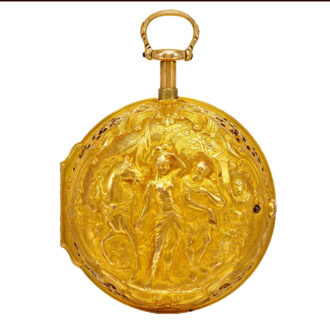
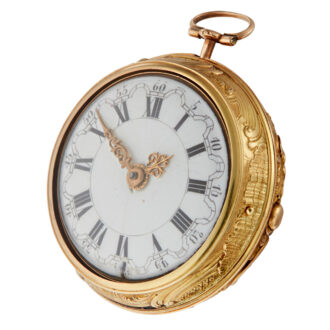
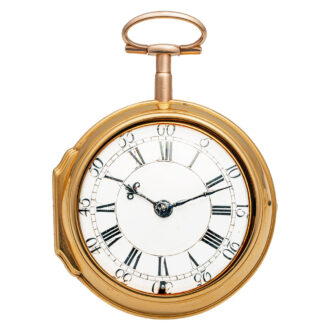
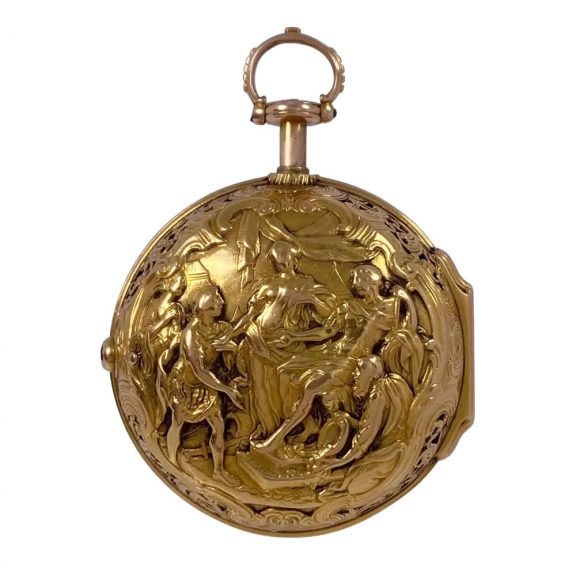
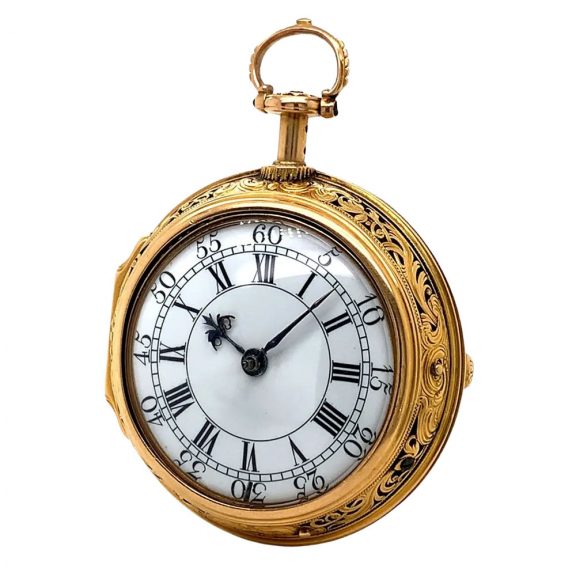
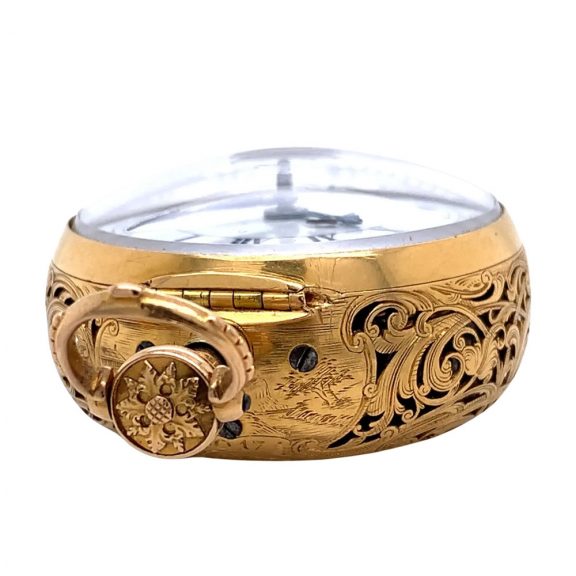
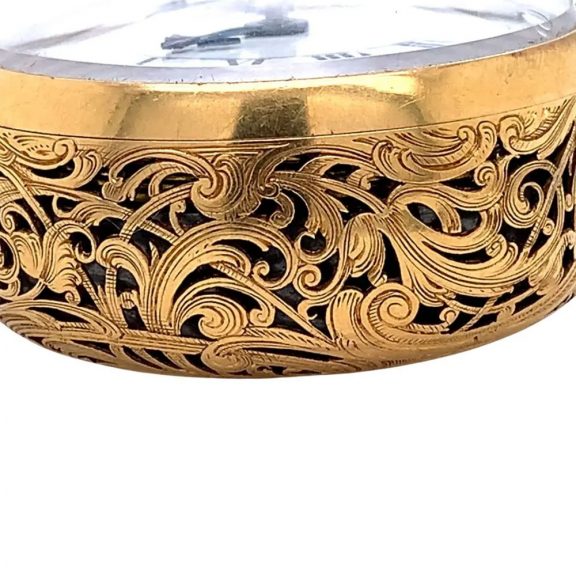
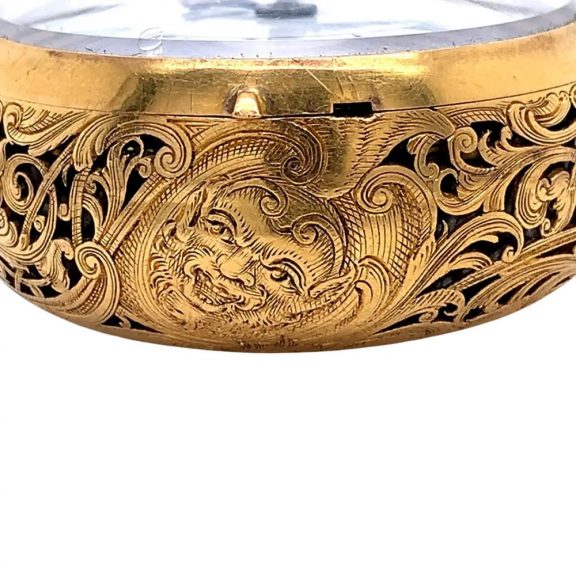
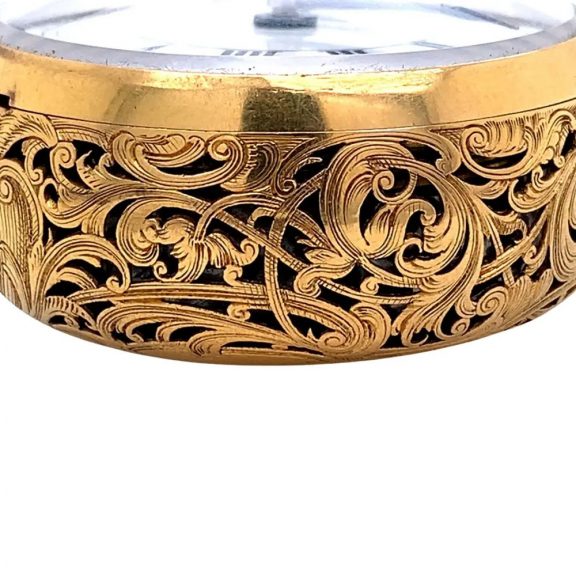
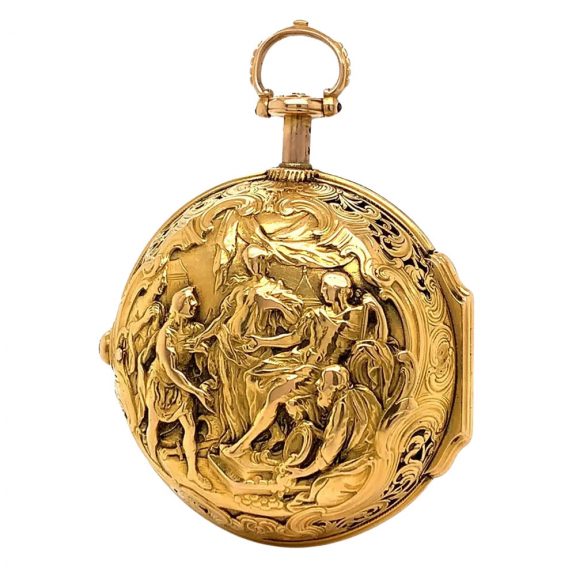
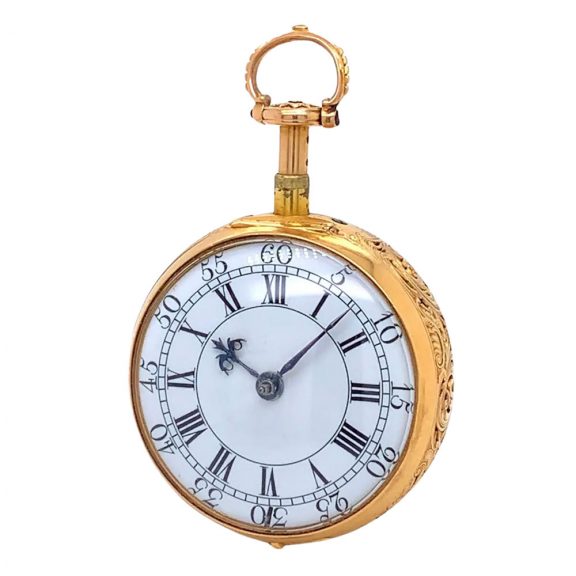
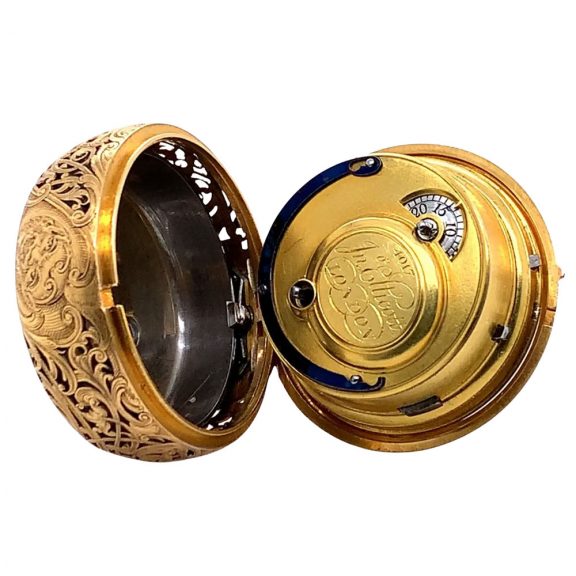
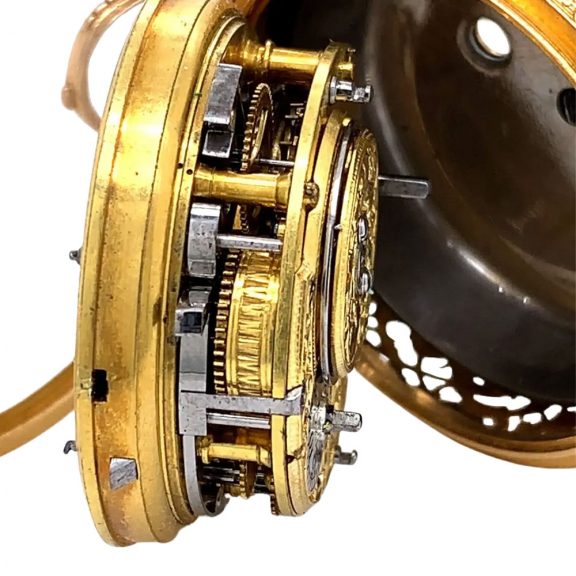
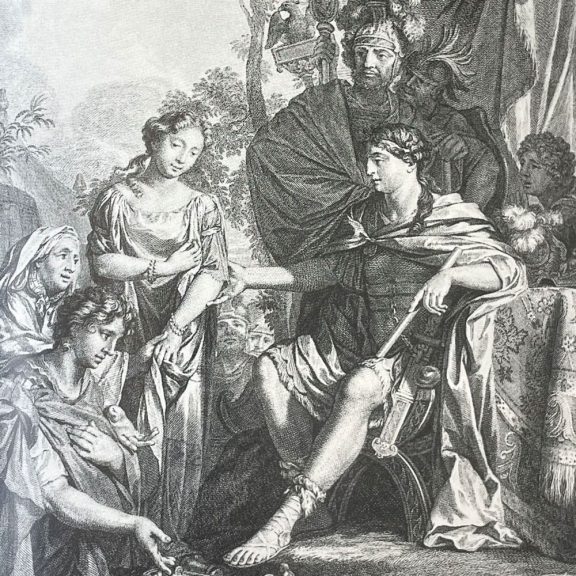
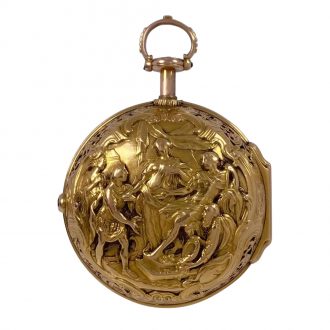
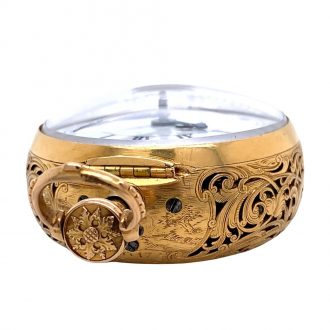
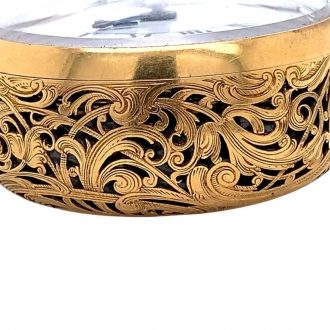
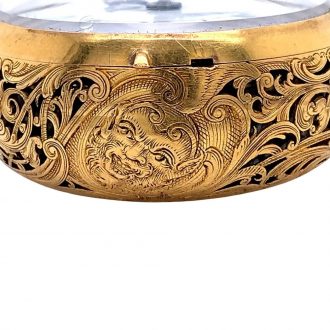
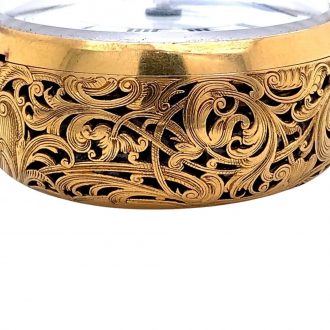
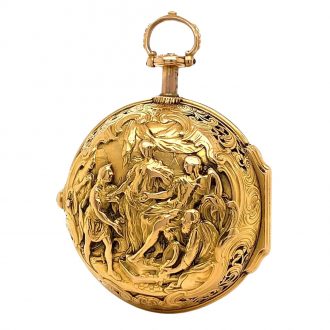
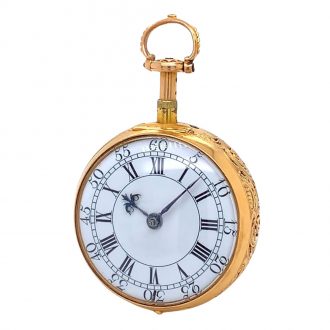
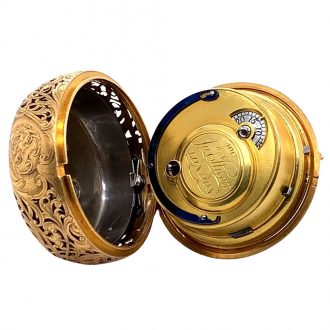
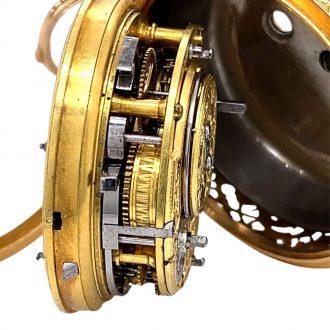
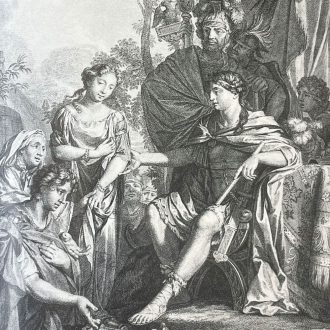
A historically important and rare English 18 carat gold pair cased quarter repeating cylinder pocket watch, circa 1755. Full plate movement, chain and fusee, a Stodgens quarter repeater, two hammers, a cylinder escapement, three arm steel balance and large brass cylinder wheel. A movement protection cap. The outer case with The Generosity of Scipio in repoussé signed Moser fecit on the back, pierced on the edge, engraved and hallmarked, the inner case is also richly decorated and shows an engraving of a rocaille with a heron rising in the middle of the back, a city view on the pendant and a grotesque mask on the opener, a stylized openwork band of flowers and volutes on the edge, hallmarked and a bottom bell. Protection cap and movement signed and numbered.
–
Diameter: 49 mm
–
Weight: 139 g
–
Signed: Jn Ellicot London
–
The Stodgens quarter repeater was preferred by Daniel Quare and other well known watchmakers.
–
John Ellicott (London, 1706 – 1772 ) was an eminent English clock and watchmaker as well as an inventor of the 18th century. His father John Ellicott the Elder, a Cornishman, also was a clockmaker who had been admitted to the Clockmakers’ Company in 1696. He died in 1733. John Ellicott the Younger joined his father’s workshop in London in 1728 and became one of the most important watchmakers in England at the time. He conducted business first from Austin Friars Street EC2 and later from Swithin’s Alley, Royal Exchange. In 1738 he was elected Fellow of the Royal Society.
Ellicott showed a keen interest in scientific matters and maintained an observatory at his home in Hackney, parish of St. John, where he observed the planet Venus. He is best known for his work on temperature-compensated pendulums which he developed in 1753, he further improved the cylinder escapement and invented the center second for pocket watches. Ellicott made many bracket clocks, was a clockmaker to King George III and edited several technical papers. He was married and of this marriage, five children were born, two sons Edward and John and three unmarried daughters, Deborah, Mary and Elizabeth. His son Edward joined the business in 1760. Over their twelve-year partnership, their clocks were simply signed Ellicott London. John Ellicott died unexpectedly as a widower in 1772 in Hackney. His son Edward continued the workshop. He died in 1791.
–
George Michael Moser was born on 17 January 1706 in Schaffhausen, Switzerland, and died on 24 January 1783 at Somerset House, London. He was a renowned artist and enameller of the 18th century, father of celebrated floral painter Mary Moser and, with his daughter, among the founder members of the Royal Academy of Arts in 1768. He was the son of Michael Moser, an eminent Swiss engineer and metalworker.
Moser trained initially as a coppersmith in Geneva and later learnt additional skills as a chaser, goldsmith and engraver. He moved to London during the 1720s and married Mary Guynier. Surviving metal works by him include elaborate gold snuffboxes and watch cases (including movements by noted watchmakers George Philip Strigel and John Ellicott, among others) and silver candlesticks in the rococo style. He subsequently rose to be head of his profession as a gold chaser, medallist, and enameller and was particularly distinguished for the compositions in enamel with which he ornamented the backs of watches, bracelets, and other trinkets. A beautiful example of this work was a watch case executed for Queen Charlotte, adorned with whole-length figures of her two eldest children, for which he received a hatful of guineas.
Moser was drawing master to George III during his boyhood, and on his accession to the throne was employed to engrave his first great seal. When the art school afterwards known as the St. Martin’s Lane Academy was established about 1736, in Greyhound Court, Strand, he became manager and treasurer and continued in that position until the school was absorbed into the Royal Academy. When he died he was buried in the churchyard of St Paul’s, Covent Garden his funeral being attended by almost all his fellow academicians and pupils. On the day after Moser’s death, a notice of him from the pen of Sir Joshua Reynolds was published, in which he was described as the first gold chaser in the kingdom, possessed of a universal knowledge of all branches of painting and sculpture, and ‘in every sense the father of the present race of artists.
Signed: Jn Ellicot London
Share this page: