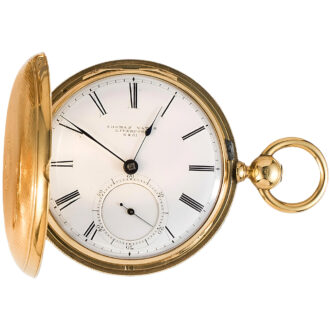
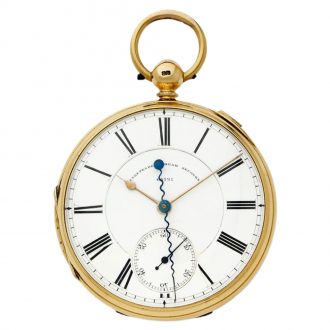
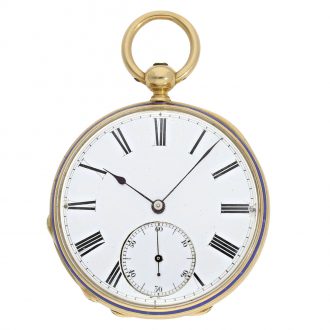
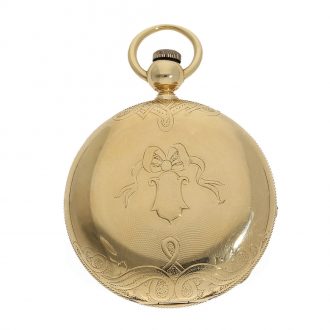
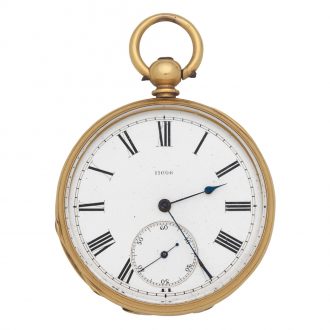
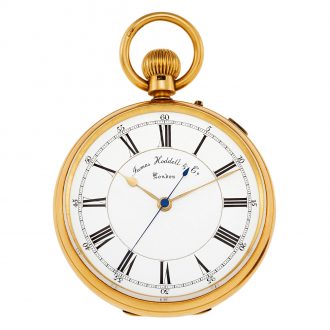
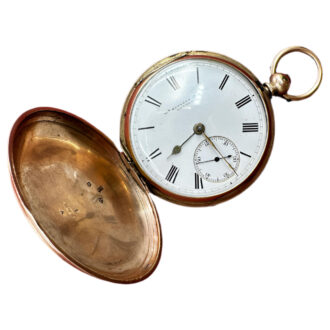
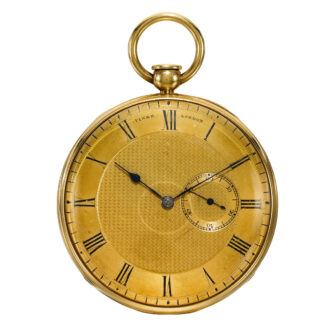
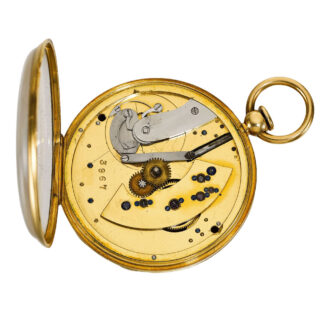
English gold watch with patented pump winding system Circa 1850
- Kenmerk
- SA0169
- Diameter
- 50 mm
- Estimate
- € 2.000 - 4.000
- Price sold
- -
Gold open faced lever pocket watch
–
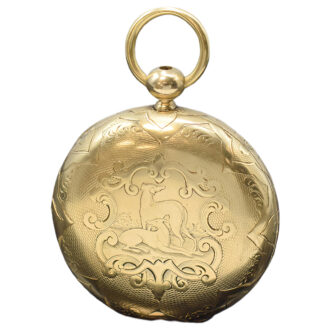
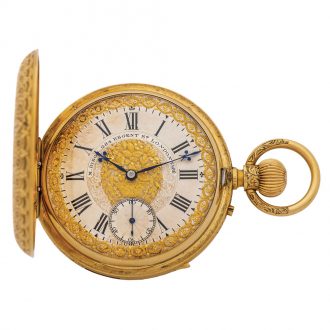
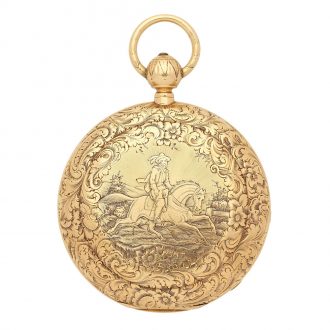
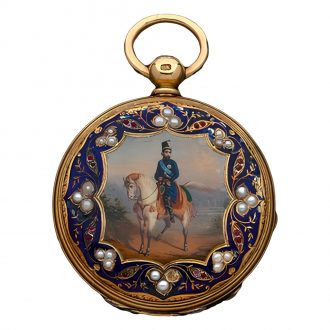
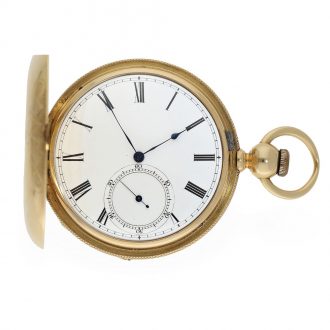
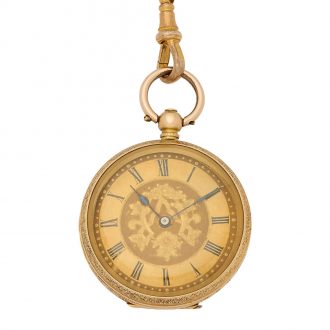
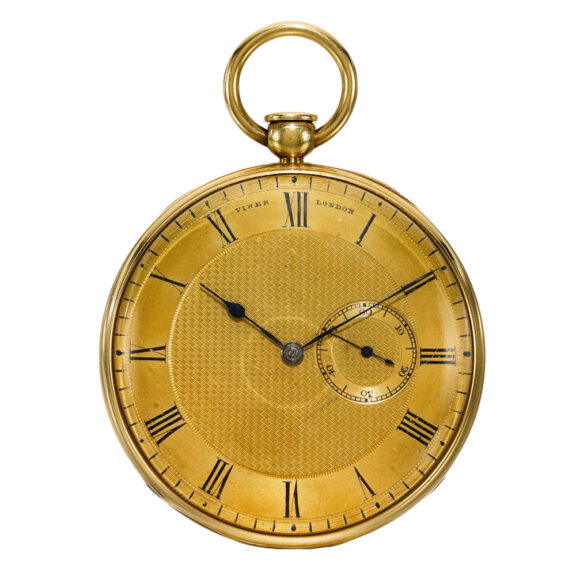
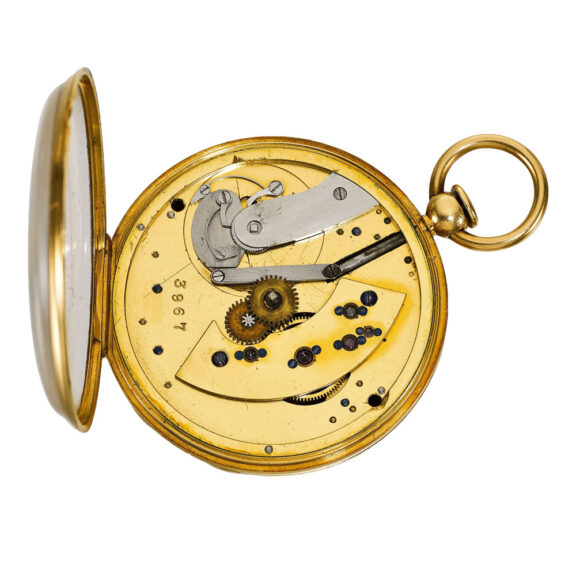
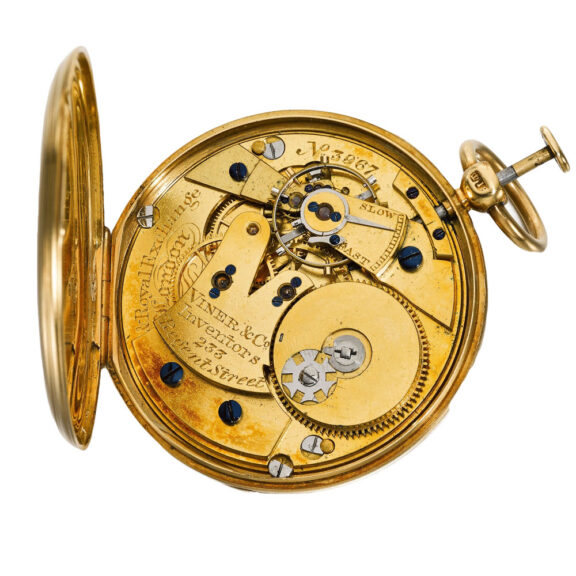
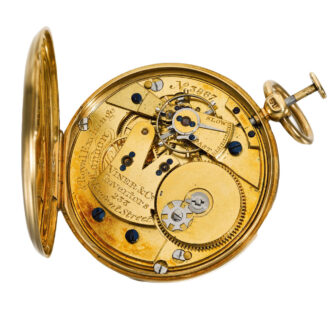
An interesting English 18 carat gold open faced pump wind pocket watch made by Viner & Co in London, circa 1850. The gilded movement, jewelled to the center, with a ratchet tooth lever escapement, bimetallic compensation balance, ruby endstone, hanging barrel and Geneva stop work. Gold dial with a satin finished chapter ring featuring black Roman hour numerals, outer minute divisions, a decorative engine turned center, eccentric, similarly finished subsidiary seconds at 3 o’clock and blued steel spade hands. The case with an engine turned back, a pull winding pendant and maker’s mark PC in a rectangular cameo for Peter Clerc. Dial signed Viner London, movement numbered and signed Viner & Co Inventors 233 Regent Street & Royal Exchange London, and the dust cover numbered.
–
Diameter: 50 mm
–
Signed: Viner & Co Inventors 233 Regent Street & Royal Exchange London
–
Charles Edward Viner (1788-1875), a renowned British watchmaker, developed a patented system for setting the alarm hand via the coaxial, rotatable crown at the top of the pendant.
–
He completed his apprenticeship with Thomas Savage in London, and in 1813, joined the Clockmakers’ Company.
–
Viner gained renown for his high quality pocket watches, which he often fitted with the ‘pump winding mechanism’ he invented.
–
In 1824, Viner entered into a formal business partnership with Hoskins (often catalogued or misspelt in historical registries as Hopkins).
–
Viner’s ‘pump winding system’ is perhaps the best known keyless winding mechanism not employing a rotating button in the case pendant. The cap in the pendant is fixed to a long stem which, via a crank and ratchet system, winds the movement by repeated extension and depression of the stem. The hands are set traditionally by a square to their center.
–
The earliest patent, No 1970 from 1793, for pump winding belongs to Robert Leslie: “A method of winding up a watch by the pendant. On the square where the key should go is a ratch, the pendant, being alternately moved in and out, turns this ratch by means of two clicks on either end of a fork fastened to the pendant.”
Signed: Viner & Co Inventors 233 Regent Street & Royal Exchange London
Share this page: