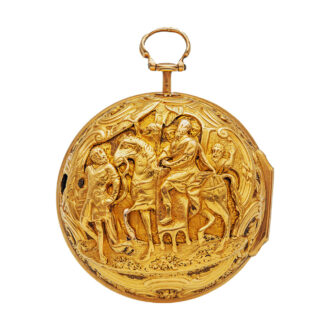
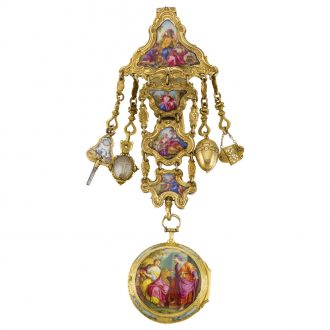
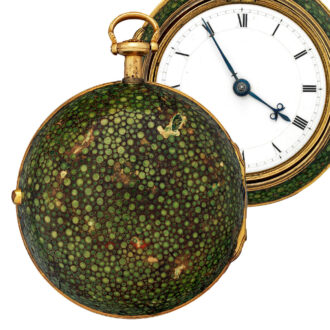
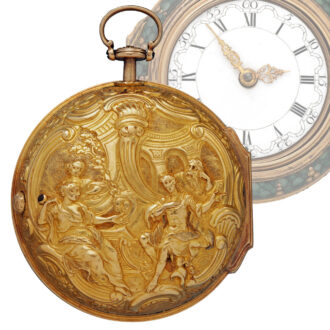
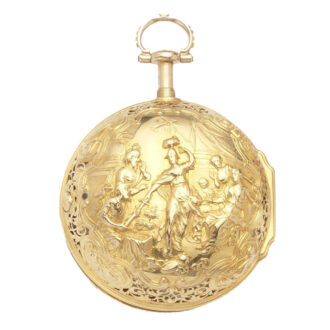
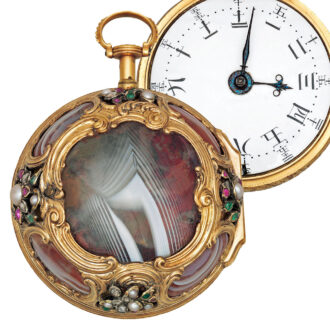
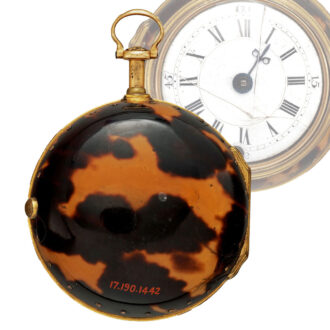
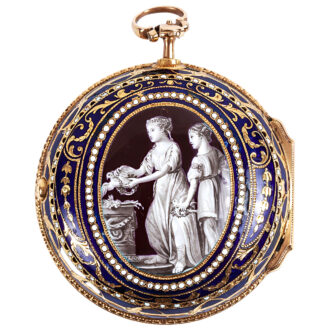
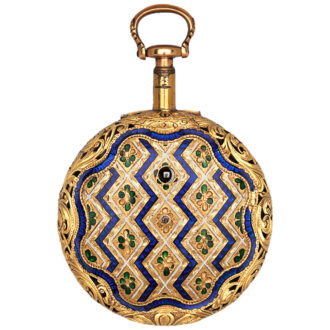
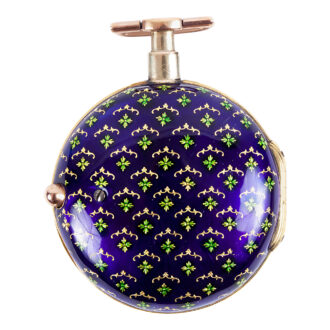
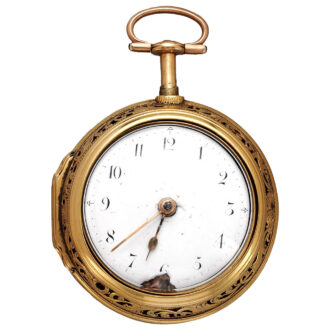
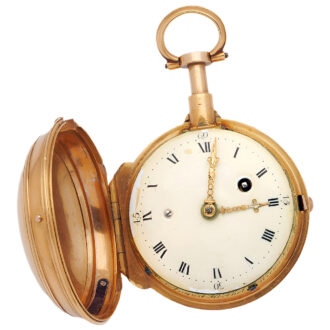
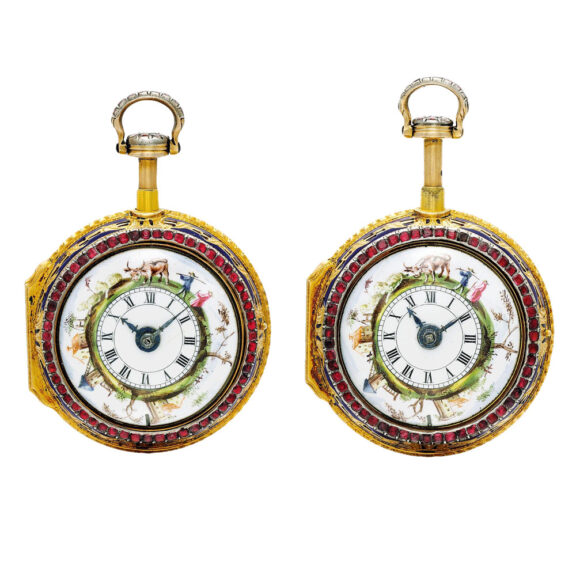
English matching pair of quarter repeating watches Circa 1770
- Kenmerk
- SA0131
- Diameter
- 34, 35 mm
- Estimate
- € 20.000 - 40.000
- Price sold
- -
Gold pair of decorative quarter repeaters made for the Chinese market
–
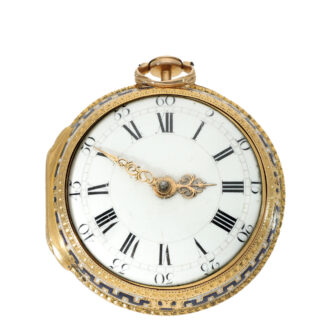
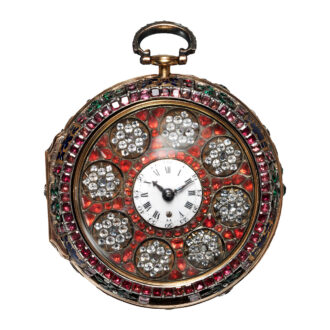
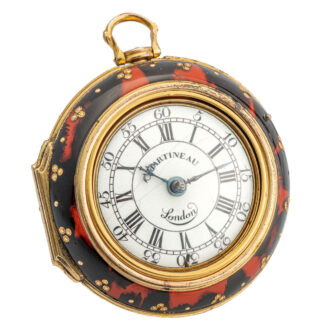
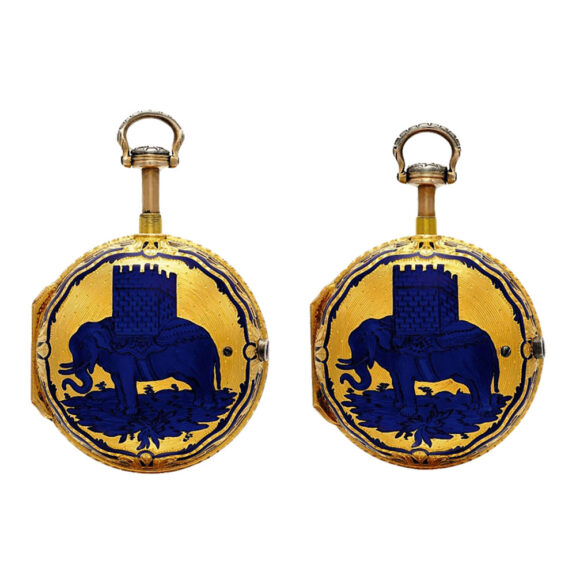
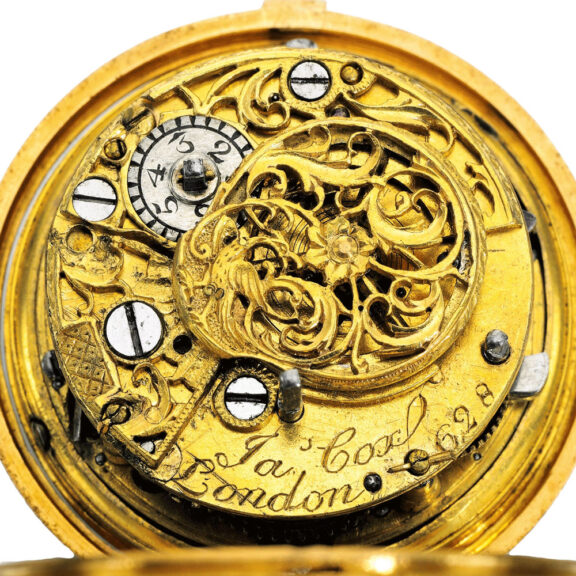
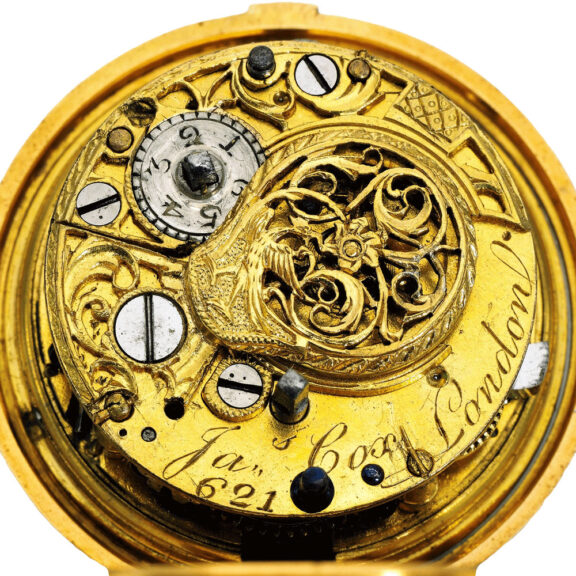
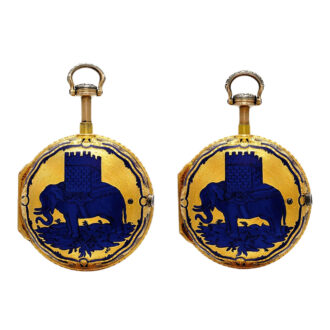
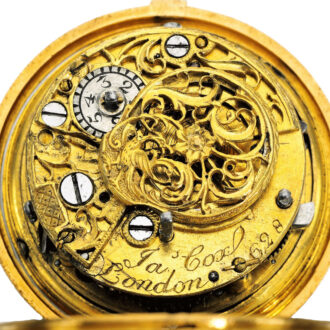
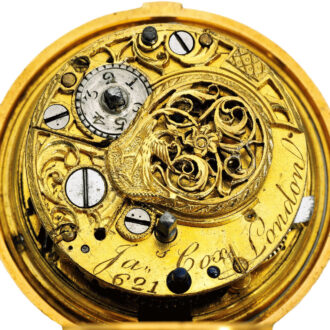
An English impressive matching pair of gold, enamel and ruby set pair cased quarter repeating verge pocket watches made for the Chinese market, circa 1770. Each with a gilded full plate movement, verge escapement, decoratively pierced and engraved balance cock, fusee and chain, cylindrical pillars, repeating on a bell to the inside of the case back, numbered and signed Jas Cox London.
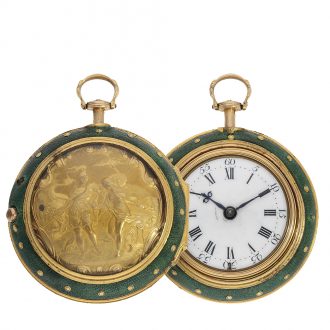
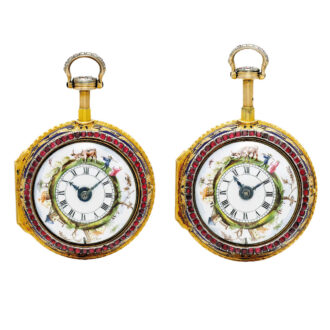
Both pieces with a white enamel dial, an outer polychrome enamel painting depicting a continuous pastoral scene, the centre with Roman time indication, outer minute divisions and blued steel hands.
The inner cases with a pierced and engraved band, an engraved scene of a town by a lake below the pendant and a grotesque mask to the base, a ruby set pendant, bow and pusher and the centre of the backs each with an engraved floral spray, each outer case centred with an Asiatic war Elephant bearing a castellated howdah in blue basse taille enamel over a chased and engraved ground, each with a decorative gilt crank key, maker’s mark PM incuse for Peter Mounier. Comes with a modern custom made fitted presentation box.
–
Diameter: 35 mm and 34 mm
–
Signed: Jas Cox London
–
Matched pairs of watches were greatly in demand in the Chinese market towards the end of the 18th century. These two watches are just 7 numbers apart and are all but identical, yet no. 628 is in fact subtle miniaturization of no. 621 with a 1 mm difference in their diameters. There are a number of reasons why the watches may have been paired in this way. One such theory is said to be an acknowledgement of the belief that for Man to be in harmony with Nature he should, like her, never make any two things precisely the same.
–
James Cox was born circa 1723 and was one of the most gifted inventors and entrepreneurs of his time. Although described as a goldsmith when he became free of the London Goldsmiths’ Company in 1745 and years later registered a mark as such, any skills as a craftsman were always secondary to his inventiveness and marketing abilities. Cox specialized in the production of complicated musical and automaton clocks and watches that were elaborately studded with precious and semi-precious stones. He employed the best clockmakers and artists to bring life to his carefully designed and ingenious mechanisms and, for a time, developed a successful export market to China. In February 1772, as a result of trading difficulties with the Orient, he set up an exhibition of his clocks at Spring Gardens, Charing Cross, London and charged an entrance fee of half a guinea. The exhibition appears to have been a moderate success, but in 1775 he was obliged to dispose of the contents of the exhibition by public lottery. Cox’s fortunes appear to have continued to decline and he was declared bankrupt in 1779. In 1783, he re-established his business, and with the help of his son John Henry Cox, set up premises in Canton, which flourished for a number of years. James Cox retired to Watford in 1795.
–
Basse taille is an enamelling technique in which the artist creates a low relief pattern in metal, usually silver or gold, by engraving or chasing. The entire pattern is created in such a way that its highest point is lower than the surrounding metal. A translucent enamel is then applied to the metal, allowing light to reflect from the relief and creating an artistic effect. It was used in the late Middle Ages, and then again in the 17th century.
Signed: Jas Cox London
Share this page: