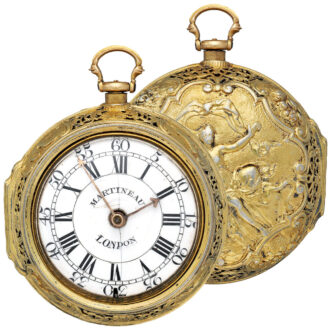
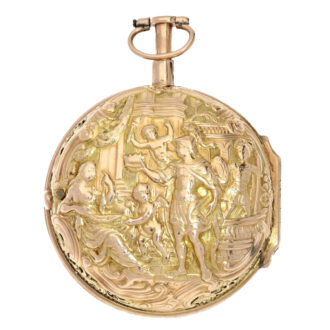
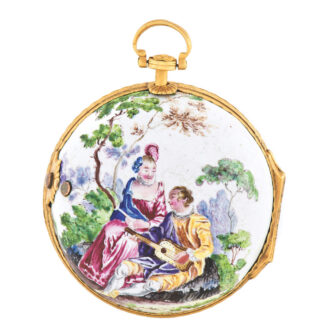
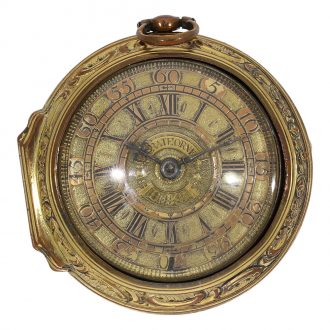
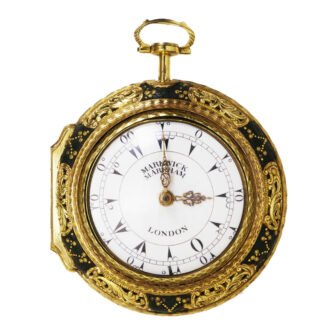
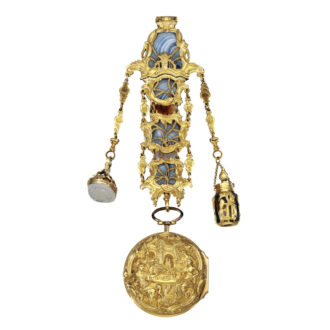
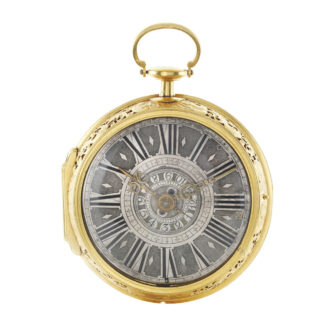
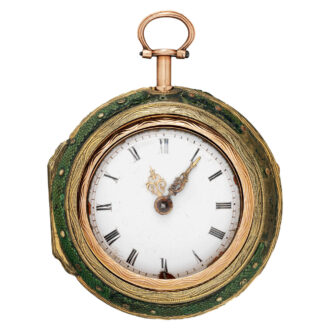
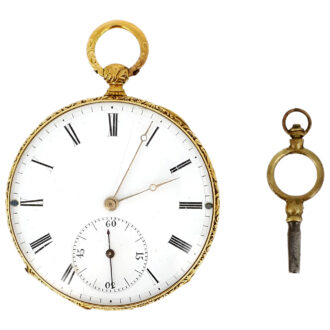
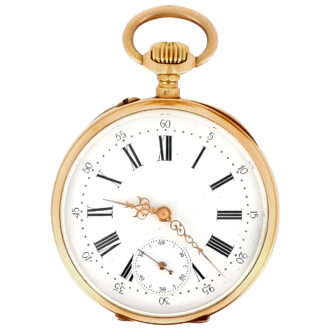
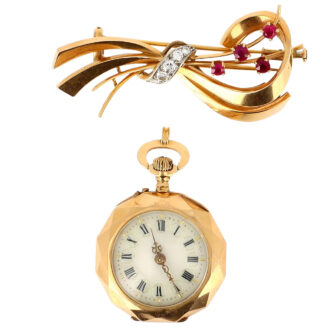
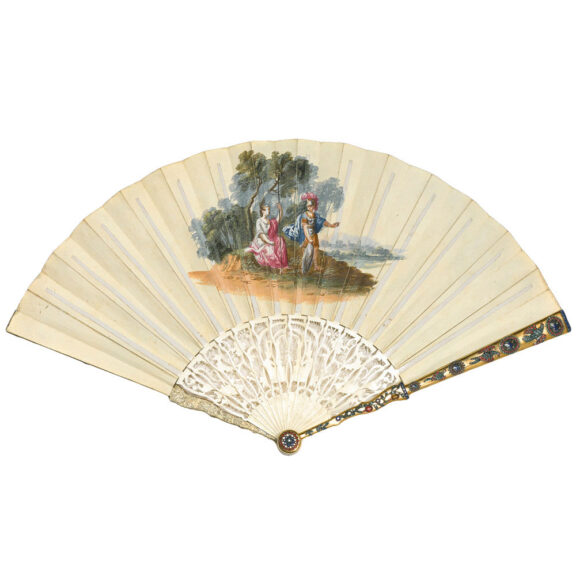
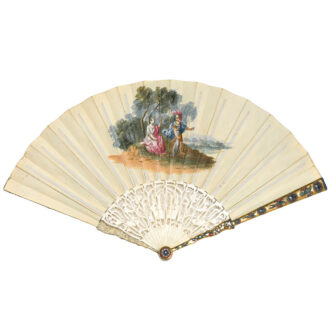
English magnificent fan with a timepiece mid 18th century
- Kenmerk
- SA0341
- Diameter
- -
- Estimate
- € 40.000 - 100.000
- Price sold
- -
Silver gilt metal and enamel and ivory paper fan with a timepiece
–
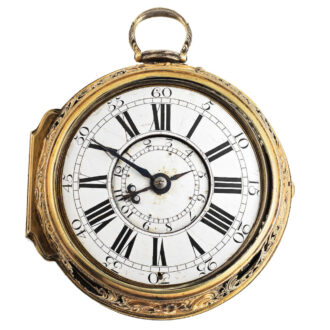
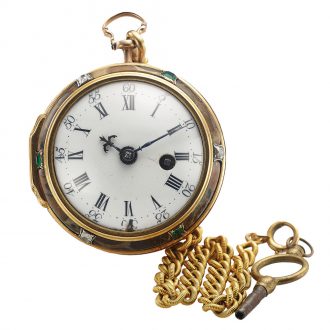
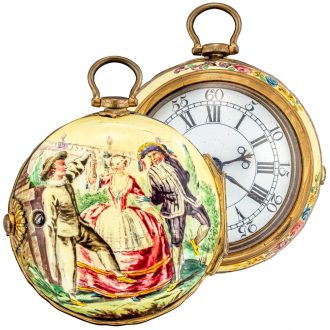
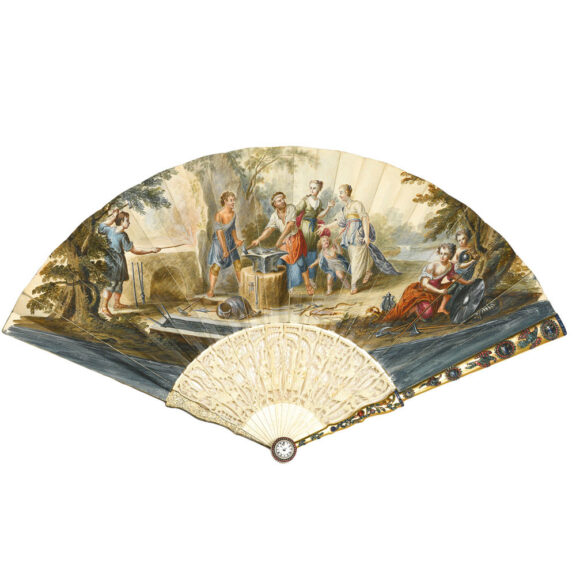
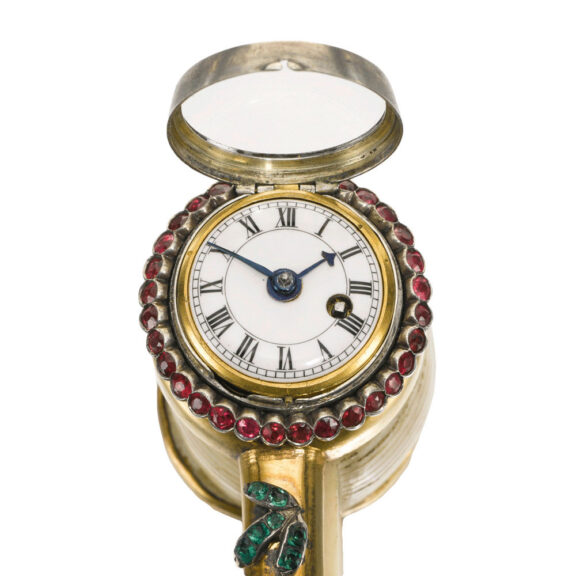
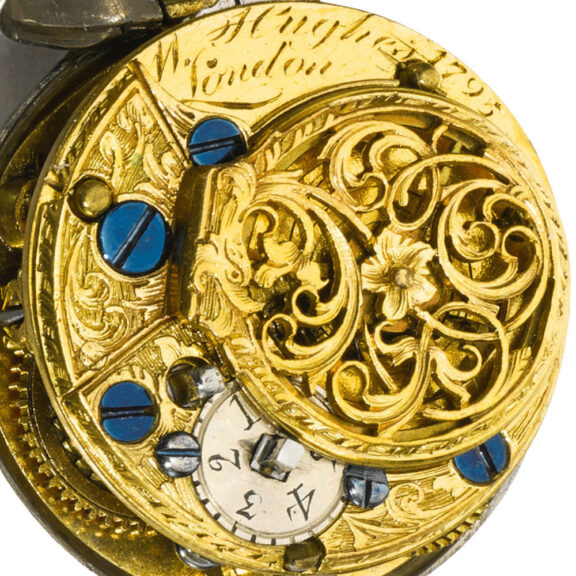
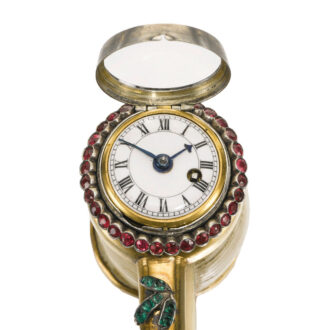
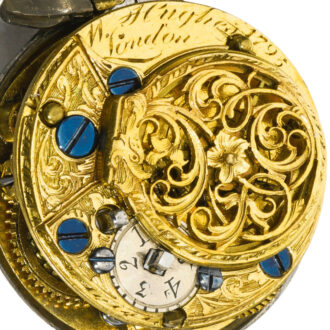
An English magnificent and very rare silver, gilt metal, enamel and ivory paper fan with a timepiece made for the Chinese market mid 18th century. Miniature verge movement, gilded backplate, decoratively pierced and engraved balance cock, fusee and chain, turned pillars, signed and numbered.
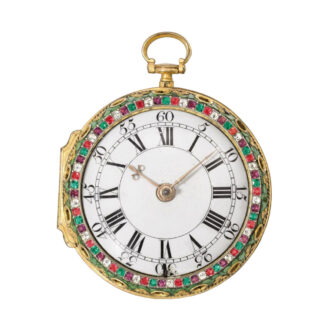
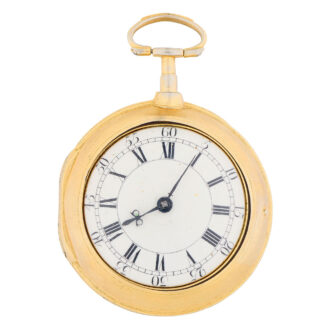
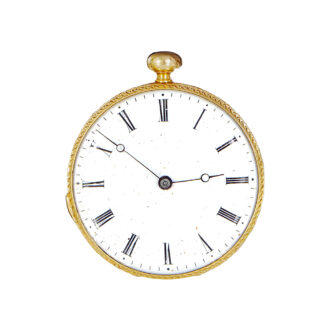
White enamel dial, Roman numerals, aperture for winding between 3 and 4 o’clock.
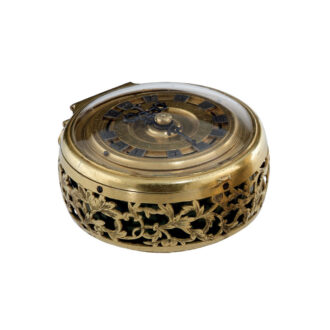
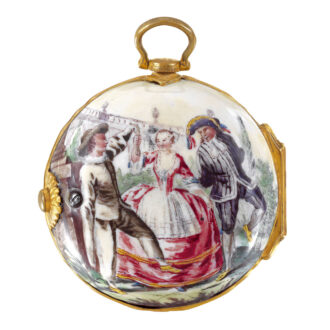
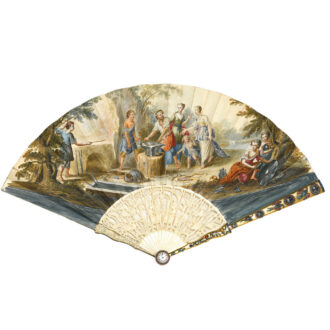
Fan with gilt finished guard sticks with multi-coloured paste set floral sprays and birds, alternating decoration of glazed ovals of basse taille enamel, ivory sticks carved with Oriental figures, two sided paper leaf painted with a scene from the Aeneid in which Venus is asking Vulcan to make a set of armour for her son Aeneas, the reverse with a painting of two ladies dressed in period costume, pivot point fitted with a watch with silver paste set bezel, the watch case with maker’s mark HT probably for Henry Cleaver Taylor. Comes with an associated key
–
Length: 280 mm
–
Signed: W. Hughes London
–
This magnificent fan watch is signed by William Hughes who specialized in pieces for the Far East market. A large musical and automata coach watch by William Hughes was formerly in the Webster collection. The 1954 catalogue cited two bloodstone boxes and a table mirror which Simon Harcourt-Smith described in his Catalogue of the Palace Museum, Peiping. William Hughes was recorded at the Dial near King Street, High Holborn until 1784. Thomas Earnshaw succeeded Hughes at his address in 1784 and Hughes himself moved to Llanfflewin in Wales. A clock made by Hughes circa 1765. Hughes was made an honorary Freeman of the Clockmakers’ Company in 1781.
Fans with watches are extremely rare, for two other examples see: Antiquorum Hong Kong, 4th June 1996 signed by Upjohn and The Sandberg Watch Collection, Antiquorum Geneva, 31st March-1st April 2001, attributed to James Cox.
–
Basse taille is an enamelling technique in which the artist creates a low relief pattern in metal, usually silver or gold, by engraving or chasing. The entire pattern is created in such a way that its highest point is lower than the surrounding metal. A translucent enamel is then applied to the metal, allowing light to reflect from the relief and creating an artistic effect. It was used in the late Middle Ages, and then again in the 17th century.
–
The Aeneid is a Latin epic poem, written by Virgil between 29 and 19 BC, that tells the legendary story of Aeneas, a Trojan who fled the fall of Troy and travelled to Italy, where he became the ancestor of the Romans.
–
Venus is the Roman goddess of love, originally the ancient Italian goddess of vegetation, and protector of gardens and vineyards. Later she was identified with the Greek Aphrodite. She was born from the foam of the sea. Venus was often depicted in Roman culture as a woman with a round object in her hand, for example, an apple or a mirror, but sometimes also with Cupid (the Roman god of love) or Victoria (the personified Roman goddess of victory) on her hand and also with a rudder or a dolphin. She was a favourite subject for many artists in antiquity too.
–
Vulcan is the Roman and Greek god of fire and the forge, and the mythical inventor of smithing and metalworking.
–
Aeneas was a mythological Trojan hero. He is the son of the goddess Venus and a mortal man, Anchises, and thus can be considered a half god. After his flight from Troy, he eventually came to Latium, Italy, after which his descendants founded Rome.
Signed: W. Hughes London
Share this page: