English one day ship’s chronometer of museum quality Circa 1796
- Kenmerk
- AD8577
- Diameter
- 124 mm
- Estimate
- € 400.000 - 600.000
- Price sold
- € 471.200
A museum-quality English ship’s chronometer, after Thomas Mudge
–
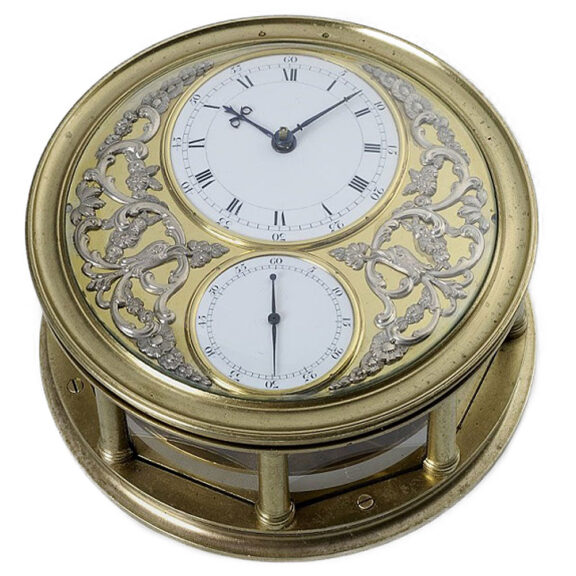
This English ship’s chronometer runs for one day on each winding. It was built to the design of the famous watchmaker Thomas Mudge, around 1796.
–
The case
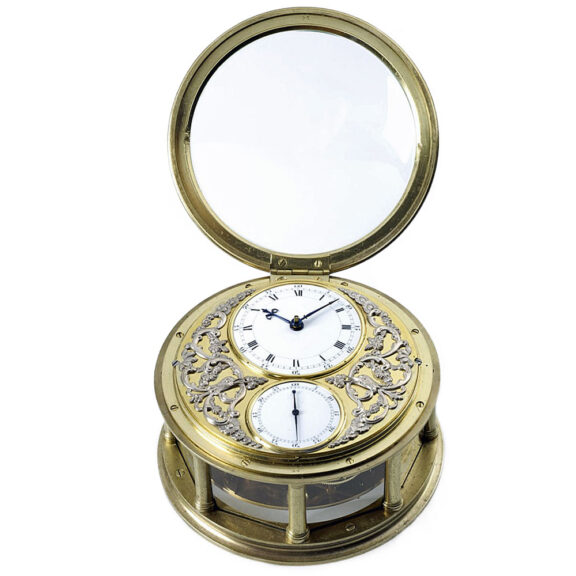
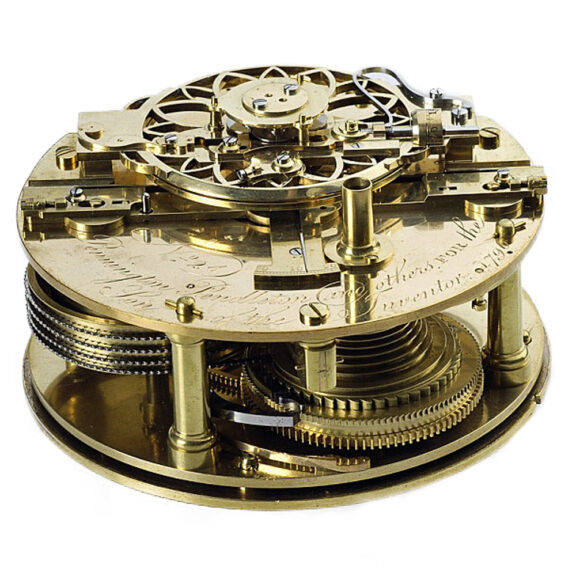
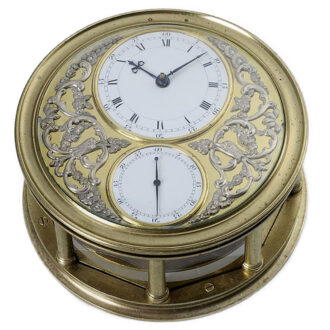
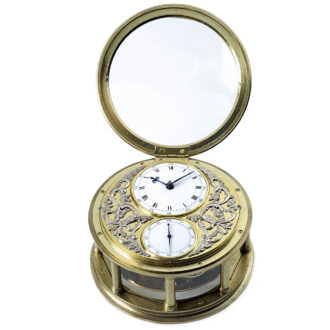
The brass case has glass on all sides, so the movement can be seen from every angle. It has shaped corner pillars and a domed glass top.
–
The dial
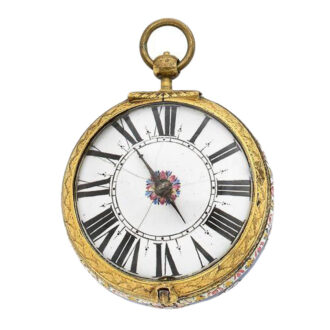
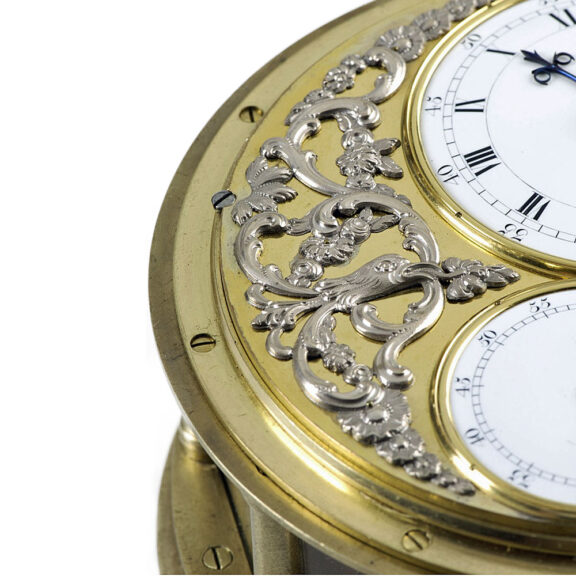
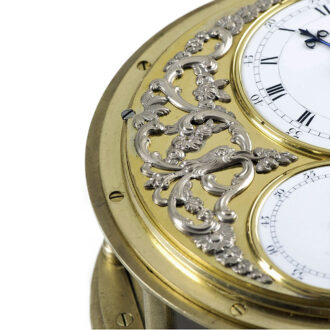
Two separate enamel dials in gilt frames sit on a gilt plate decorated with fine leaf scrolls. The hours are in Roman numerals and the minutes in Arabic numerals. The hands are of blued steel, in the “beetle and poker” style.
–
The movement
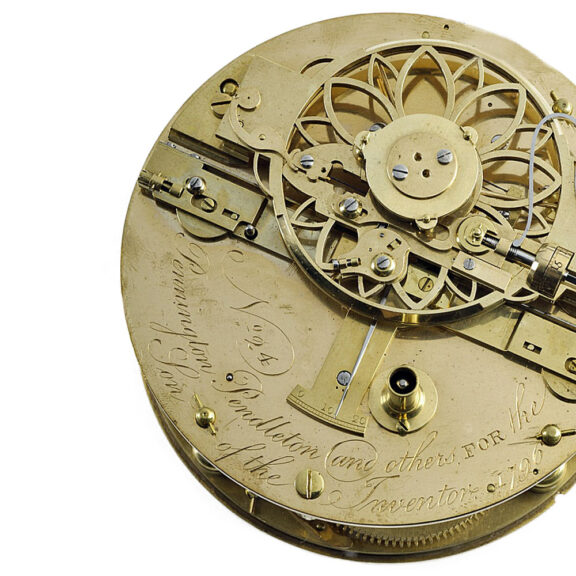
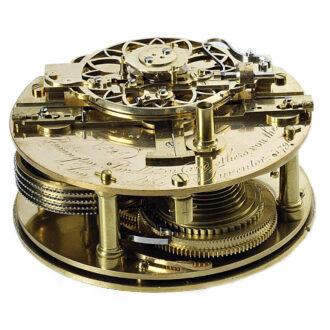
The signed brass movement has shaped pillars and finely polished wheels with six spokes. A chain and fusée keeps the force of the mainspring even, and Harrison’s maintaining power keeps the chronometer running while it is being wound.
–
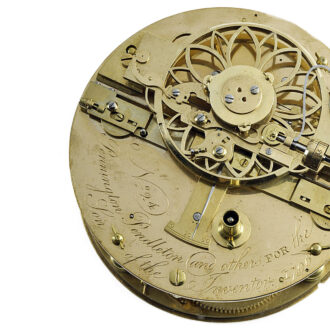
The escapement is Thomas Mudge’s constant-force (remontoir) escapement, built from drawings by Johann Jakob Huber, with a fifteen-tooth escape wheel. The large polished brass balance has three arms. To reduce friction, its steel staff turns between four steel rollers. The balance is held by an openwork bridge with a geometric pattern.
–
The chronometer has two blued balance springs:
The lower spring corrects for changes in temperature. Two straight strips made of two different metals bend with heat and cold, and they can be adjusted with screws on each side.
The upper spring is used for fine adjustment of the rate. It is set with a key and an index screw, using a slide and lever, and an engraved scale with a pointer shows the setting.
–
Diameter: 124 mm
–
Dimensions: 124 x 60 mm
–
Signed: Pennington, Pendleton and others for the Son of the Inventor 1796
–
This chronometer is one of the few in the series that was fitted with an escapement after the original design by Thomas Mudge Snr. However, the production costs for the design were very high and most of the watches by ‘Pennington, Pendleton and Others’ were fitted later with a chronometer escapement in the style of Earnshaw
–
Thomas Mudge 1715–1794
In 1774, Thomas Mudge built his first timekeeper with a constant-force escapement. He made it to compete for the Longitude Prize: £20,000 offered by the British Parliament to anyone who could find a reliable way to measure longitude at sea.
–
Mudge later made two more timekeepers of the same type. None of them won the prize, and Mudge died a bitter man.
–
About a year before Thomas Mudge died, his son formed a partnership with two watchmakers, William Howells and Robert Pennington. His plan was to make timekeepers to his father’s design in a workshop.
–
Mudge senior oversaw the work until he died in 1794. For that reason, the first chronometers were signed “Howells and Pennington for Thomas Mudge”.
–
Progress was slow. In the first 18 months only eight chronometers were made. In 1796, Mudge junior took on more workers to speed things up. Howells did not agree, and the partnership ended. This was bad news for Mudge junior: the workshop belonged to Howells, so he had to find new premises.
When the partnership ended, Howells set up a new business with Paul Philip Barraud and George Jamison. They made simpler versions of Thomas Mudge’s design.
–
Mudge junior opened his own workshop. He hired the escapement maker Richard Pendleton to work with Robert Pennington, and they built chronometers exactly to his father’s design.
–
Both workshops saw themselves as the true heirs of Thomas Mudge. So from number 9 onwards, there are two separate series of these chronometers.
–
Neither business did well. Mudge junior had to close his workshop in 1798. By then it had made 19 more chronometers, 27 in total. Howells did even worse: his workshop closed in 1799 after making only seven.
Signed: Pennington, Pendleton and others
Share this page: