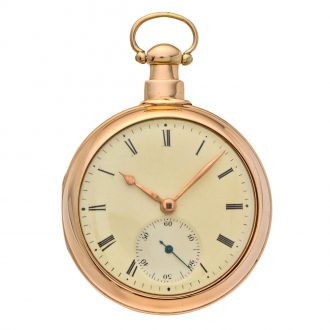
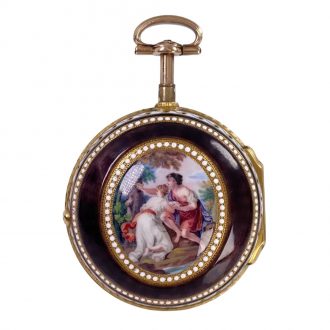
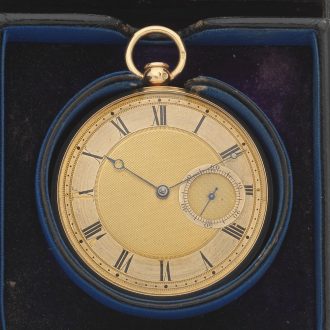
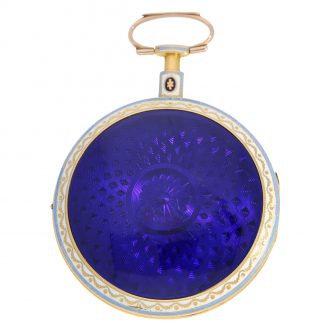
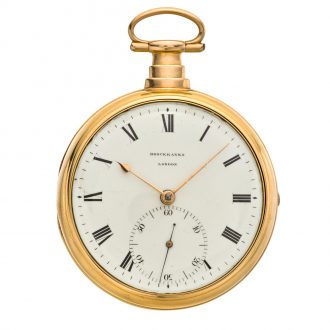
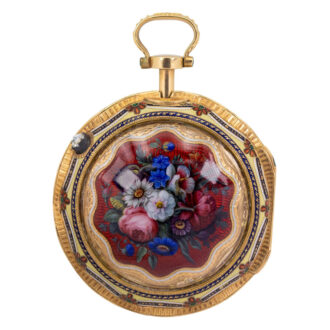
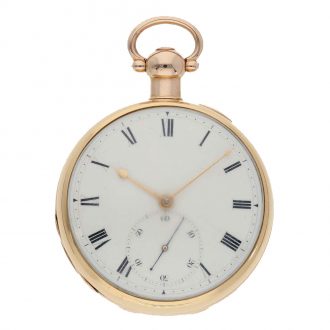
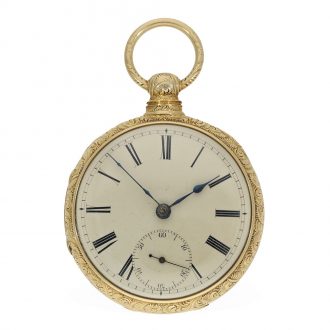
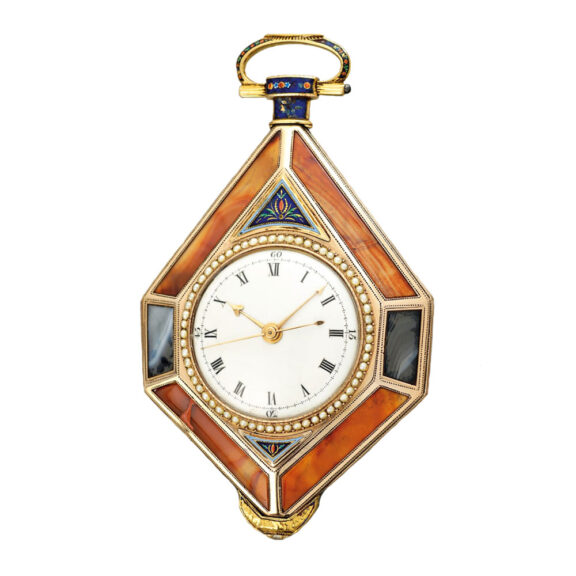
English centre seconds watch of museum quality Circa 1810
- Kenmerk
- TD0142
- Diameter
- -
- Estimate
- € 60.000 - 120.000
- Price sold
- -
Gold and enamel hexagonal duplex watch by William Ilbery
–
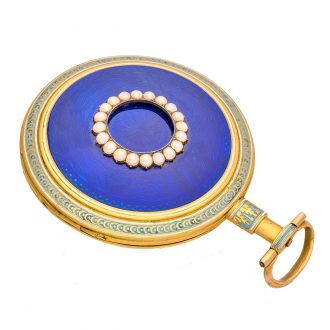
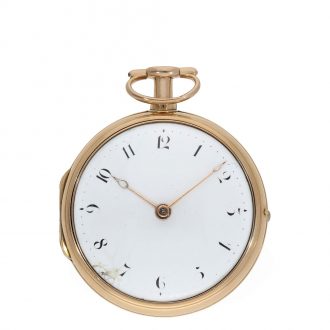
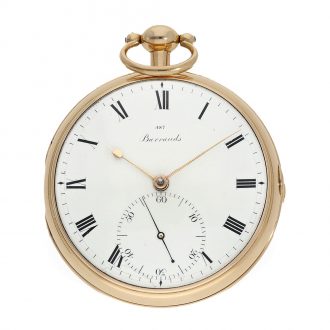
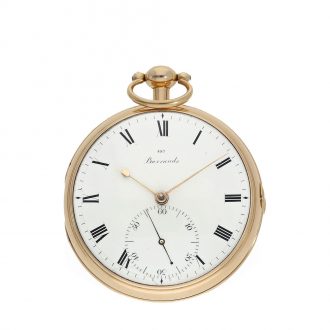
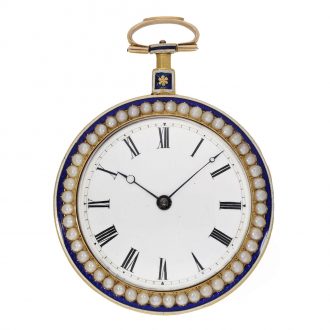
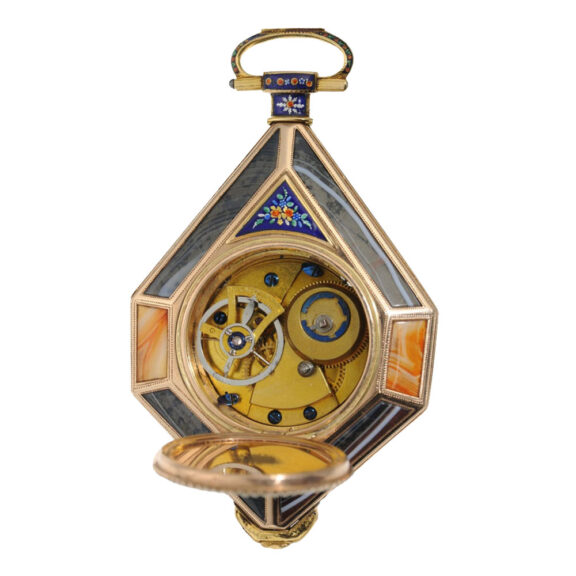
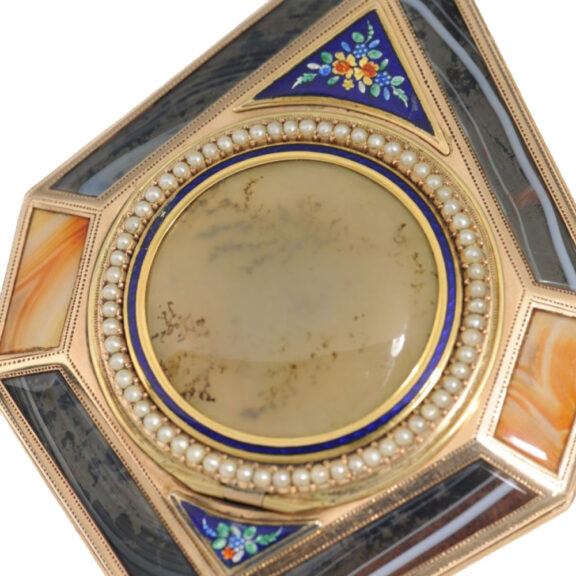
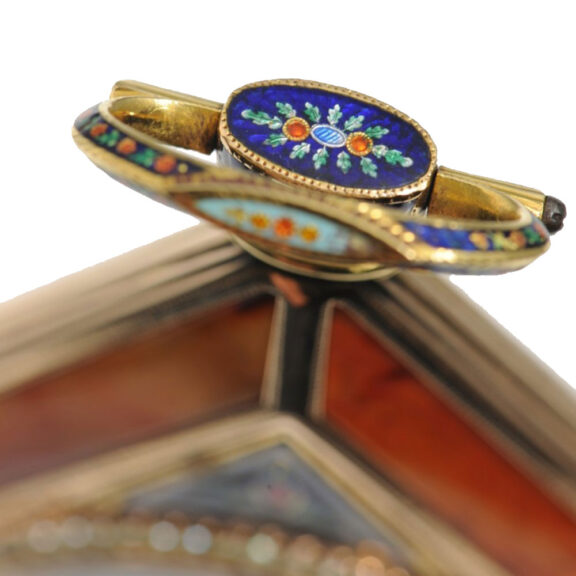
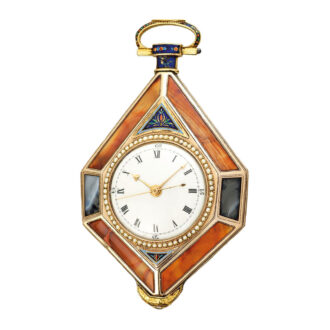
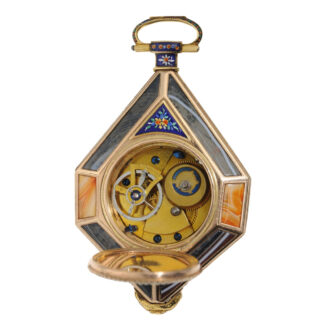
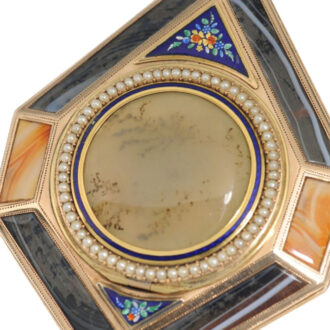
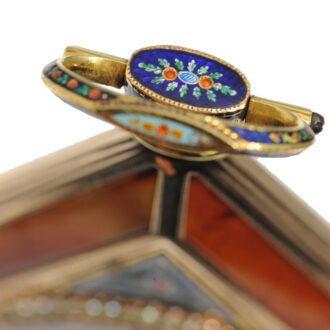
Very fine English 18 carat gold and enamel centre seconds pocket watch made for the Chinese market, circa 1810. Bridge movement Chinese calibre, keywind, going barrel, duplex escapement, five armed steel balance. White enamel dial with Roman hours and Arabic fifteen minutes, gold heart-shaped hands and a central second hand. Elongated hexagonal case, the front and back partitioned in opposing segments plated with grey agate and carnelian, segments divided by gold bars, the hinged lid to the back covering the movement is made from rare moss agate with natural inclusion, around the edge a slim border of blue enamel, set with fine half pearls, the bezel studded with half pearls, both sides of the pendant and engraved bow decorated with opaque and translucent enamel with paillon décor. A piece of museum quality.
–
Dimensions: 98 x 58 mm
–
Weight: 113 g
–
Signed: William Ilbery London
–
Objects with such distinct “moss” marking patterns have always been highly sought after and they were often used in the 18th century for pocket watch pairs designed for the imperial court in China. Unfortunately, many such pieces were lost over time so that only about ten clocks by Ilbery in a moss agate case are known. These are the forms we know of today: drop-shaped octagonal, drop-shaped hexagonal and elongated hexagonal such as this piece. It is a magnificent example of the wonderful cooperation between the clockmaker, the jeweller and the lapidary artist. The lavish ornamentation and the fanciful forms of the watches were intended to stimulate the imagination of the onlooker and to meet the high standards of Chinese society.
–
William Ilbery (circa 1760-1839) began working in London’s Goswell Street in 1780 and moved to Duncan Terrace later. Influenced by the examples of James Cox in London and Pierre Jaquet-Droz in Switzerland. Ilbery specialized in producing luxury watches for the Chinese Market. At first, he very much adhered to the traditional English style with its full plate movement and duplex escapement. For later movements, Ilbery took his inspiration from the Lépine calibre with free-standing barrel, as did Jaquet Droz with the watches he signed in London and William Anthony in London. Ilbery had the cases of his watches exquisitely decorated by the best enamellers from Geneva such as Jean-Francois-Victor Dupont or Jean-Louis Richter. William Ilbery initiated the production of opulently engraved movements for the Asian market in Fleurier in Switzerland. Other makers in Fleurier such as Bovet and Juvet followed his example. Ilbery should therefore be considered one of the most renowned makers of the so-called “Chinese watches”. Although he worked mainly in London, Ilbery kept in close contact with the trade-in other countries. A watch signed “Ilbery Paris” is known and Ilbery & Son are recorded in London and Fleurier as well as in Canton.
Signed: William Ilbery London
Share this page: