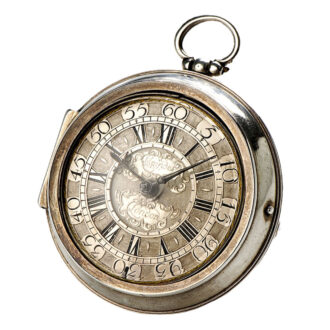
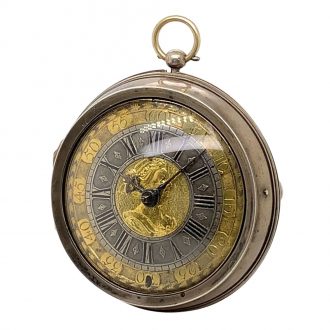
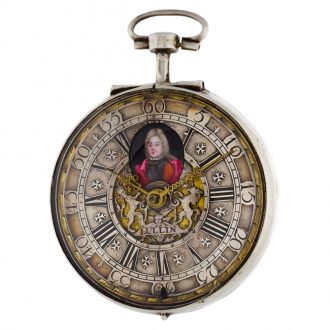
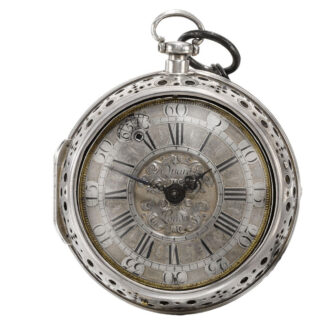
English quarter repeating watch by Daniel Quare Circa 1705
- Kenmerk
- SA0320
- Diameter
- 58 mm
- Estimate
- € 15.000 - 25.000
- Price sold
- € 21.000
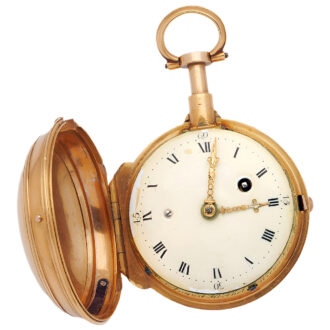
Rare English silver early quarter repeating verge watch
–
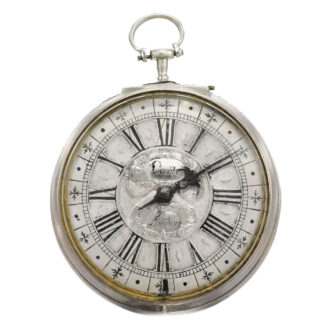
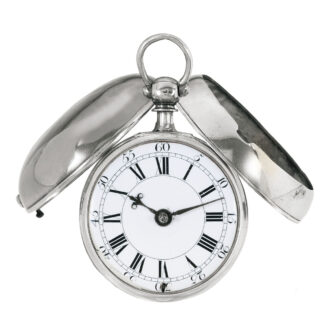
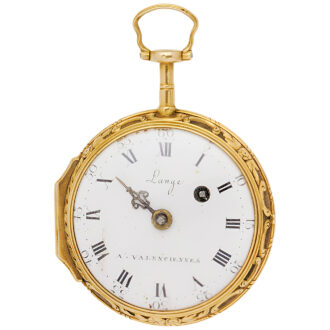
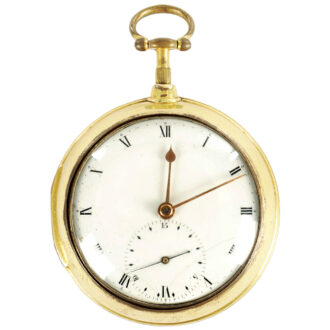
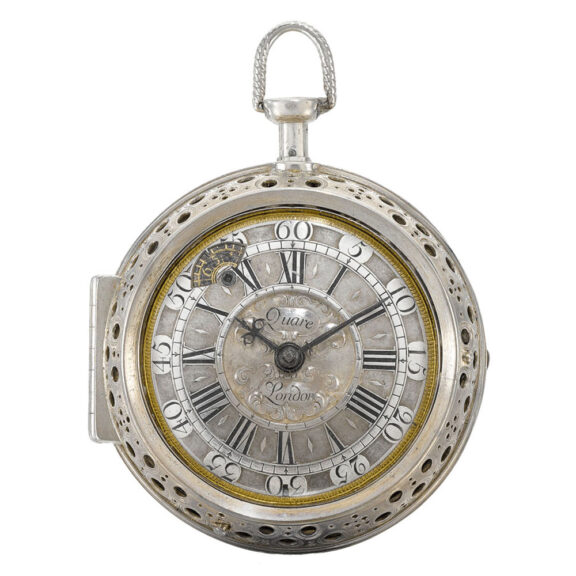
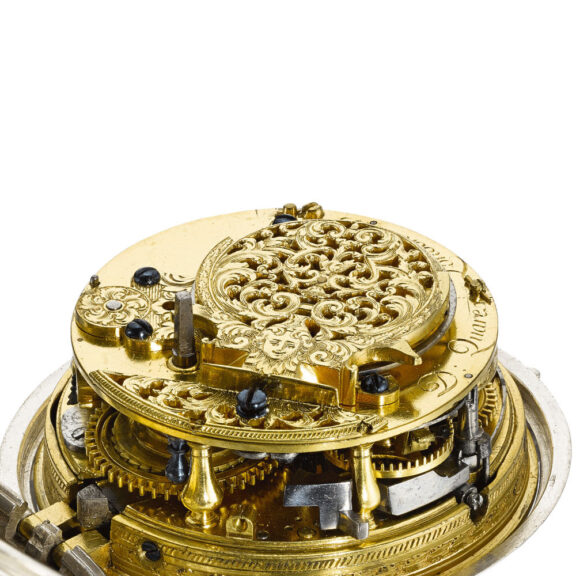
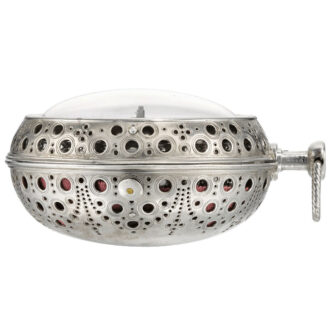
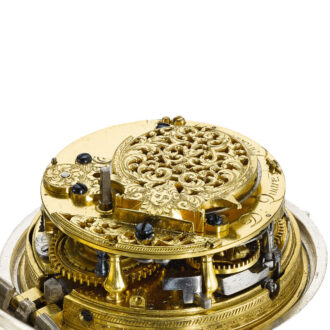
A rare silver English pair cased early quarter repeating verge watch, circa 1705, gilded full plate movement, verge escapement, decoratively pierced and engraved masked balance cock, flat three-arm balance with spring, fusee and chain, gilt metal dust ring, polished steel hammers repeating on a bell to the inside case back, round baluster pillars, signed D. Quare, London.
silver champlevé, Roman numerals with half-hour divisions between and to the ring beneath, outer Arabic minute ring, blued steel beetle and poker hands, outer gilded ring, fan-form aperture and female square for regulation, cartouches with scrolling foliage to the borders, signed Quare, London.
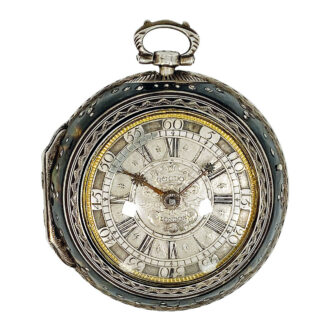
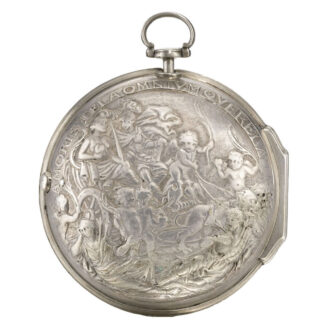
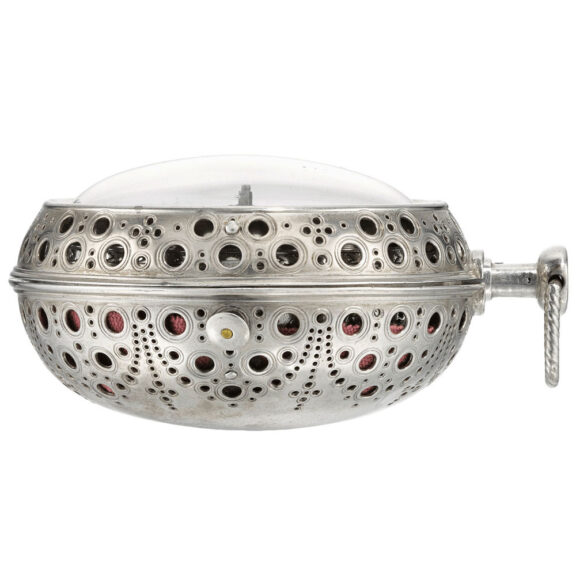
Silver case, the band with engraved decoration of scrolling foliage inhabited by birds and pierced for sound emission, a grotesque mask to the base, rope twist bow, case maker’s mark possibly WI or William Jaques (partially obscured by winding hole), silver outer case with symmetrically arranged pierced roundels of varying sizes to front and back bezels, pulse piece to the band between 7 and 8 o’clock, maker’s mark WG incuse for William Ginn
–
Diameter: 58 mm
–
Signed: D. Quare London
–
Most unusually for a repeating watch, the silver champlevé dial of the present piece has an aperture for regulation with the corresponding setting square. The blued steel hands are intricate in design and beautifully made. Quare is known to have had two numbering series for his watches, one of which appears to have been reserved for his repeaters. Both the style and number of this watch would suggest a date of execution around 1705, although it is possible that it was made a little earlier.
Most unusually for a repeating watch, the silver champlevé dial of the present piece has an aperture for regulation with the corresponding setting square. The blued steel hands are intricate in design and beautifully made. Quare is known to have had two numbering series for his watches, one of which appears to have been reserved for his repeaters. Both the style and number of this watch would suggest a date of execution around 1705, although it is possible that it was made a little earlier.
Daniel Quare (c.1647/8-1724) was born in Somerset. A highly esteemed watchmaker, Quare was admitted to the Clockmakers’ Company in 1671, later becoming Master in 1708. Quare established himself as an important horological innovator by inventing a type of repeating work around 1680. Whilst Quare was developing his repeating mechanism, his rival, the Revd. Edward Barlow, was developing his own version. Barlow had invented the rack form of striking in 1676 and, in 1685, Thomas Tompion made a watch for Barlow that incorporated the latter’s repeating system. Three years later, in 1688, Daniel Quare and Edward Barlow presented their different forms of repeating watches to King James II in order that he might declare which he regarded the superior. The King favored Quare’s form, noting that Barlow’s required two pushers, one for the hour strike and one for the quarters, whilst Quare’s single push-piece activated both the hours and quarters.
As a Quaker, Quare was unable to be appointed Royal Clockmaker, however, as Cedric Jagger notes in his book Royal Clocks, Quare “was given free access via the Back Stairs.” Indeed, Quare was well connected both at home and abroad, a fact borne out by the impressive wedding guest lists of his daughters Anne and Elizabeth, which boasted noble families and envoys from around Europe. In 1718 Quare went into partnership with Stephen Horseman, after which their work was signed ‘Quare and Horseman’. Daniel Quare is buried at the Quakers’ cemetery at Bunhill Fields, Finsbury.
Signed: D. Quare London
Share this page: