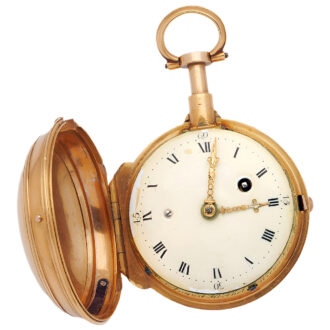
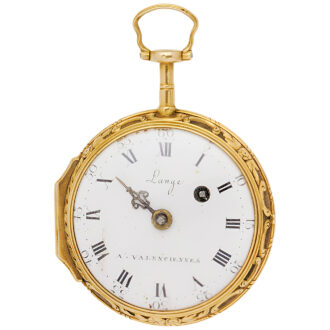
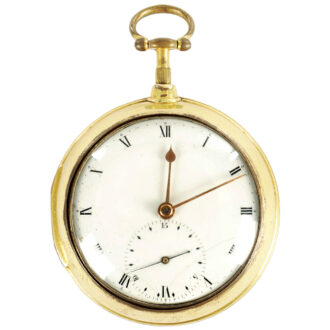
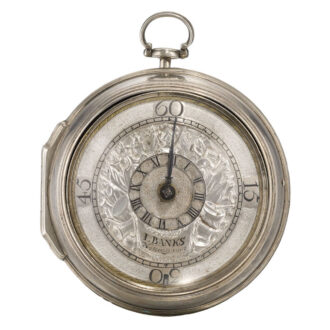
English unusual verge watch with differential dial Circa 1705
- Kenmerk
- SA0319
- Diameter
- 55 mm
- Estimate
- € 8.000 - 16.000
- Price sold
- € 14.600
Very rare and unusual silver verge watch with differential dial
–
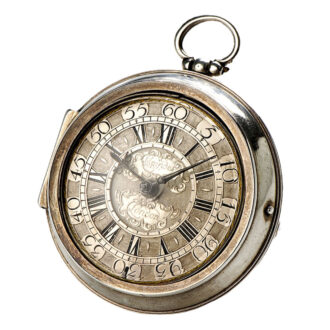
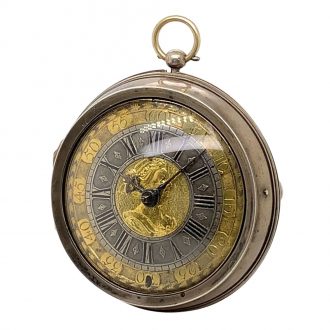
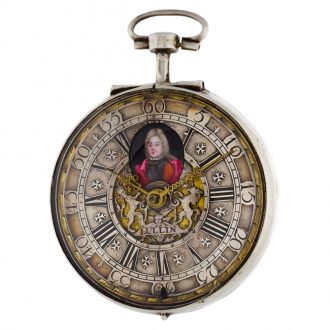
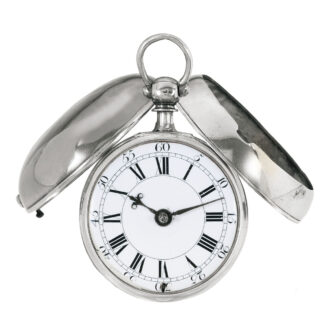
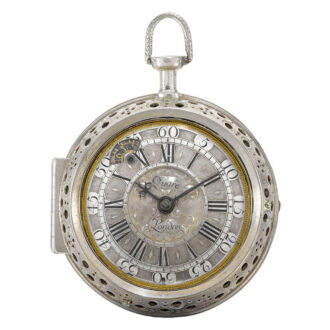
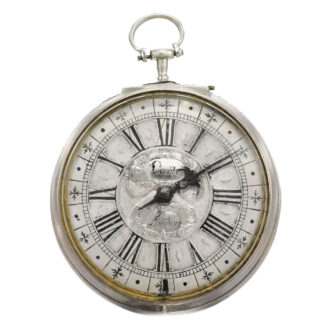
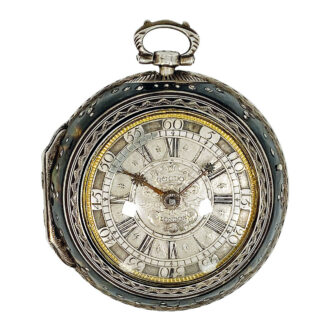
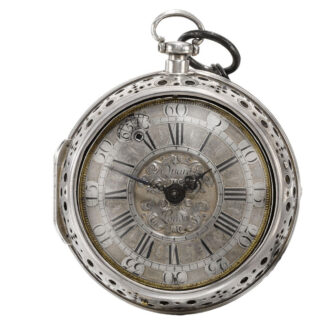
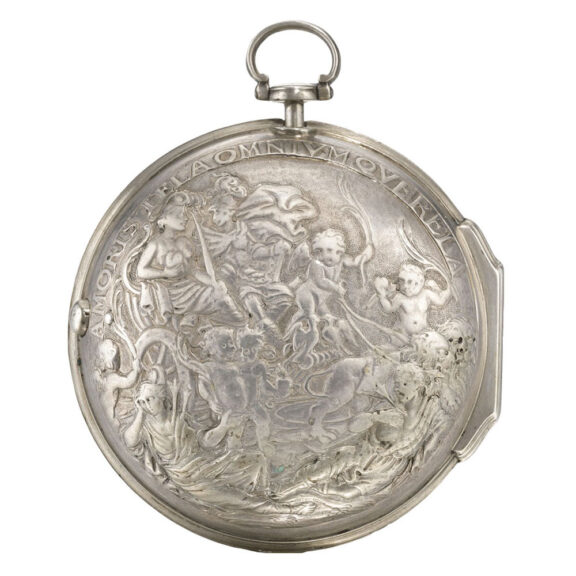
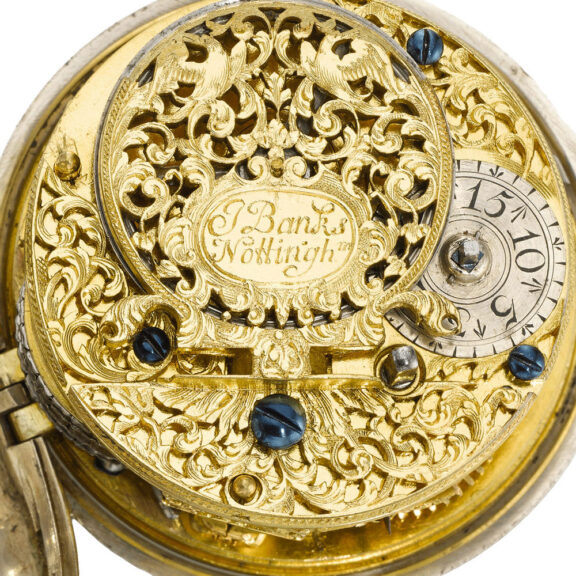
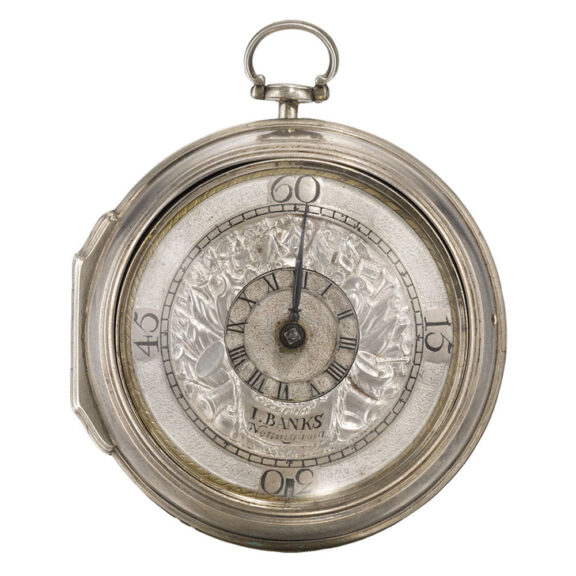
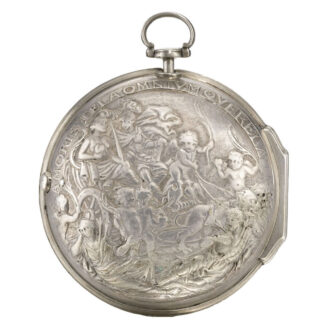
A very rare, unusual English silver pair cased verge watch with differential dial, circa 1705. Gilded full plate movement, verge escapement, balance cock decoratively pierced and engraved with foliage and birds, oval reserve signed J Banks Nottinghm, fusee and chain, crested Egyptian pillars. Silver champlevé differential dial, inner revolving hour disk, outer Arabic minute ring, embossed and chased band between with trophies of war, all against a stippled ground, single blued steel poker minute hand, signed within a banner I. Banks Nottingham. Plain silver inner case, stirrup bow and pendant, inner case with maker’s mark T.P. within a cameo, embossed outer case with an allegorical scene of The Triumph of Love below the Latin inscription: Amoris tela omnium querela, hinged with shaped end joints.
–
Diameter: 55 mm
–
Signed: J Banks Nottinghm
–
The differential dial is a rather ingenious means by which to display the time. A single hand indicates the minutes towards the edge of the dial whilst the current hour, indicated on the central disk, always appears beneath the minute hand. This method of display was described by George Daniels and Cecil Clutton in their book “Watches” thus: “the differential hour arrangement is very rare indeed. An ordinary minute hand goes round once an hour. The centre of the dial is occupied by a revolving disk with the hours from I to XII numbered on it in the ordinary way. This is geared to rotate. Thus the current hour is always immediately under the minute hand”.
In many ways, it is surprising that the differential dial was not more widely used. The greater accuracy of the watch at the end of the 17th century, as a result of the widespread introduction of the balance spring, saw the increasing use of the minute hand. It is likely that, for some, the introduction of a secondary hand to the dial of a watch may have been an unwelcome cluttering, or indeed confusing addition to the dial of a watch. For this reason, the clarity of the differential dial’s display had much to recommend it. Nevertheless, it clearly did not catch on as a design and very few examples are known, indeed, David Landes in his book “Revolution in Time” suggests that “all the differential dials of the period may have been made by a single artist, who supplied them to master watchmakers for resale under their own names…Every one that I have seen has the same martial emblems on the dial, and they all seem to have come from the same shop”.
At least two other watches by Banks with the same style of differential dial are known, one formerly in the Courtney Ilbert Collection was purchased by the British Museum from Christie’s in 1958 and another is in a private collection. These are signed, as the present example, simply J Banks on both the dial and movement but the latter, from a private collection, although signed in the same way on an identical dial, is signed James Banks, Nottingham on the movement. This last watch would seem to clearly establish that the forename Joseph, often assumed for the maker of these particular watches, is incorrect. This last watch is also interesting in that the case, made by the same maker (Richard Blundell) as those belonging to the watch in the British Museum, is hallmarked for 1698, and is the earliest recorded example of a hallmark on a silver watch case.
Signed: J Banks Nottinghm
Share this page: