English unusual silver single-handed verge watch Circa 1705
- Kenmerk
- SA0411
- Diameter
- 46 mm
- Estimate
- € 3.500 - 7.000
- Price sold
- -
Unusual silver single-handed verge watch
–
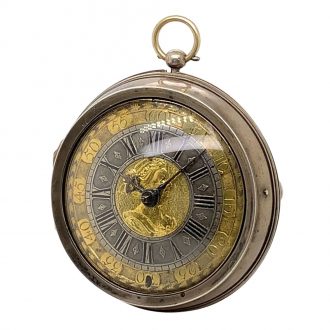
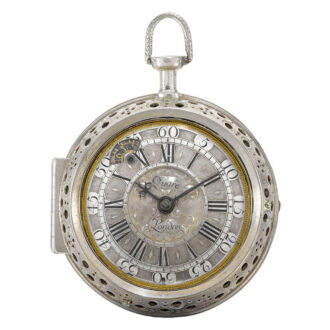
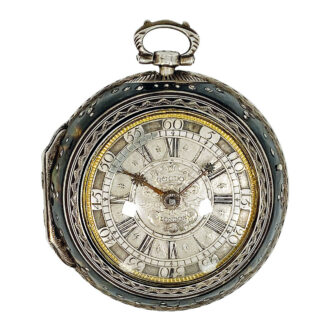
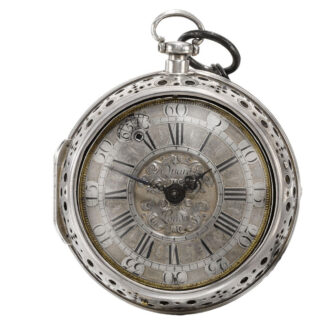
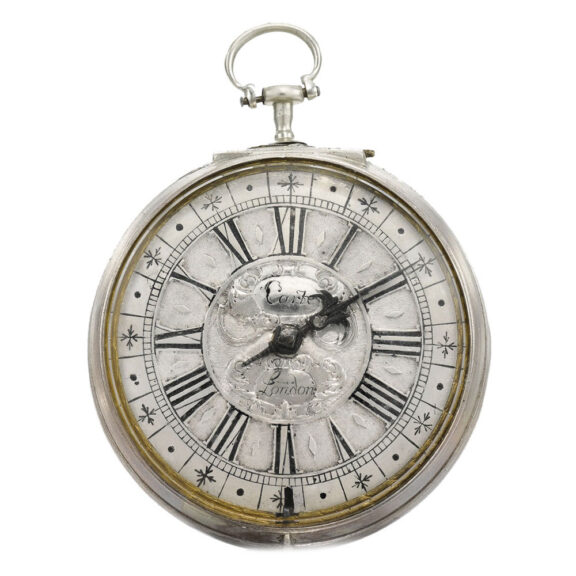
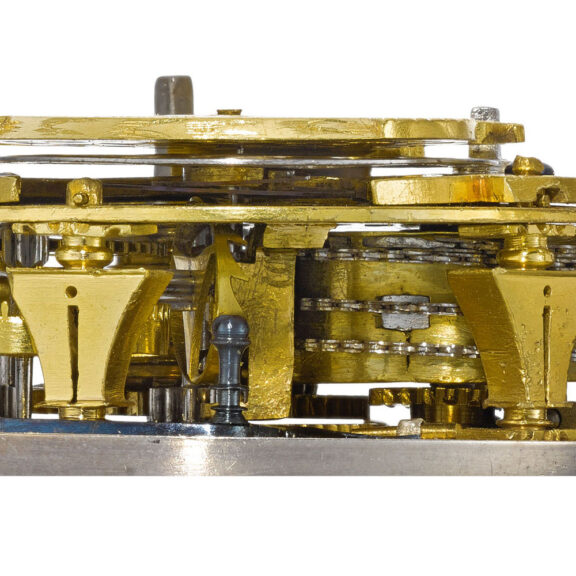
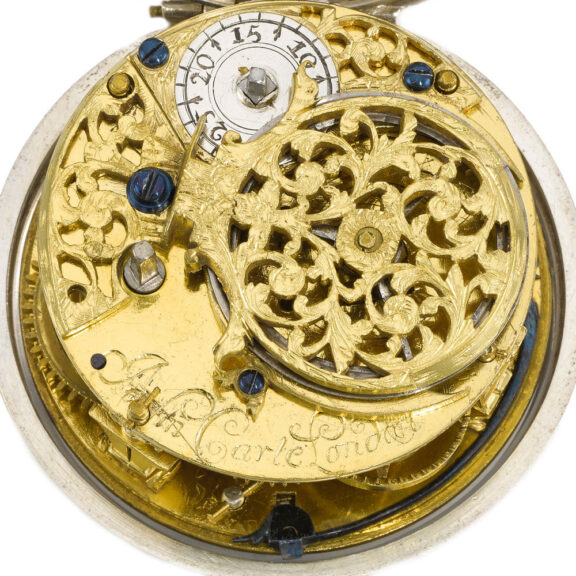
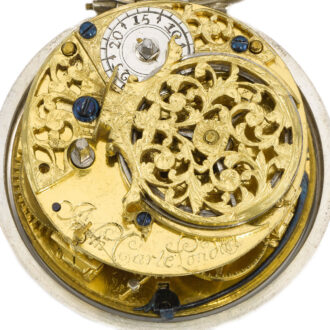
An English unusual silver single-handed verge watch, circa 1705, gilded full plate movement, verge escapement, decoratively pierced balance cock engraved with foliage and animal-head streamers at the neck, fusee and chain, Egyptian pillars, signed John Carte, London.
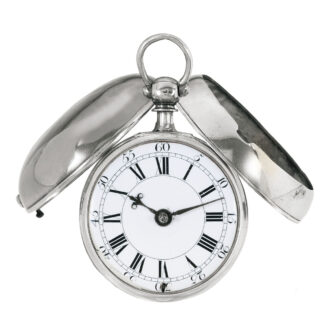
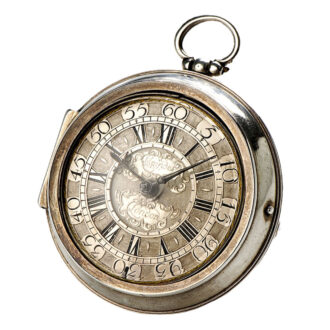
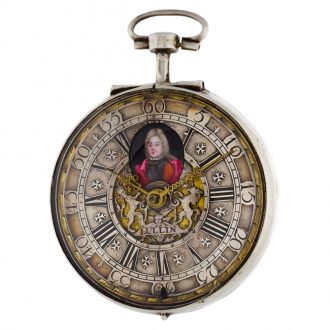
Silver champlevé dial, black Roman numerals with half-hour divisions between, outer ring calibrated with five-minute divisions, further outer ring with quarter-hour divisions composed of alternating crosses, lines and dots, central cartouches signed Carte, London and surrounded by scrolling foliage, single elongated tulip hand.
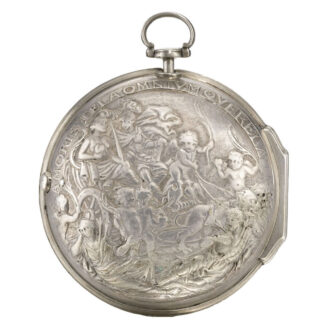
Plain silver case, stirrup-form pendant, back with winding aperture, case maker’s mark RB in cameo probably for Richard Blundell, lacking outer case.
–
Diameter: 46 mm
–
Signed: John Carte London
–
The greater accuracy of the watch at the end of the 17th century, as a result of the widespread introduction of the balance spring, saw the increasing use of the minute hand. It is likely that, for some, the introduction of a secondary hand to the dial of a watch was an unwelcome cluttering or indeed confusing addition to the dial of a watch and it is perhaps partly for this reason that examples of the traditional single-handed watch continued to be made. However, there is no doubt that there was also a prevailing fashion to present time in a variety of ways during this period. The single hand indicates time to the outer ring of this watch which is calibrated for each five-minute period within the hour. To the edge of the dial are symbols which act as useful reminders for the positions of the quarter hours.
John Carte was apprenticed to the Coventry maker, Samuel Watson, with whom he moved to London in 1691. In the early 1690s Carte was living at the Dial and Crown near Essex street and in 1698 had moved to Lombard Street where he was said to have been visited by Peter the Great of Russia, to whom he allegedly sold a world time clock. The Bodleian library in Oxford holds a manuscript written by Carte, dated to circa 1713, in which the author outlines his theories for determining longitude. This manuscript is the subject of a book by Anthony Turner: “John Carte on Horology and Cosmology,” published by the AHS and Rogers Turner Books, 2014.
Signed: John Carte London
Share this page: