English silver historically interesting early chronometer Circa 1816
- Kenmerk
- HC0959
- Diameter
- 53 mm
- Estimate
- € 4.500 - 10.000
- Price sold
- € 5.700
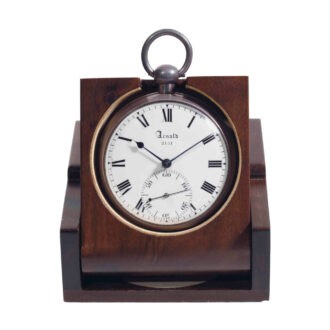
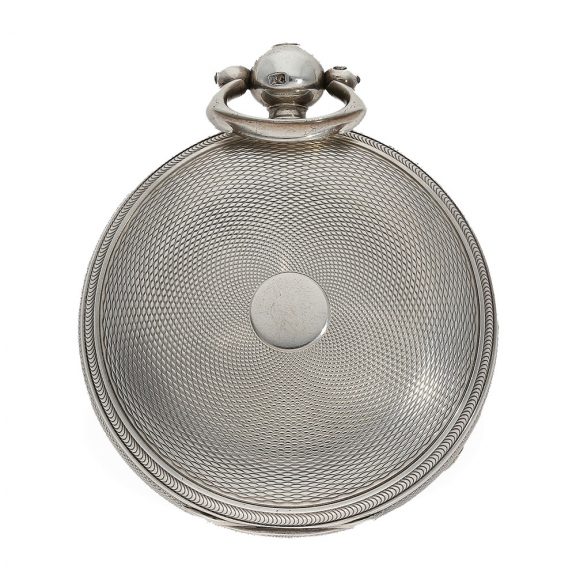
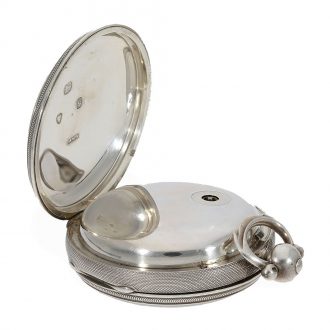
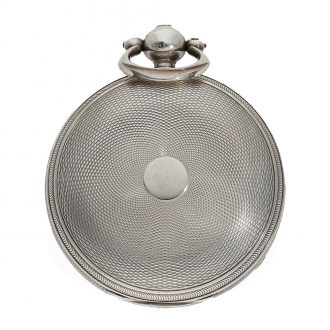
Pocket watch chronometer in engine turned case
–
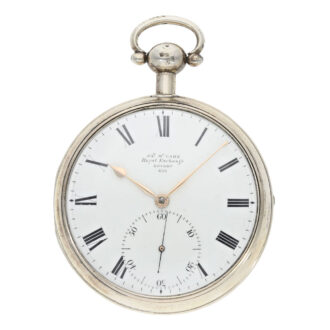
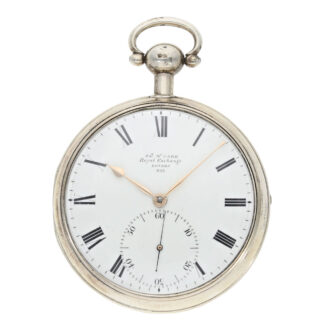
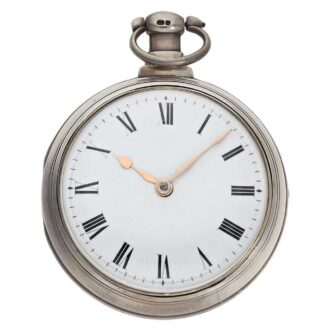
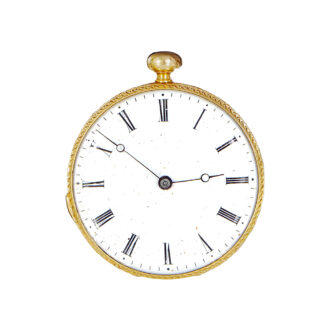
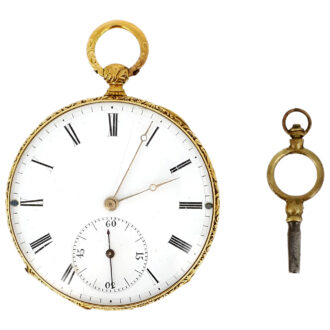
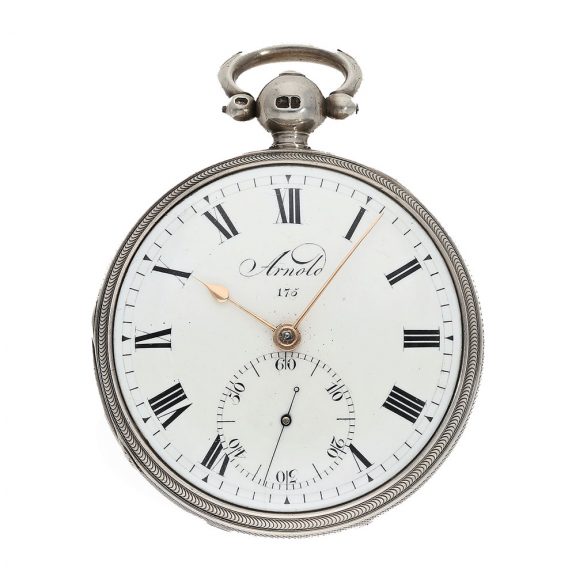
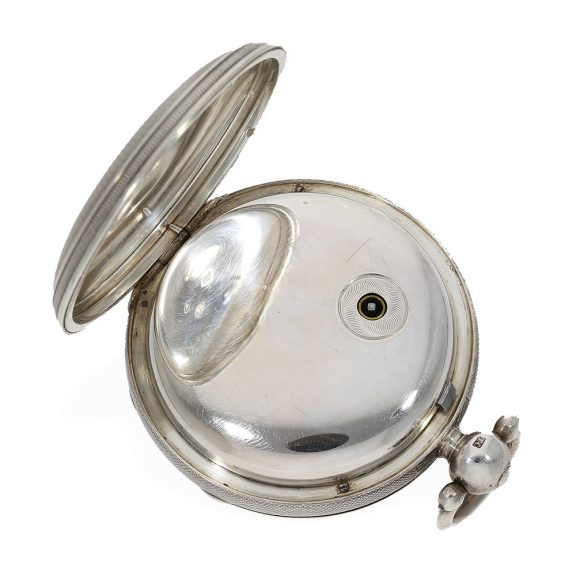
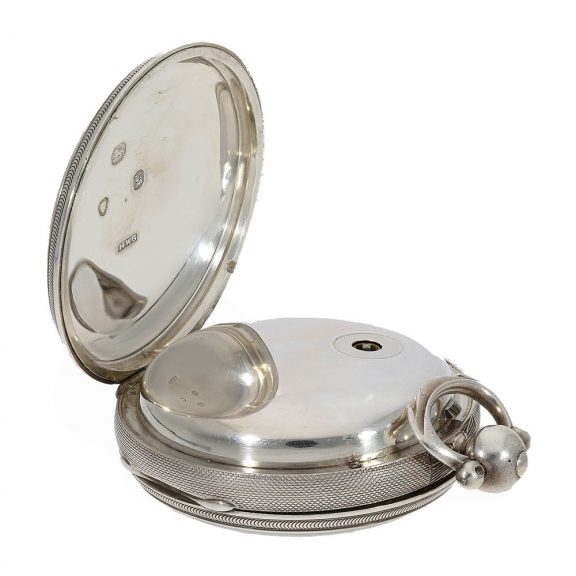
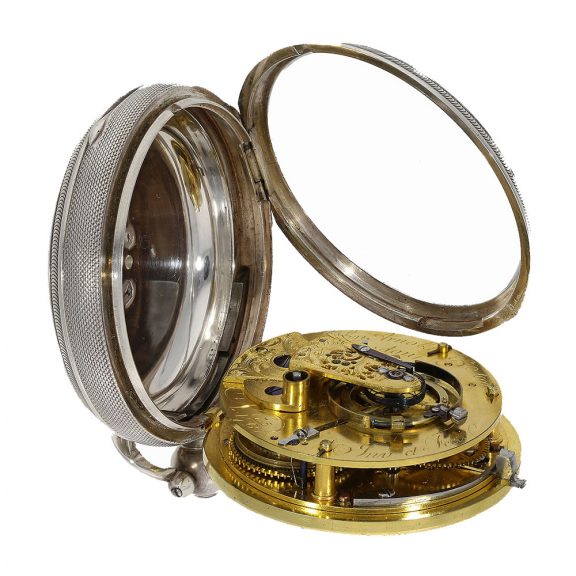
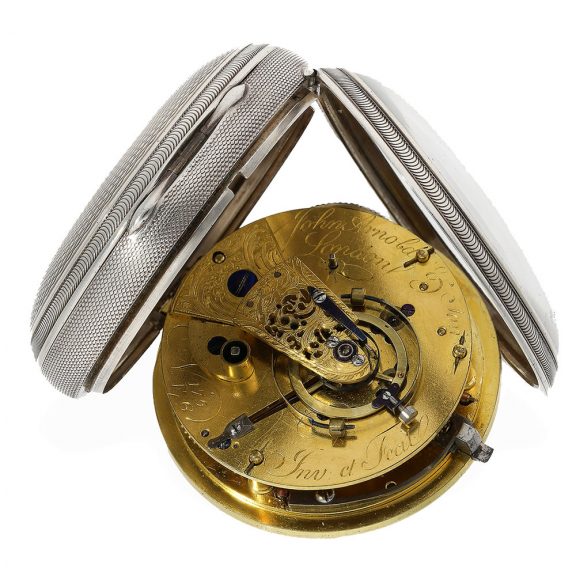
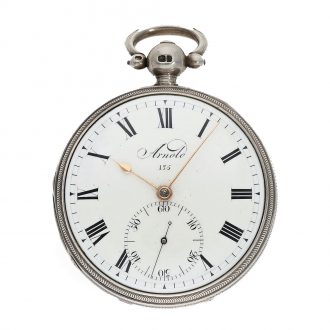
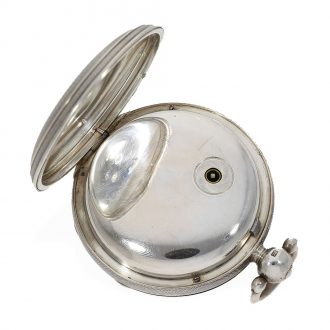
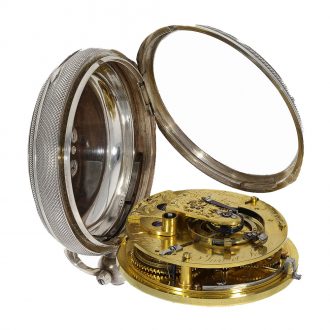
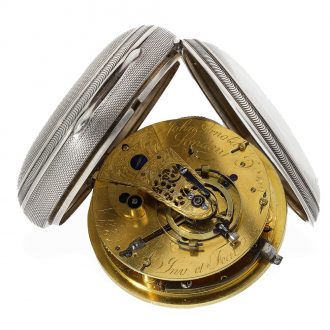
An historically interesting very early numbered chronometer, originally made by John Arnold in London, England, circa 1816. The numbered open faced case of this watch was crafted from silver and has London Hallmarks from 1845. The white enamel dial has Roman hour numerals, a subsidiary seconds dial at six o’clock with Arabic numerals and gold hour and metal seconds hands. The movement has a very early Arnold chronometer escapement with OZ balance, a helical hairspring and a diamond end stone.
Dial and movement have matching numbers and are signed.
–
Diameter: 53 mm
–
Weight: 128 g
–
Signed: Arnold (dial); John Arnold & Son (movement)
–
The watch is listed and described in Hans Staeger: “100 Jahre Präzisionsuhren von John Arnold bis Arnold & Frodsham”. Like many of the surviving Arnold chronometers, this watch was probably restored by Arnold & Frodsham in 1845 and received a new case during this service.
–
John Arnold
John Arnold was born in 1736 and died on August 11th, 1799. He was an English watchmaker and inventor. Arnold was apprenticed to his father, who was also a clockmaker in Bodmin, Cornwell and probably also worked with his uncle, a gunsmith. Around 1755, at the age of 19, he left England and worked as a watchmaker in the Hague, Holland, returning to England around 1757. In 1762, he met William McGuire on whom he made a sufficient impression and McGuire gave him a loan, enabling him to set up a workshop at Devereux Court, Strand, London. By the time he was 28, Arnold’s watches, be they verge or cylinder, displayed interesting original components such as straight-line compensation curbs and minute repeating by increments of 10 minutes instead of the more common 15 minutes. In 1764, Arnold obtained permission to present an exceptionally small half quarter repeating watch with a cylinder escapement mounted in a ring to King George III. He made another watch for the King around 1768, which was a gold and enamel pair-cased watch with a movement that had every refinement, including minute repetition and center seconds. It was around 1770 that Arnold developed a portable precision timekeeper. His basic design was simple whilst consistently accurate and mechanically reliable. Importantly, the relatively simple and conventional design of his movement facilitated its production in quantity at a reasonable price whilst also enabling easier maintenance and adjustment. He successfully found a way to simplify Harrison’s timekeeper design. He established himself at 2 Adam Street, Adelphi Buildings, Strand, in 1771 and researched marine chronometers here over the next eleven years. Arnold was the first to design a watch that was both practical and accurate, and also brought the chronometer into use in its modern sense, as a precision timekeeper. His technical progress enabled the quantity production of marine chronometers for use on board ships from around 1782. Arnold was admitted to the Clockmakers’ Company in 1783. The important French watchmaker Abraham-Louis Breguet was a very good friend of Arnold. It appears Arnold gave Breguet permission to incorporate or develop any of Arnold’s inventions and techniques into his watches. Arnold’s son John Roger Arnold was born in 1769 and served an apprenticeship with both his father and Abraham-Louis Breguet. In 1787, he and his father founded the company, Arnold & Son. John Arnold also appears to have been the first to think of the concept of the tourbillon. He seems to have experimented with his idea but died in 1799 before he could develop it further. It is known that Breguet made a successful and practical tourbillon mechanism around 1795 but he acknowledged Arnold as the inventor by presenting his first tourbillon in 1808 to Arnold’s son, John Roger, as a tribute to his friend Arnold Sr.
Signed: Arnold (dial); John Arnold & Son (movement)
Share this page: