Swiss gold musical watch made for the Chinese market Circa 1815
- Kenmerk
- TA1593
- Diameter
- 54 mm
- Estimate
- € 120.000 - 200.000
- Price sold
- € 197.150
Gold quarter repeating cylinder watch
–
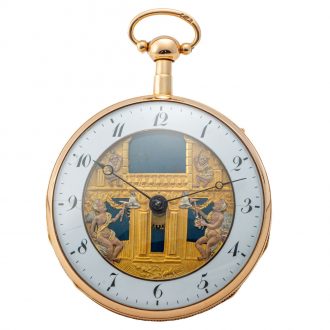
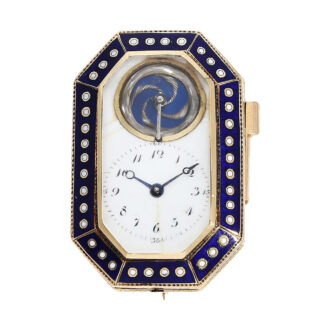
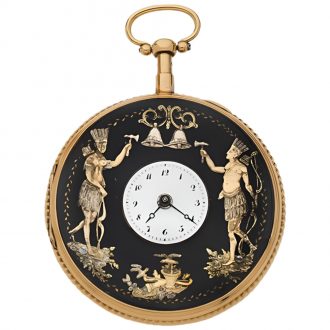
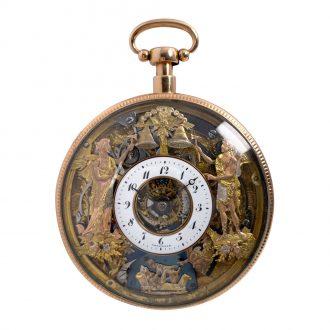
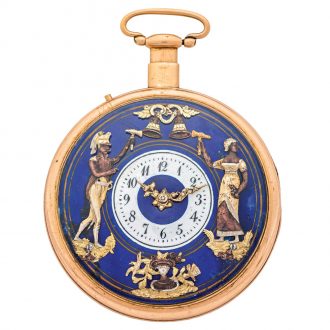
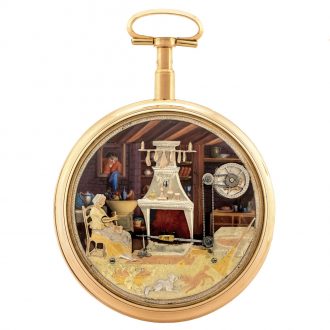
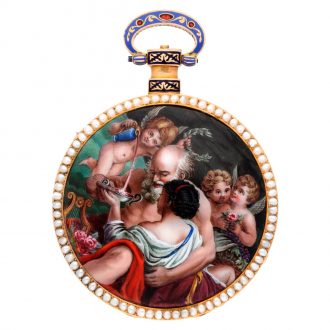
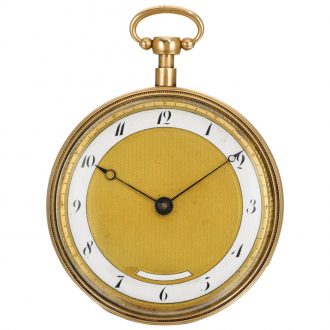
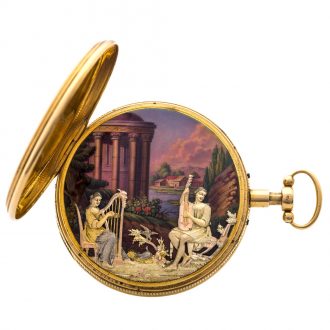
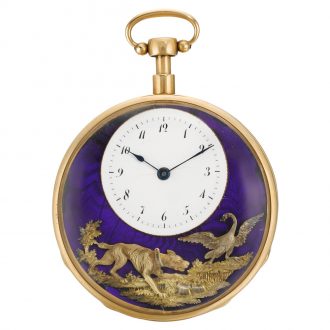
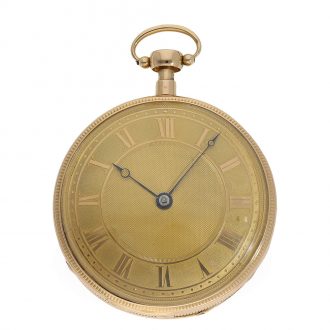
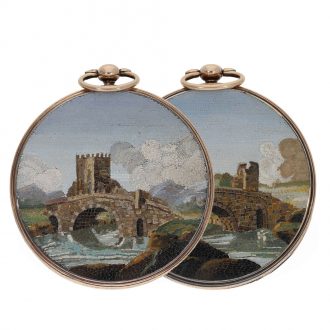
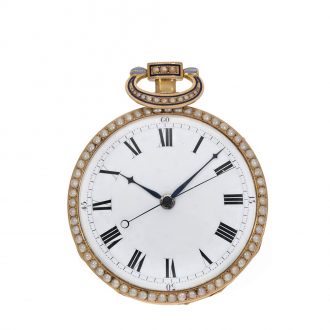
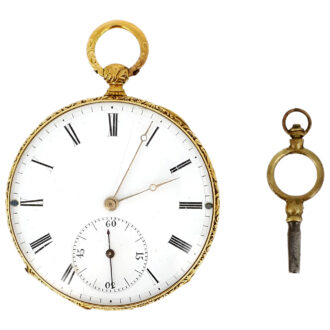
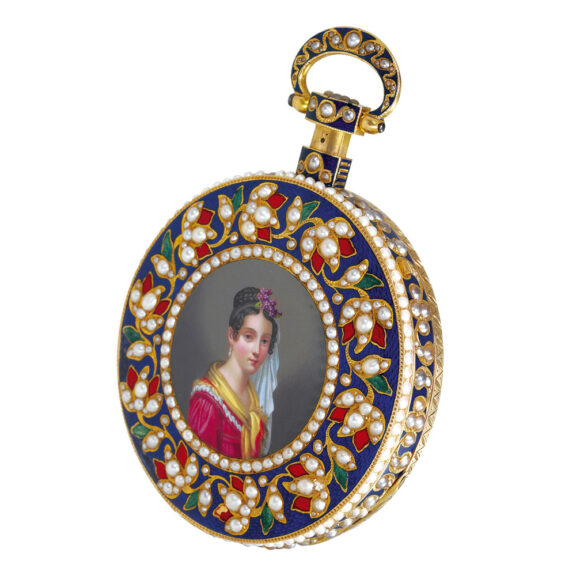
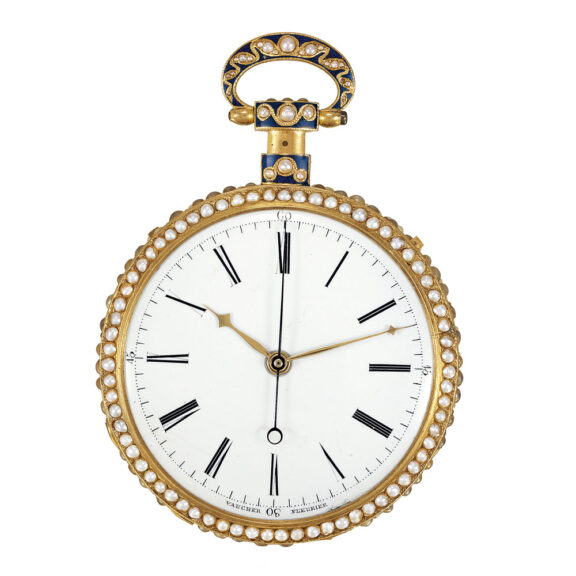
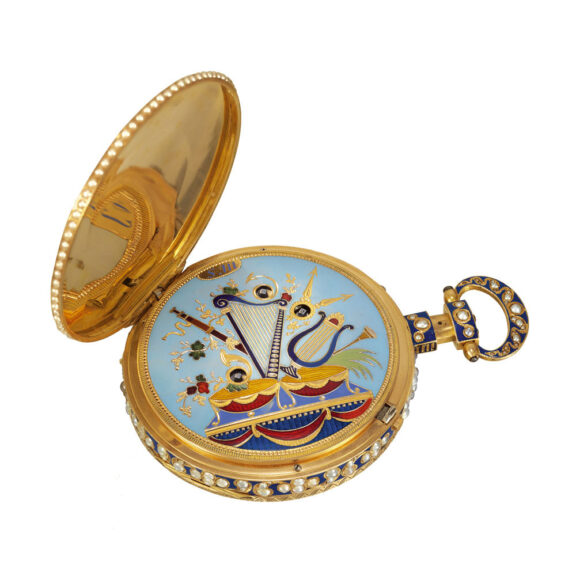
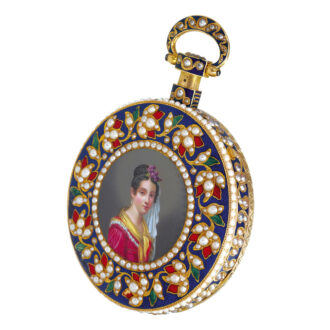
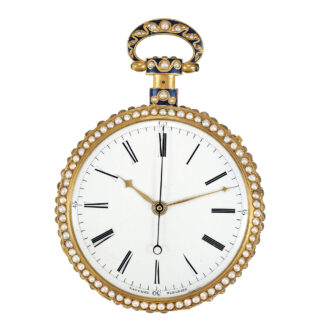
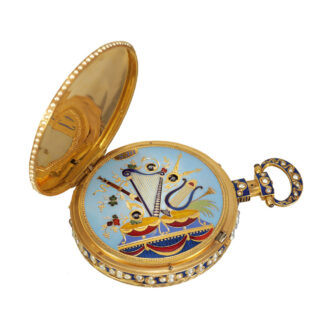
An extremely fine and very rare Swiss 18 Carat gold, enamel and pearl set open faced quarter repeating musical centre seconds pocket watch, circa 1815 made for the Chinese market. Allegory of Autumn by Piguet & Meylan, Genève. The Empire case by Frères Oltramare, the back with a polychrome enamel portrait of a young lady representing autumn in a red dress, with a yellow scarf around her neck and a white veil and grapes in her hair framed by split pearls, the enamelling by Jean Abraham Lissignol, the outer translucent imperial blue border decorated with red and green enamel flowers set with split pearls, the band, pendant and bow decorated to match, the bezel also split pearl-set, a bolt at 6 o’clock to activate the music, the lever at 4 o’clock protruding from under the cuvette for music/silent. Hinged gold cuvette decorated with a champlevé enamel musical trophy.
–
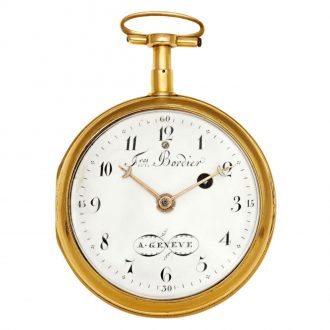
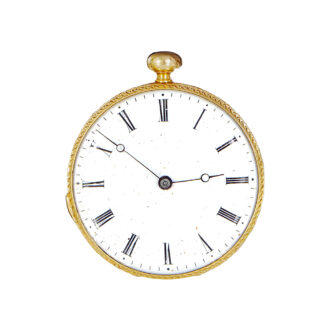
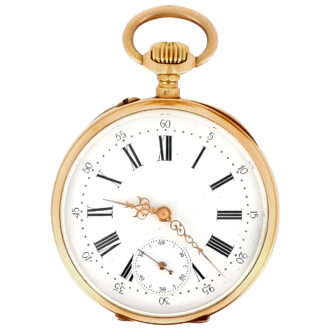
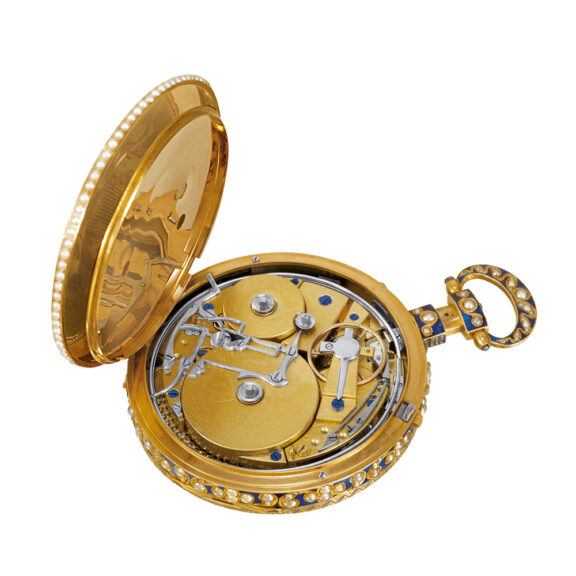
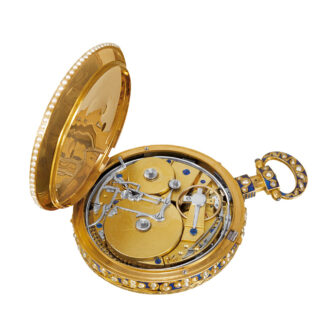
White enamel dial with radial Roman hours, outer minute divisions and Arabic quarter hour numerals, gold lozenge hands. A gilt-brass movement, going barrels, cylinder escapement, three arm gold balance with flat balance spring, index regulator, sur plateau musical movement with 23 vibrating teeth playing on both sides of the pinned disc, playing music on the hour or at will, repeating on gongs activated by depressing the pendant. Dial signed Vaucher Fleurier, the case punched with maker’s mark FO for Frères Oltramare, movement punched PM for Piguet & Meylan.
–
Diameter: 54 mm
–
Signed: Piguet & Meylan Genève
–
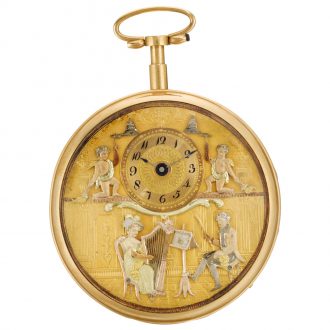
A watch from this series, ‘Winter’, is in the Patek Philippe Museum in Geneva and a similar watch from the same series is in the Rolex Wilsdorf Collection (Montres et Émaux de Genève).
–
Piguet & Meylan both originally from the village of Le Chenit in the Vallée de Joux, Isaac Daniel Piguet (1775-1841) and Philippe Samuel Meylan (1772- 1845) came to Geneva as young men and formed a partnership that lasted from 1811 to 1828. The company specialized in elaborate and beautifully decorated musical watches, including skeleton and automaton watches and mechanical animals. The firm was established at 45, Rue Jean Jacques Rousseau in Geneva. After their association came to an end, both Piguet and Meylan continued for some time to work with their sons.
–
Frères Oltramare. Originally from Genova, Italy, the family settled in Geneva, Switzerland in the 17th century. Branches of the family were engaged in the watchmaking trade by the second half of the 18th century. The watchmaker Pierre Oltramare (1753-1827) had apprenticed under the ‘maître horloger’ Jean Pattey of Passiery in 1768. The mark of F.O. is that of Louis-David-Benjamin and Jean Hughes. Both trained as ‘monteur de boites en or’, makers of gold watch cases. They worked together in an informal association and later entered a maker’s mark as the Frères Oltramare between 1810 and 1811. When Geneva was liberated from French occupation they re registered the same mark on November 4th, 1815, their workshop was at Rue de Coutance 82. The two brothers ended their partnership on March 31, 1826.
–
Jean Abraham Lissignol was a Swiss painter, revolutionary and one of the finest enamellers of his time. He was born in Geneva on May 7th, 1749 and died in Plainpalais on June 28th, 1819. He was the pupil of Jean-Marc Roux and later became his partner. Specialized in snuff boxes and watch cases, he worked for Jaquet-Droz & Leschot, the Rochat Brothers and John Rich.
Signed: Piguet & Meylan Genève
Share this page: