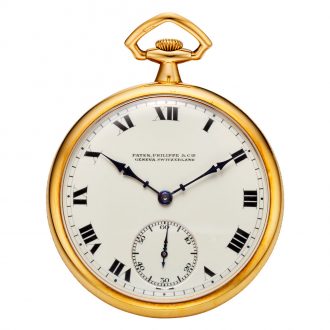
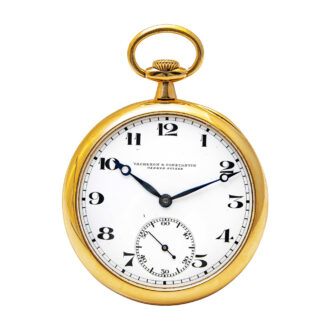
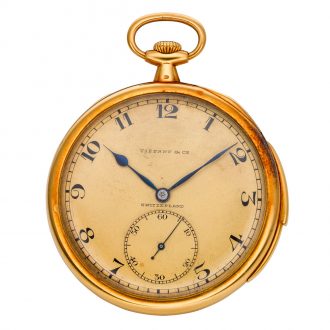
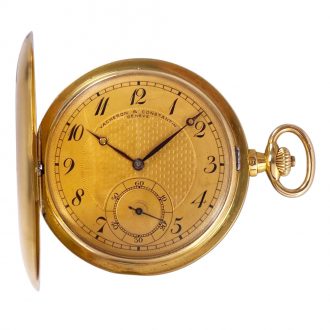
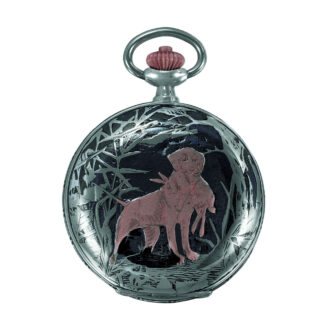
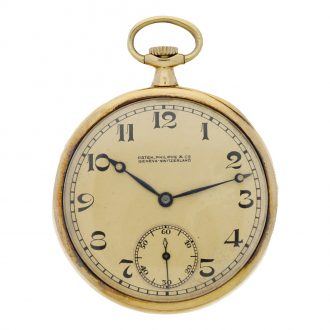
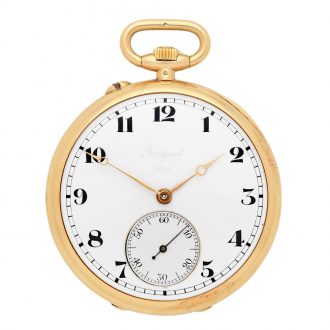
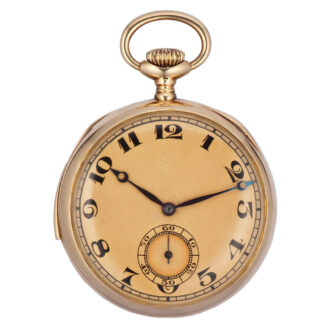
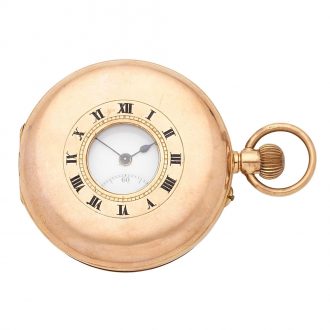
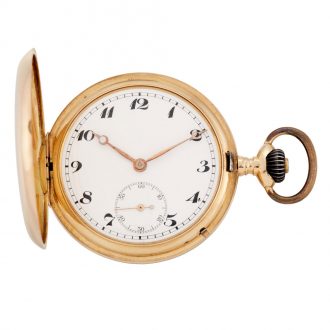
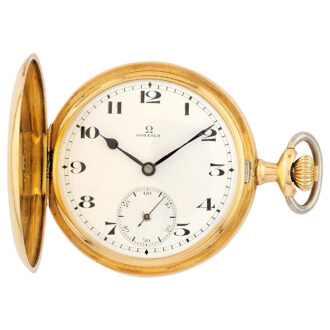
Swiss 18k gold extra Chronometer pocket watch Circa 1919
- Kenmerk
- TA1896
- Diameter
- 50 mm
- Estimate
- € 9.000 - 14.000
- Price sold
- -
Gold open faced pocket watch
–
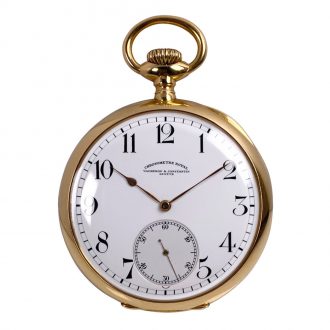
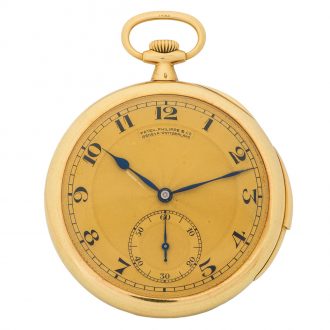
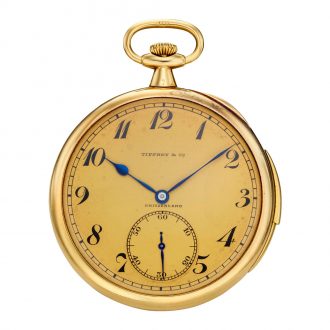
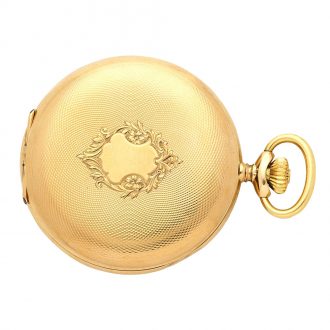
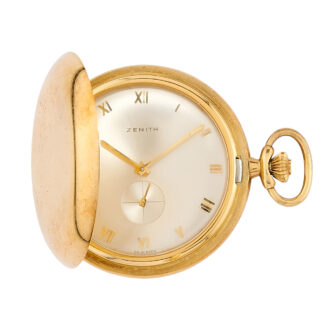
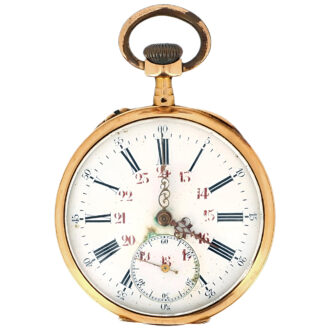
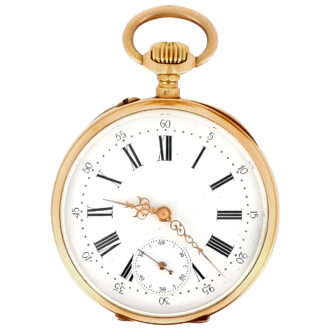
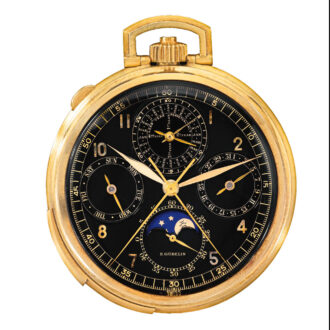
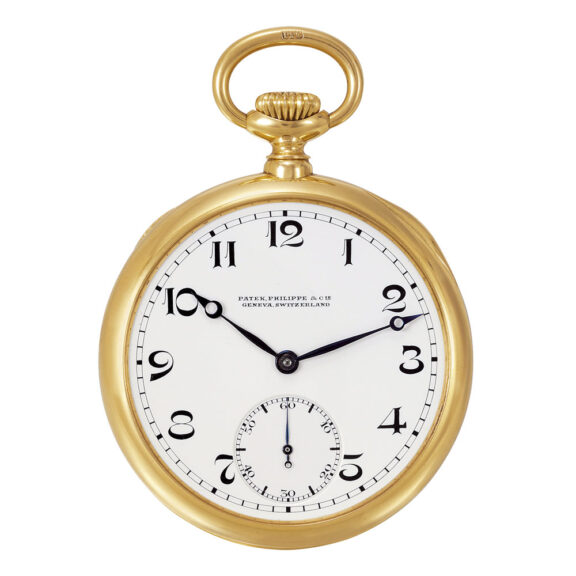
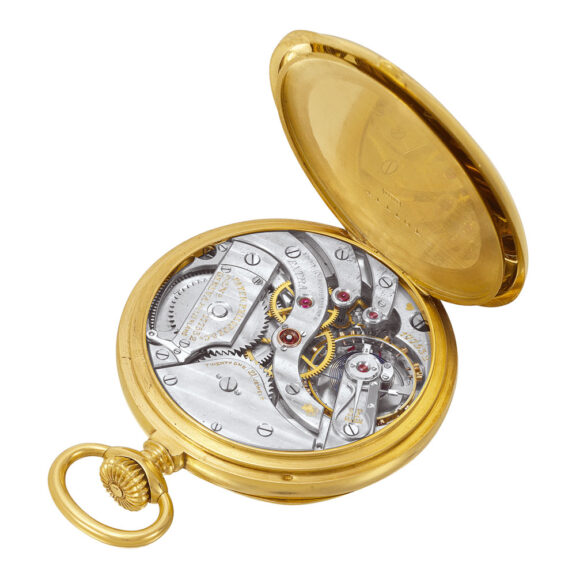
A very fine and rare Swiss, 18K yellow gold keyless extra Chronometer pocket watch with Guillaume balance, circa 1919. Bulletin Observatoire was obtained on January 28th 1926. Sold on June 15, 1927. Accompanied by the Extract from the Archives and a copy of the Observatory bulletin. A polished case, the back cover with engraved monogram. Hinged gold cuvette with dedication inscription.
–
White enamel dial with Paris numerals, outer minute track, subsidiary seconds dial. Blued steel Breguet hands. A rhodium-plated movement, Geneva striping decoration, engraved twice with the movement number, 21 jewels, wolf’s tooth winding, straight-line counterpoised lever escapement, Anibal-brass Guillaume balance with winged arms, gold temperature adjustment screws and platinum mean time screws, blued steel Breguet balance spring with an inner and outer terminal curve, swan-neck micrometre regulator with index. Dial, case and movement signed. Property of an Italian Gentleman.
–
Diameter: 50 mm
–
Signed: Patek Philippe & Cie Genève
–
Anibal (Acier au NIckel pour BaLanciers) An alloy invented by the Nobel prize winner Dr Charles Edouard Guillaume, it exhibits unusual properties, both in terms of thermal expansion and in changes in elasticity. These properties are very different from those of two other famous alloys invented by Guillaume, Invar and Elinvar. Around 1900 Guillaume attempted to eliminate the so-called middle-temperature error caused by the fact that the change of rate in a timekeeper with a steel brass bimetallic balance is approximately a linear function of temperature, while the change of rate is caused by a change in the elasticity of a balance spring is approximately a quadratic function. Thus, it equals zero at only two temperatures, causing a secondary error. Countless attempts were made to eliminate middle-temperature error, usually by means of auxiliary compensation devices.
–
In 1899, Guillaume noticed that steel with an addition of 44.4% nickel had a negative square coefficient of thermal expansion. This alloy, combined with brass in a bimetallic lamina, makes its expansion close to quadratic. Balances with bimetallic rims made of Anibal and brass are usually called Guillaume balances, or, as their inventor called them, integral balances. When combined with special balance springs, they exhibit remarkable temperature stability, on occasion not exceeding 1/50 second per day at 1oC.
Signed: Patek Philippe & Cie Genève
Share this page: