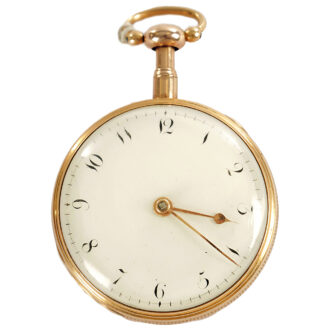
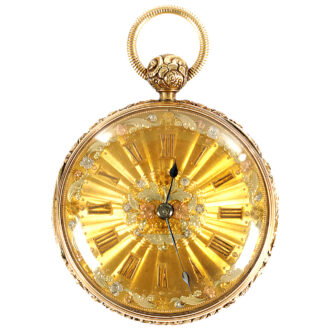
French gold, enamel verge watch with earlier enamel panels Circa 1780
- Kenmerk
- AS9628
- Diameter
- 53 mm
- Estimate
- € 5.500 - 12.500
- Price sold
- € 4.100
Gold and enamel pocket watch by Charles François Bouvier
–
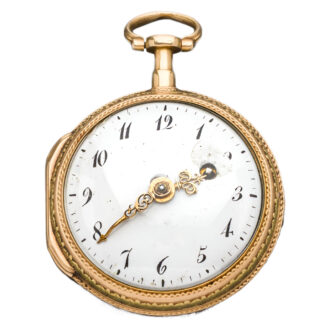
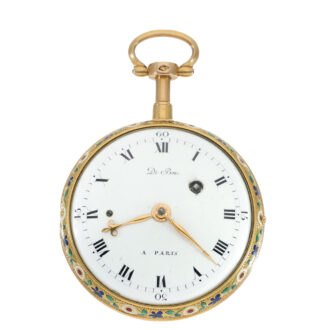
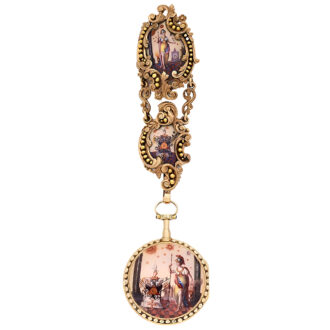
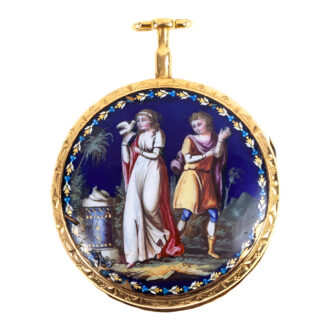
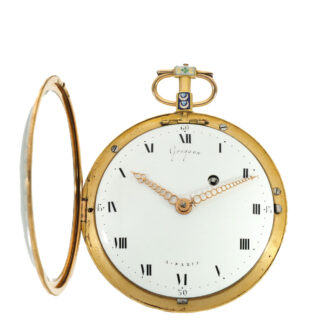
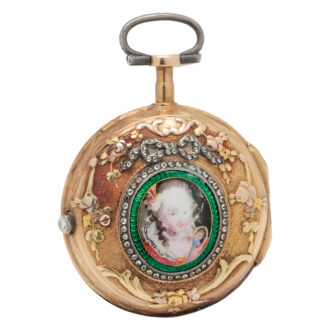
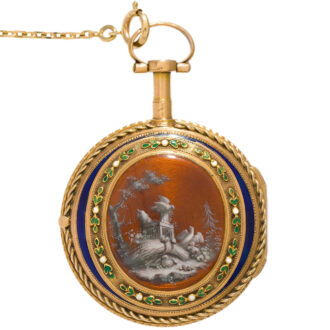
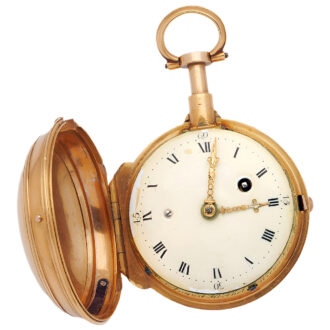
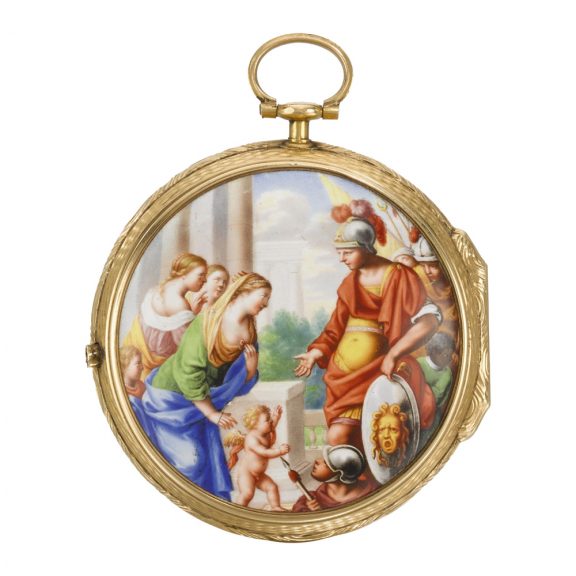
A gold and enamel French single-cased verge watch with earlier enamel panels depicting scenes of the life of Anthony and Cleopatra in the Blois style, circa 1780. The watch showcases a gilded full plate movement with a verge escapement. The balance bridge is intricately pierced and engraved with geometric foliate scrolls. It also includes a silver regulation plate, square baluster pillars, fusee and chain, and is signed by Chs. Frs. Bouvier of Paris. The dial features a white enamel chapter ring with raised roundels carrying Roman numerals and outer Arabic 5-minute indications. At the dial centre, there is an earlier Blois-style enamel panel depicting Cleopatra and the Asp, complemented by decoratively pierced gilded hands. The case features an earlier Blois-style polychrome enamel painted scene on the outside back, depicting the Meeting of Anthony and Cleopatra. The inside back is similarly decorated with Anthony’s Suicide. It also includes gold bezels with engraved waveform decoration, a stirrup pendant, and a bow.
–
Diameter: 53 mm
–
Signed: Charles François Bouvier, Paris
–
Enamel watches from the 17th century, featuring cases painted on all surfaces including the band, were quite fragile and prone to damage from even minor impacts. Despite this, the appreciation for the beauty and quality of enamel-painted scenes led to a practice where older enamel panels were removed from damaged watch cases, with the broken parts being cut away and the remaining panels set into a later case fitted with a new movement. Interestingly, there was speculation at the time of this watch’s sale at the Sotheby’s auction in 1962 that the panels may have been contemporary to the watch’s case and movement, and were made to appear as if they had been removed from an earlier watch. It was suggested that an enameller named Guillaume Bouvier was working at the same time as Charles François Bouvier, and there was a possibility that the two may have been relatives and collaborated on the watch. Additional commentary on the watch was made in an article for Antiquarian Horology (vol.104, no.11, p.706) in November 1962, where it was noted that “although the composition is in an early manner, the colours are much brighter, even brighter than the Huauds. Also, the dial centre is separate from the chapter ring, with its numerals painted on raised bosses. Perhaps the Bouvier of Paris was related to the enameller of the same name, and this watch was their joint production. Whatever the explanation, it is a fine watch in splendid condition.”
–
The movement runs smoothly. There is a small hairline near the opening catch of the enamel chapter ring, and the enamel panel in the centre has been modified to fit the dial, resulting in some unevenness around the winding aperture. Scratches are present around the winding aperture, as well as a couple of further scratches running towards the dial centre. The case has a hairline crack on the case back running from the edge up through the main figure to the left side of the case, with further fine hairline towards the upper left corner – these cracks are also visible on the inside case back. The bezels retain a crisp definition.
Signed: Charles François Bouvier, Paris
Share this page: