Important French gold watch with sonnerie striking Circa 1806
- Kenmerk
- TA1308
- Diameter
- 59 mm
- Estimate
- € 200.000 - 350.000
- Price sold
- € 338.250
Gold minute repeater with gold dial
–
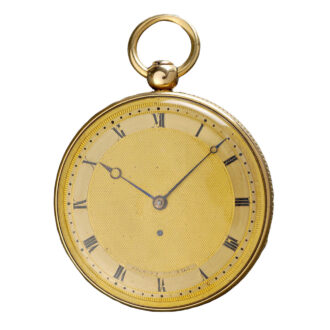
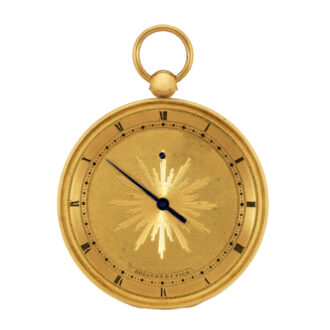
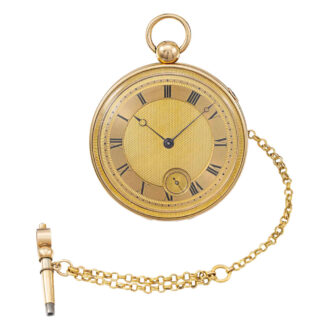
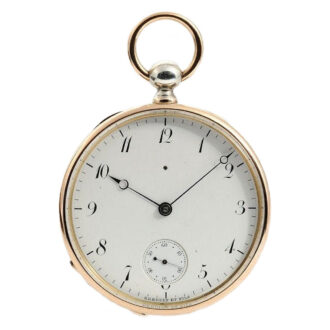
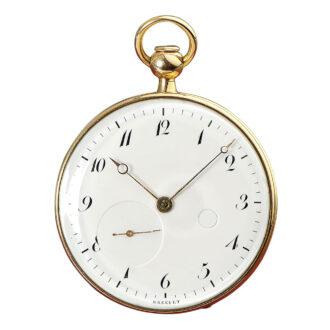
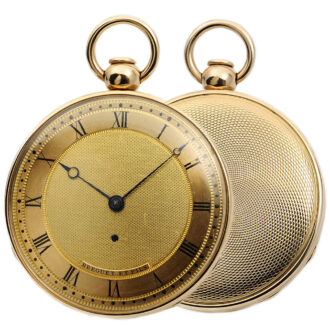
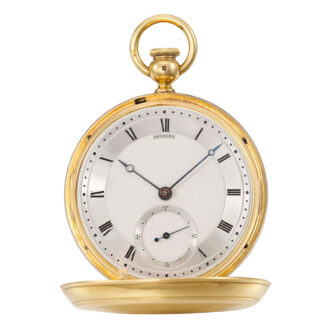
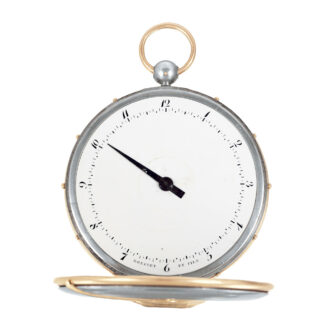
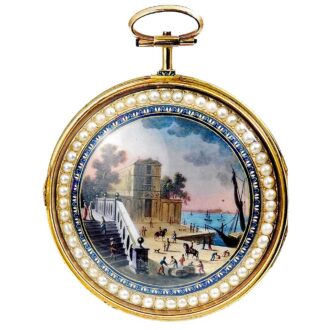
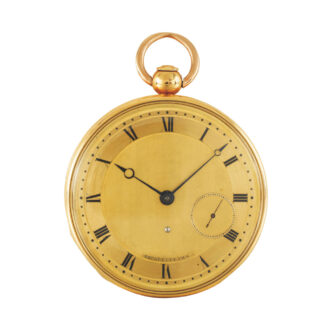
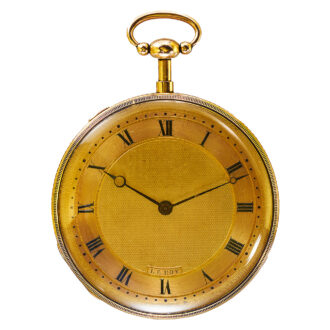
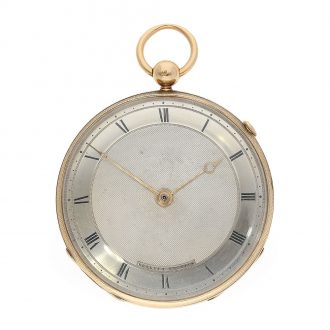
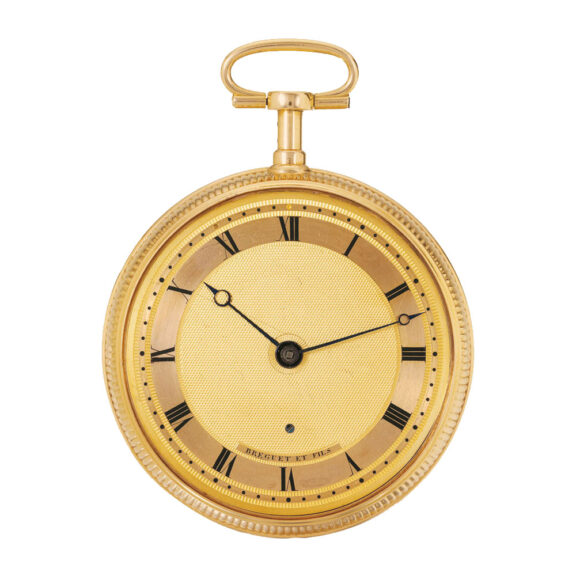
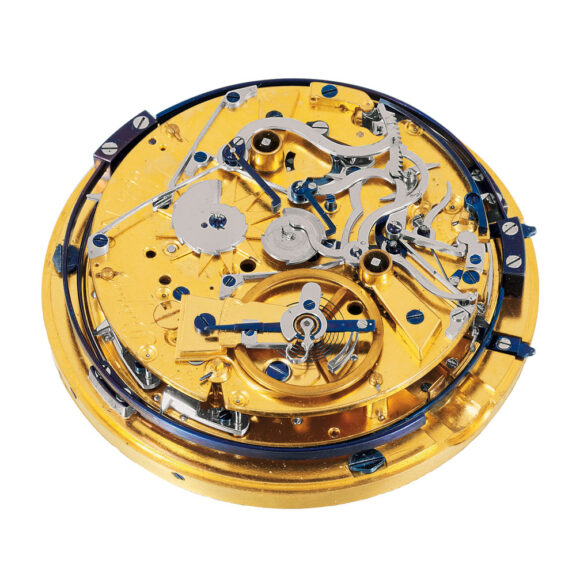
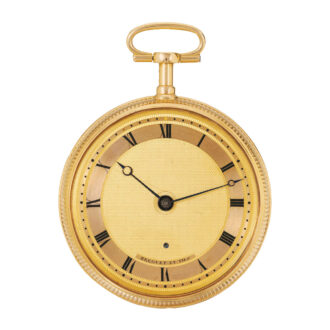
An extremely fine and important French 18K gold, grande and petite sonnerie striking, independent two-train clockwatch with minute repeating and ruby cylinder escapement, circa 1806. Sold to Monsieur Castaneda, le 1 Brumaire, for 3600 Francs with a discount of 400 Francs. A consular body by Tavernier (mastermark), engine-turned, reeded bezel and border, central rosette. Hinged gold cuvette with apertures for winding. Gold engine-turned dial, secret signature at each side of 12 o’clock, brushed chapter ring with radial Breguet numerals, outer minute track with dot markers, secured by a screw above 6 o’clock, strike/silent, hours and quarters/quarters only selection levers in the dial plate. Blued steel Breguet hands.
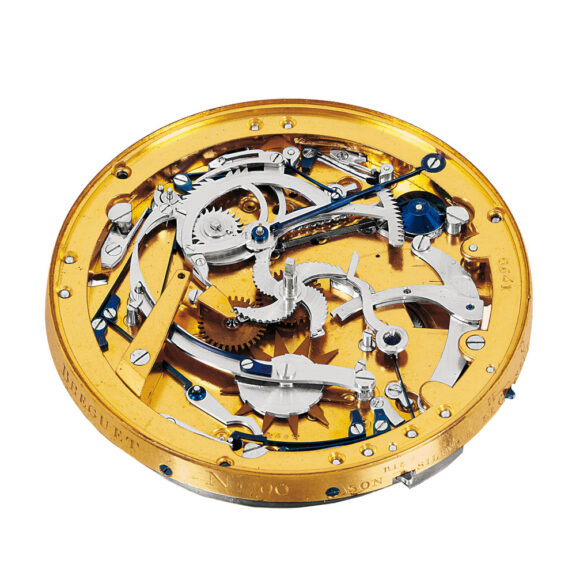
A gilt brass full plate movement, two barrels for going and striking trains, ruby cylinder escapement, plain three-arm gold balance with pare-chute on the upper pivot, blued steel flat balance sping, index regulator with bimetallic temperature compensation curb, all-or-nothing repetition system repeating on two large gongs activated by depressing the pendant, independent striking train set on the back plate. Dial, dial plate, cuvette and movement signed.
–
Diameter: 59 mm
–
Signed: Breguet Paris
–
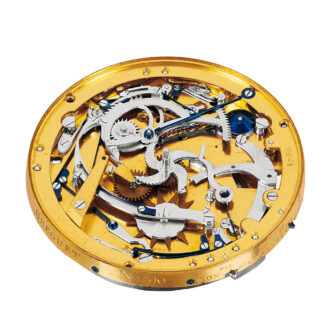
It is interesting to note that this watch was sold for 3,600 francs, more than twice the price of a simple tourbillon watch at the time (1,800 francs), or four times the price of a gold souscription watch (800 francs). This high price reflects the fact that it was a watch of great value, and very difficult to construct. and very difficult to construct. For example, if we refer to the Breguet archives, the prices of tourbillon watches ranged from 600 francs, sold in 1836 to 4640 francs, sold in 1822. The repetition system in this early 19th century watch could be a prototype of the modern minute-repeating system, with the exception of the movable star. It employs a very long all-or-nothing lever (prevailing from striking when the piston is not pushed to the very end, and thus assuring that the repeating always corresponds to the correct hour). The long lever allows for just a slight movement of the star. The independent striking train is elegantly set on the back plate, allowing the owner the pleasure of observing the striking mechanism in action. The necessity of an independent train was due to the fact that the system based on a single train both for striking and repeating, disengaging one when the other was in operation, had not yet been invented. It was almost a half century before Henri Golay invented a mechanism allowing these two functions to be set in a single train in 1859. However, just before his death, Breguet was working on a new striking mechanism. If he had had enough time, he would no doubt have improved it to the point at which it would also encompass the repeater mechanism, in the same manner as he had improved the minute-repeating system, as exemplified by this watch. Mr. Castaneda The name of Castaneda comes up in Abraham-Louis Breguet’s correspondence and appears frequently among the buyers in Breguet’s sales ledgers. As is explained by Emmanuel Breguet in his book, “Breguet Horloger depuis 1775”, Mr. Castaneda was one of the couriers. These were specialized companies handling commercial transactions as well as the transport of merchandise, in this case between France and Spain. Mr. Castaneda must therefore have been a Spanish businessman who traveled regularly to France, liaising with important Spanish clients, and particularly the Spanish royal court.
Signed: Breguet Paris
Share this page: