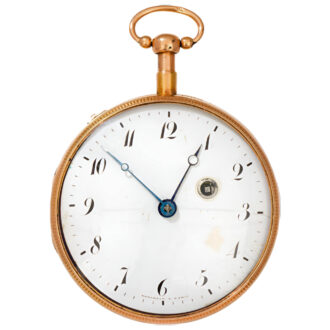
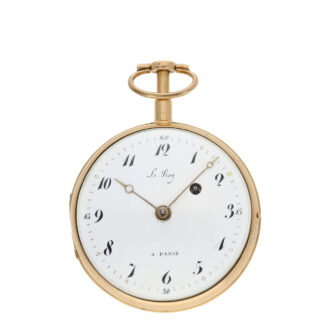
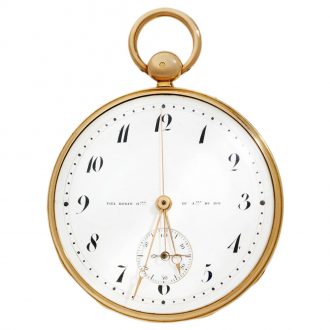
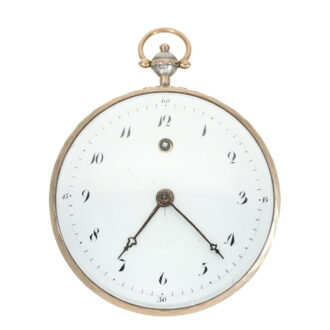
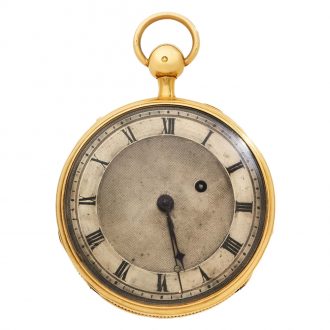
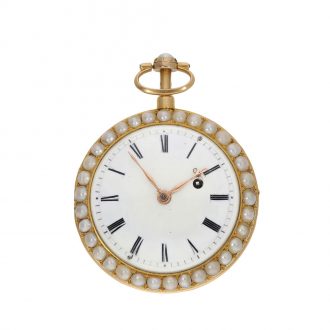
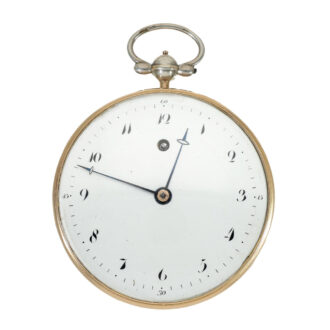
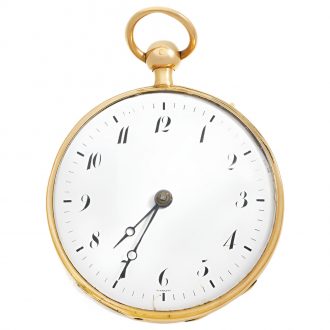
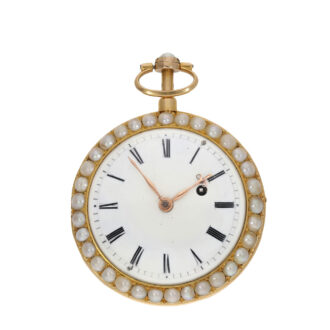
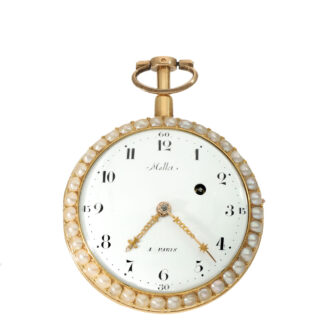
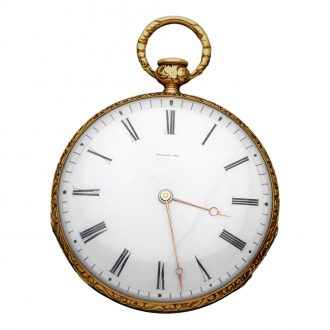
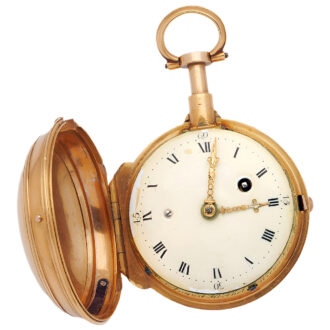
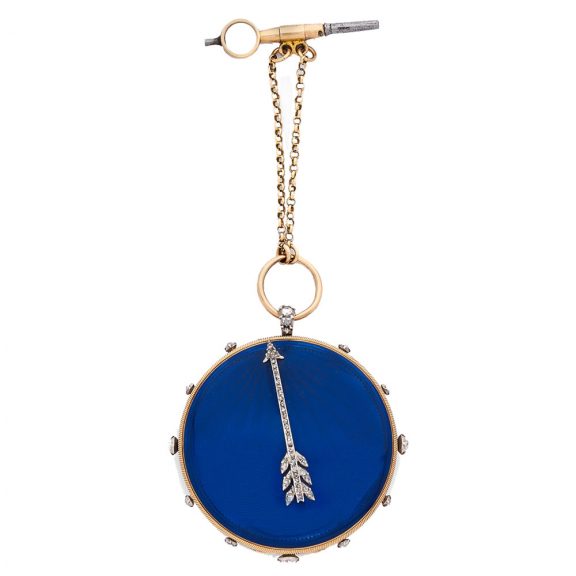
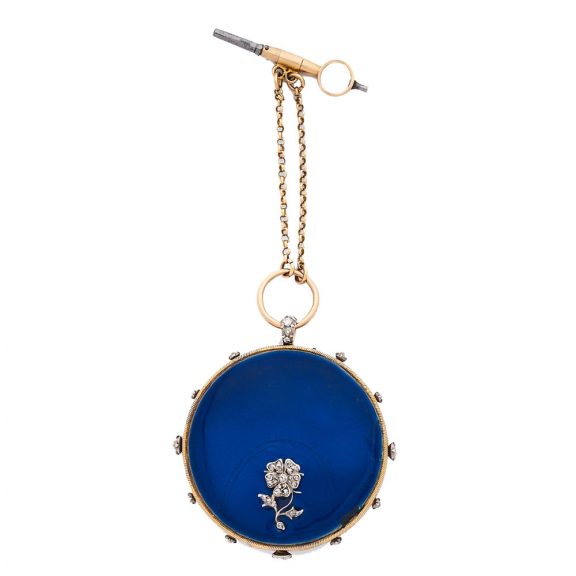
French gold médaillon montre à tact cylinder watch Circa 1800
- Kenmerk
- FF0046
- Diameter
- 40 mm
- Estimate
- € 40.000 - 75.000
- Price sold
- € 51.850
Attractive rose gold, enamel and diamond set watch by Breguet
–
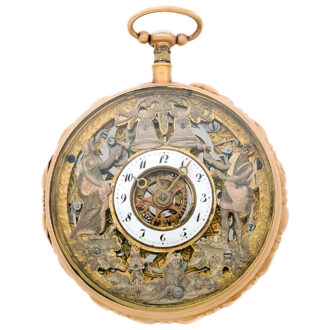
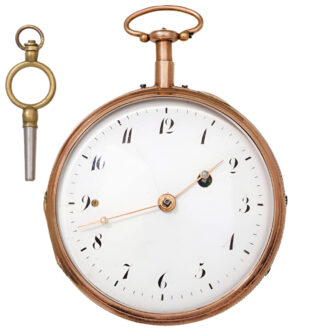
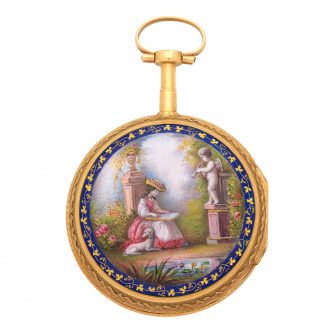
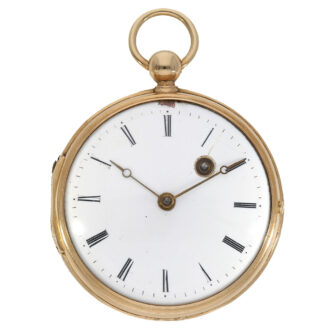
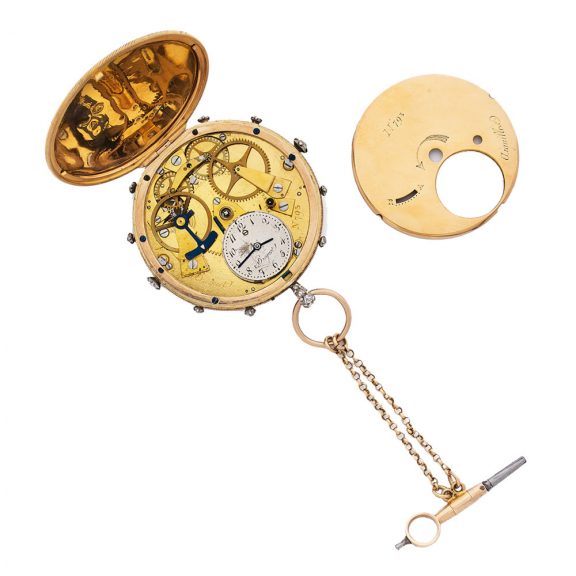
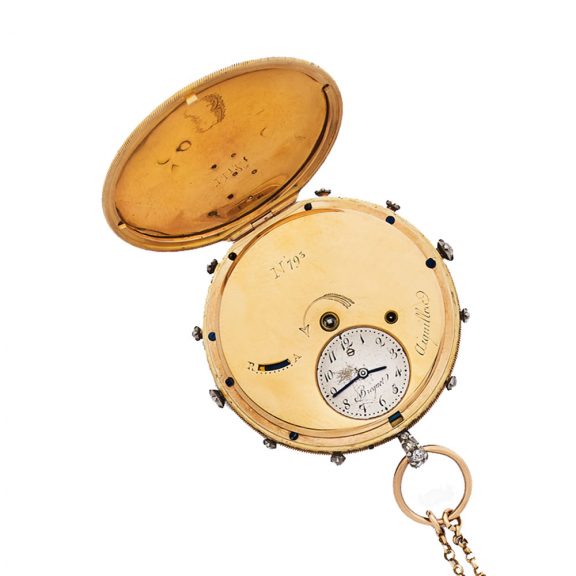
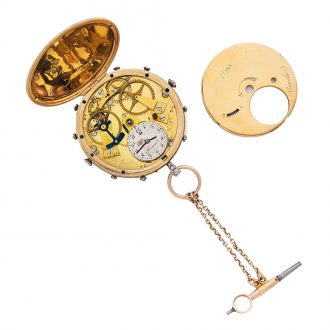
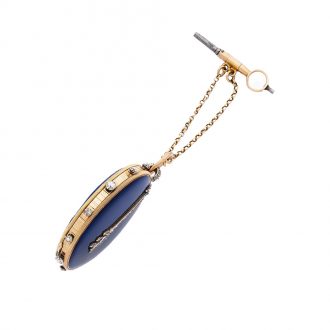
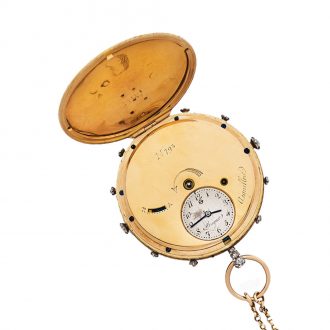
A very fine French 18 carat gold and royal blue translucent enamel hunting cased pocket watch so called Montre à Tact diamond set and accompanied by a double chain and its key, sold on October 1, 1800 to Mr Busty for 1,500 Francs, circa 1800. Gilt movement with key winding, subscription calibre with gold finish, ruby cylinder with central barrel, simple three-arm balance in brass, flat hairspring in blued steel, advance and delay adjustment index in blued steel, signature on the plate Breguet No. 793.
–
Off centre dial for indicating hours and minutes on a silver background with Arabic numerals, all the gears and mechanism visible, the cover has a small opening to reveal only the dial, a signed gold protective bowl protects the whole, it bears the number of the watch as well as the winding square and opening for advance / delay.
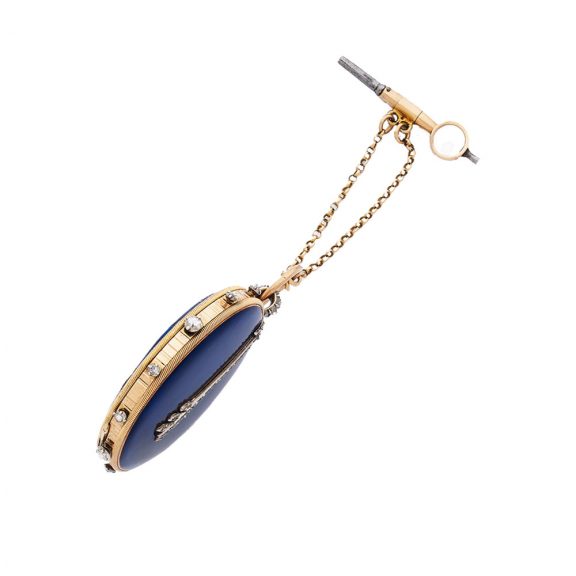
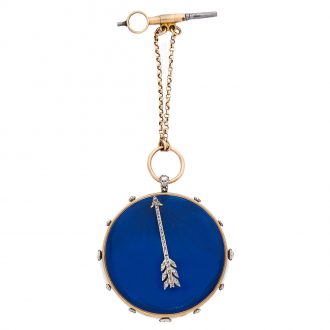
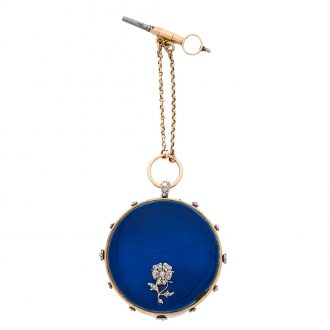
Gold hunter case with translucent blue enamel on the front and back, on the front a flower set with diamonds and on the back an arrow hand set with diamonds for the tactile function for reading the hours using the diamonds on the case band, push button for secret opening on the case band.
–
Diameter: 40 mm
–
Weight: 54.1 g
–
Signed: Breguet
–
“The tact watch” by Breguet
“The tact watch” was invented by Abraham Louis Breguet in the late 1790s at a time when it was considered improper to read the time in public. The “tact” system could help to read the time while being in society without taking the watch out of one’s pocket and perhaps offending one’s host or neighbour during the highly popular private salons of the time.
As in this engraving of an evening at the Princess of Salm’s in 1806, which features very prestigious guests, including Abraham-Louis Breguet, considered one of the most prominent personalities of his time, well beyond the circle of watchmakers.
Breguet tact watches are classified under different categories, from small to medium and finally large. Of all the tact watches made by Breguet, the “small” category to which our watch belongs is undoubtedly the most sought after. The most famous of all the small-sized tact watches with royal blue translucent enamel is the one made by Breguet for Madame Bonaparte under the number 611, described as Petite montre médaillon à tact and acquired on February 18, 1800 by the famous Joséphine de Beauharnais, future Empress of the French from 1804 to 1809.
This tact watch sold on October 1, 1800 to Mr. Busty, is one of the first examples of a “tact watch”, the same year as the one sold to Joséphine de Beauharnais, on 29 Pluviose An 8 (February 18, 1800). It is estimated that about thirty-five tact watches like ours are known to date. These exclusive watches were quite expensive, their price being between 1000 and 2000 francs of the time.
Abraham-Louis Breguet (1747–1823)
This watchmaker is considered the father of modern watchmaking, is a Swiss watchmaker who revolutionized the art and science of time measurement. His life and work are marked by technical inventions, a timeless aesthetic style and a lasting influence on the watchmaking industry.
Born in Neuchâtel on January 10, 1747 and died in Paris on September 17, 1823, this watchmaker was at the origin of an unprecedented watchmaking revolution with all his inventions and innovations that built the legend of the Breguet house, which will celebrate its 250th anniversary next year.
–
The important achievements that marked the beginnings of the Breguet house:
–
1775 Abraham-Louis Breguet sets up his own business on the Quai de l’Horloge on the Île de la Cité in Paris.
1780 Development of the perpetual watch, designating self-winding watches with an oscillating weight, the first great success of Breguet’s career.
1783 Creation of the “apple” hands, to which he will give his name and which are today called “Breguet-style hands”.
1786 Interest in guilloché for its aesthetics and its functional character of protection, readability of the dial and delimitation of the different reading zones.
1790 Invention of the pare-chute, a system of protection against shocks, the ancestor of the anti-shock system that we know today on all watches with manual or automatic winding.
Signed: Breguet
Share this page: