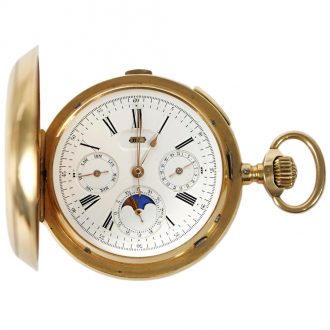
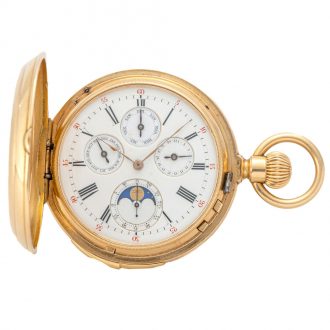
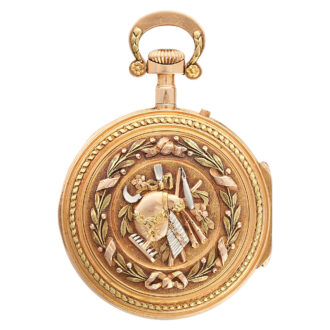
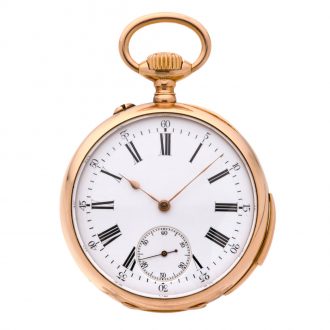
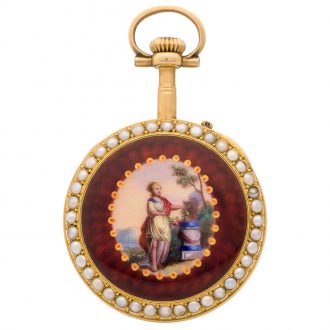
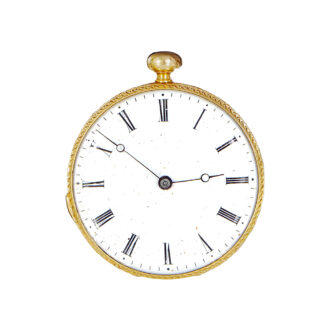
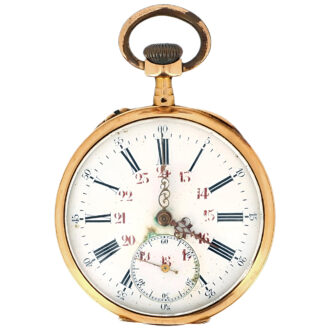
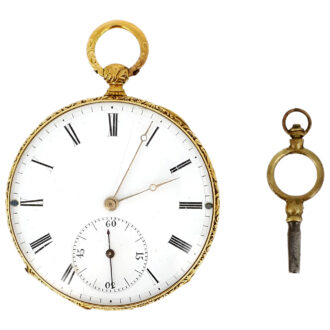
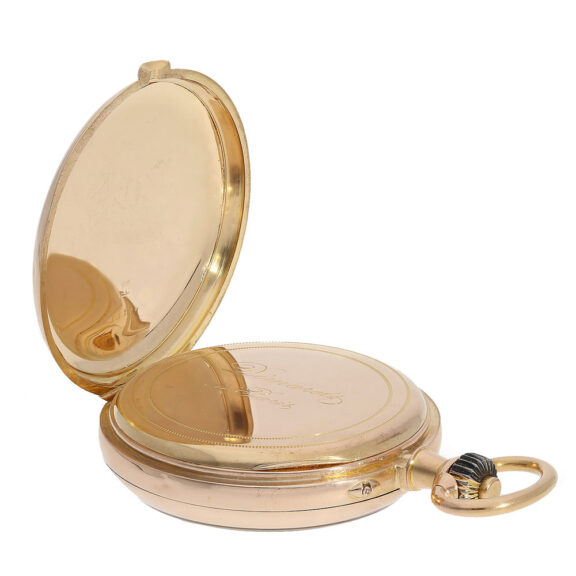
French seconde morte pocket watch with chronograph Circa 1890
- Kenmerk
- HC0480
- Diameter
- 50 mm
- Estimate
- € 3.000 - 4.500
- Price sold
- € 2.800
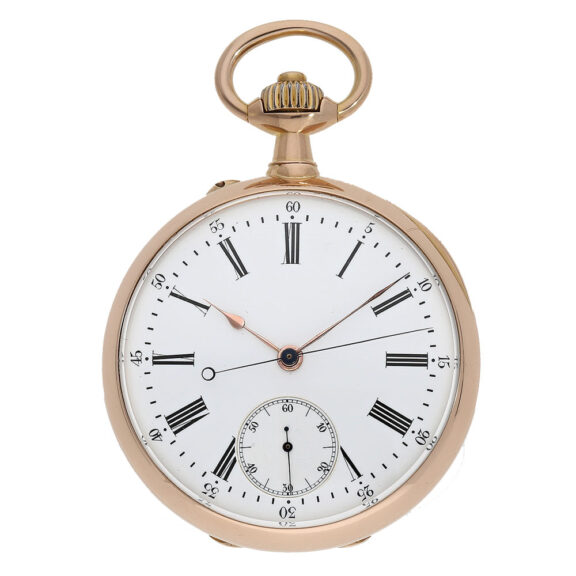
Seconde morte in top quality 18 carat gold pocket watch
–
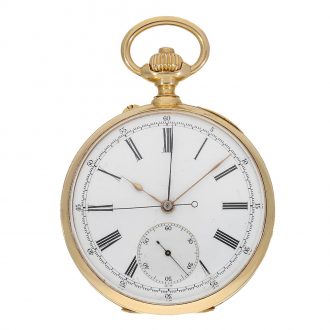
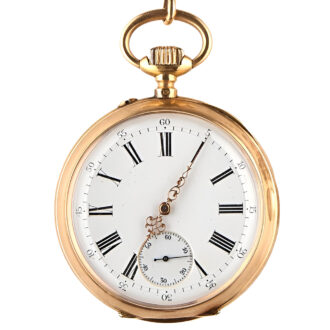
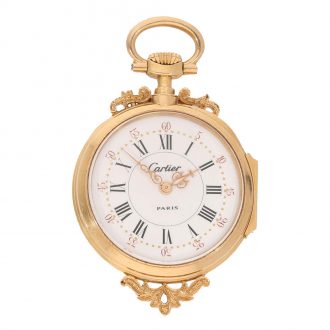
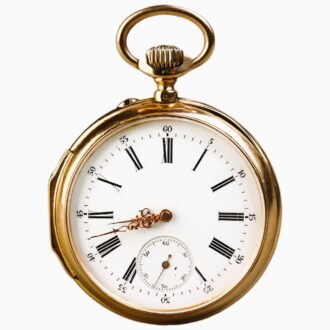
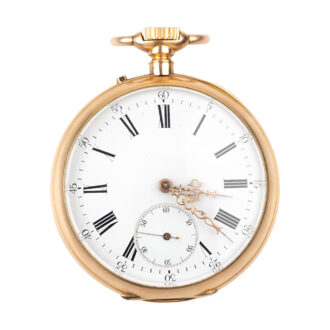
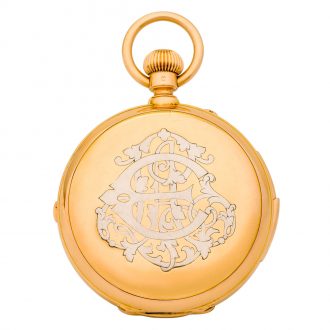
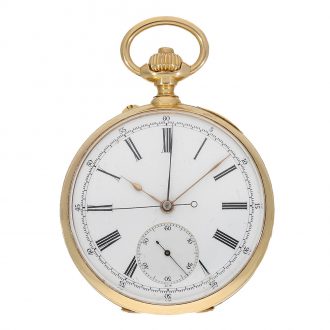
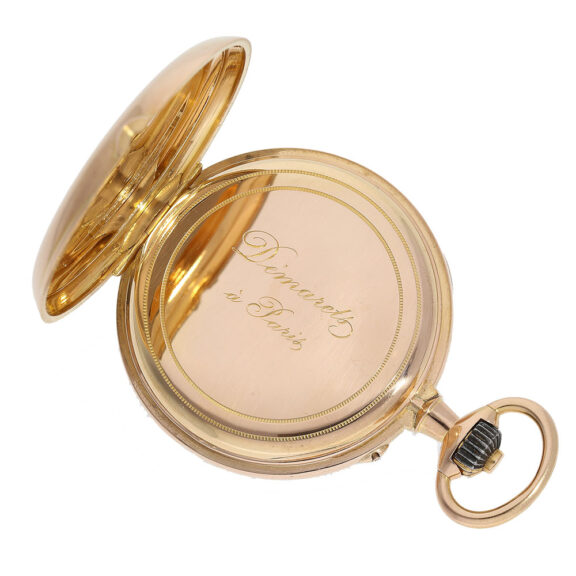
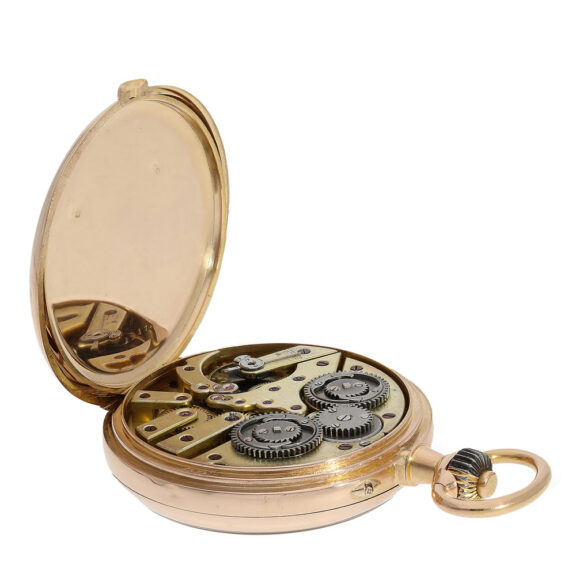
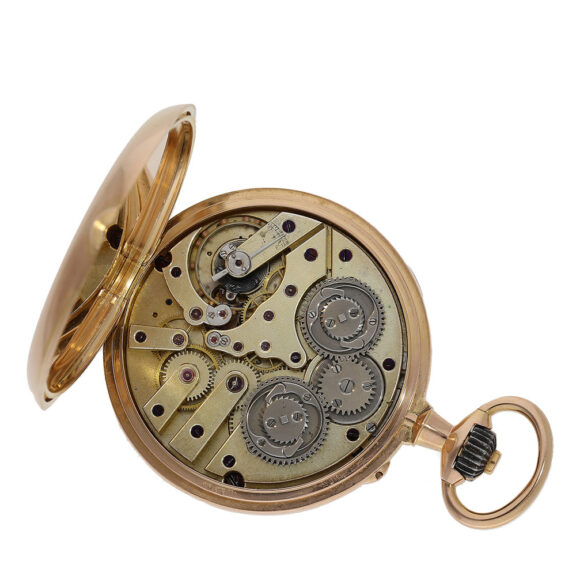
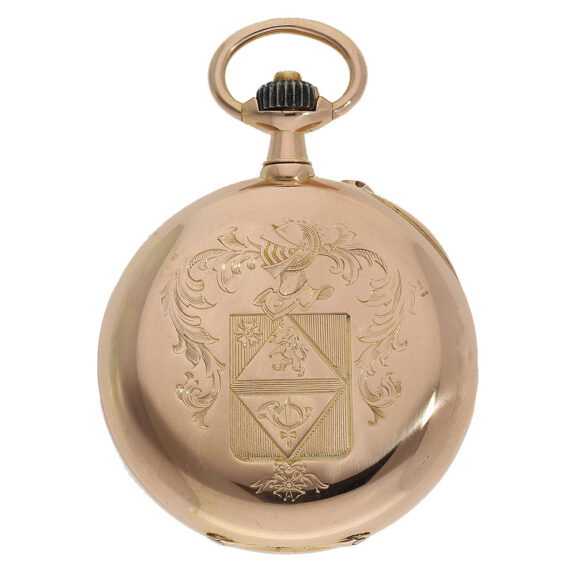
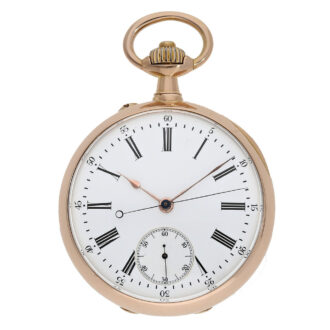
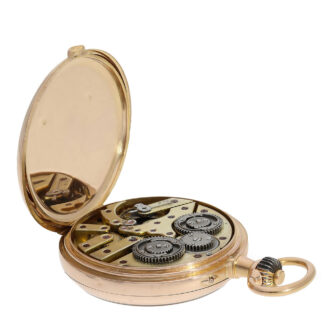
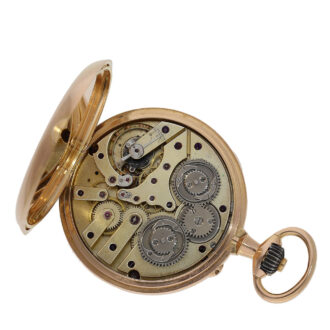
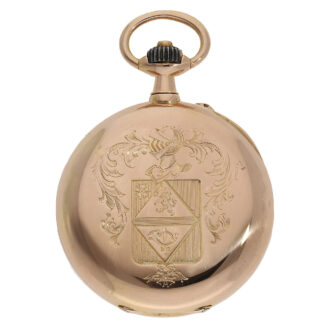
A very fine French 18 carat red gold open faced cylinder pocket watch in top quality with chronograph and seconde morte, circa 1890. The former property of an aristocrat. The à goutte (water drop-shaped) case features a noble coat of arms on the back. The perfectly preserved white enamel dial with Roman numerals for the hours, an outer ring with Arabic numerals for the minutes, a subsidiary dial for the seconds and red gold hands. The movement has a very rare escapement, chronograph and winding according to Mairet. This means that the watch not only tells time but also has a chronograph function, allowing the user to measure elapsed time with precision. Such a feature was highly sought after in the late 19th century and it speaks to the ingenuity and technical prowess of Démarets.
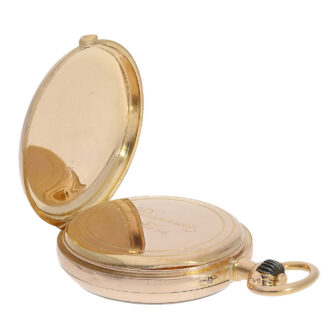
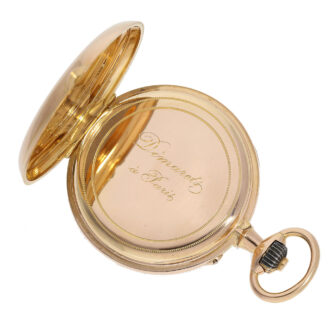
The dust cover of the watch is signed.
–
Diameter: 50 mm
–
Weight: 105 g
–
Signed: Démarets à Paris
–
Sylvain Mairet grew up with his uncle. F.I. Favre-Bulle was a renowned watchmaker of his period. Mairet was to become one of the best watchmakers in Le Locle. He lived in London from 1831 until 1834 where he struck up a friendship with J.F. Cole and mostly worked for B.L. Vulliamy. He often created the watches to his own design and invented a keyless winding system for watches with two train movements. Sylvain Mairet was the official Swiss agent to the London Universal Exhibition in 1862 and wrote the official report. He received a gold medal at the 1867 Paris Exhibition, as a testimony to his ability and the beneficial influence which he had exerted on the progress of watchmaking in the Canton of Neuchâtel.
–
The seconde morte, also known as dead-beat seconds, is a complication of a mechanical movement in which the second hand moves every second. This is in contrast to the usual ‘running’ of the second hand. This complication is rare and was seen in the years before the quartz revolution, the 1970s and 1980s, but actually died a silent death because of the same quartz revolution. The reason for this was that the second hand moves per second in almost the same way as quartz watches, which ultimately also use a frequency of 1Hz. With that, the ‘running’ second hand became the distinction between mechanical watches and quartz watches. Incidentally, that external similarity only applies to the second hand jumping per second, the underlying mechanism of the dead seconds complication is of course of a completely different order.
Signed: Démarets, à Paris
Share this page: