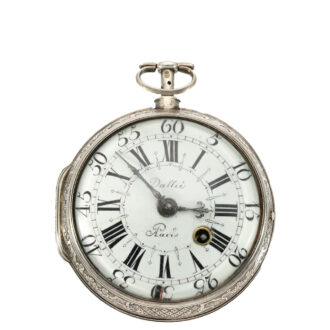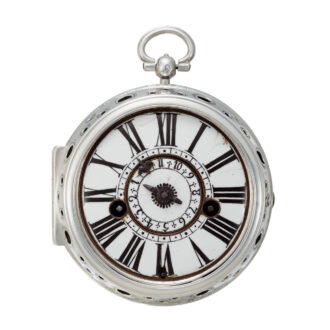
French silver exceptional oignon pocket watch Circa 1688
- Kenmerk
- HC2262
- Diameter
- 60 mm
- Estimate
- € 2.250 - 4.500
- Price sold
- € 2.500
Exceptionally large watch with cartouche dial
–
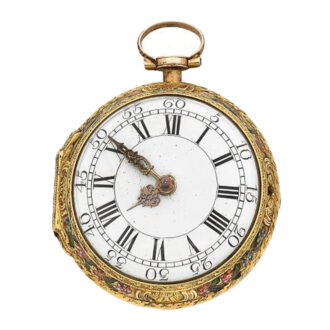
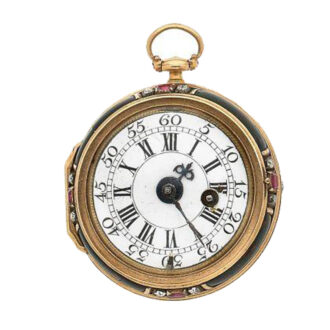
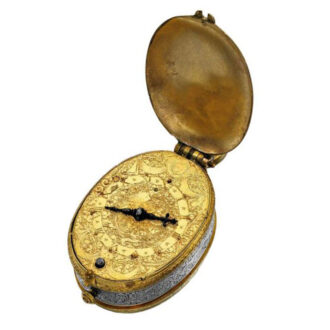
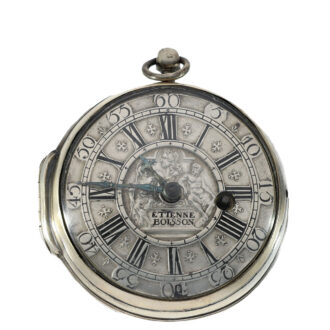
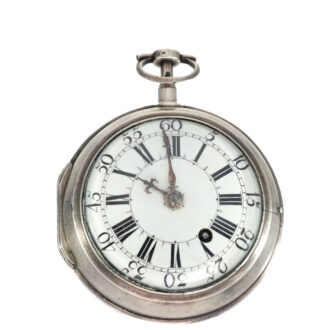
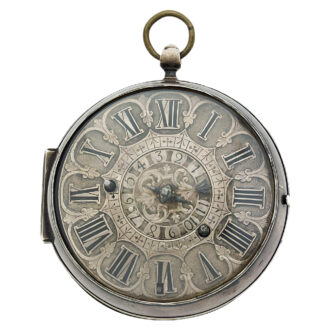
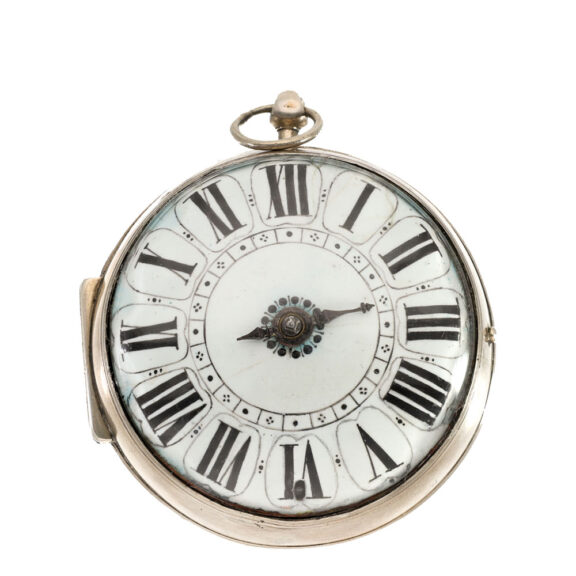
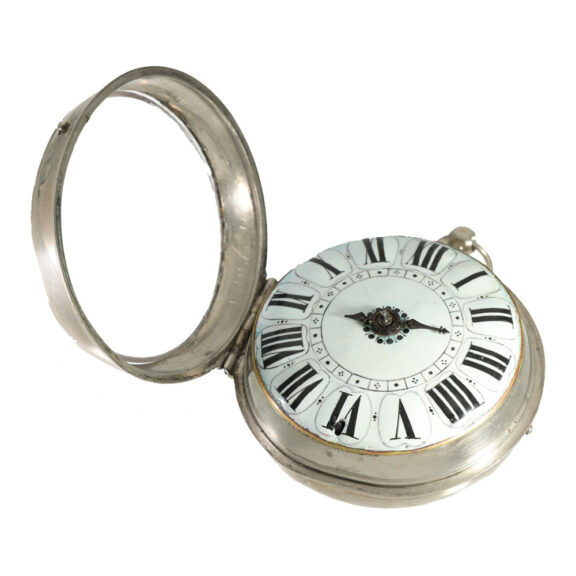
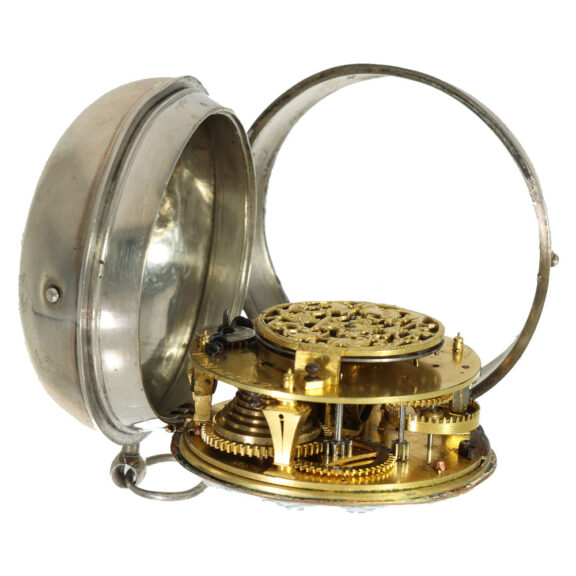
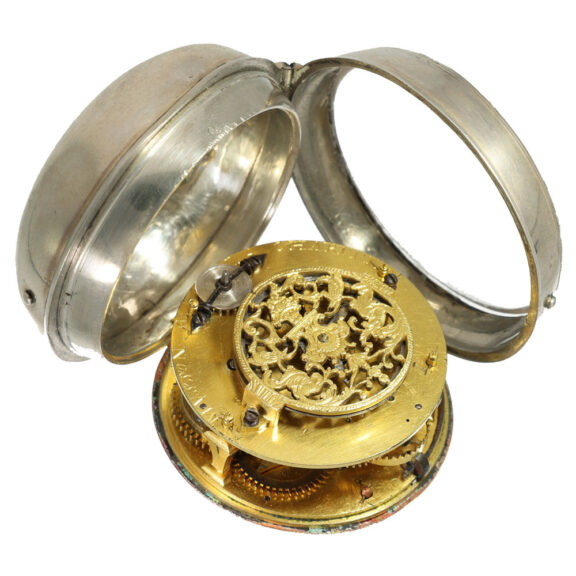
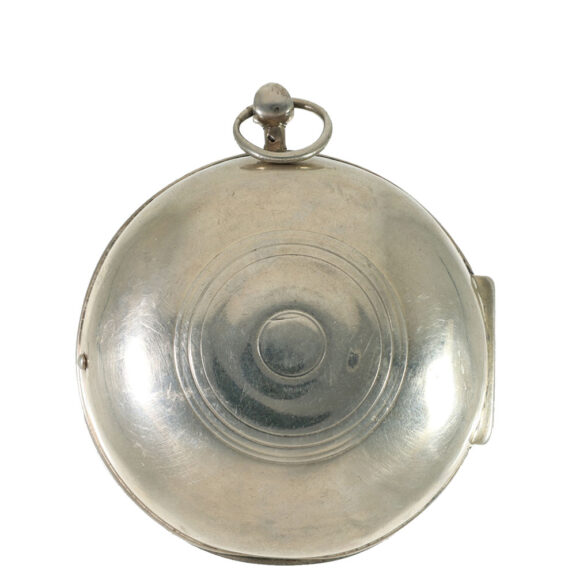
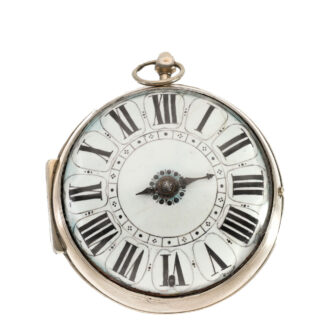
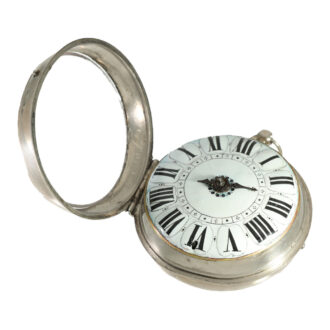
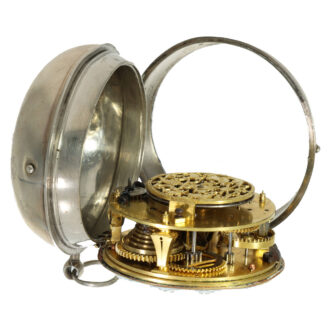
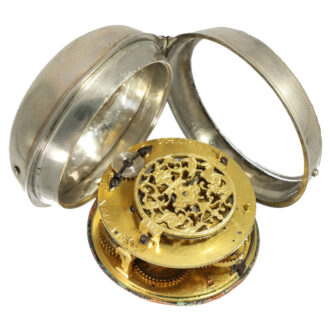
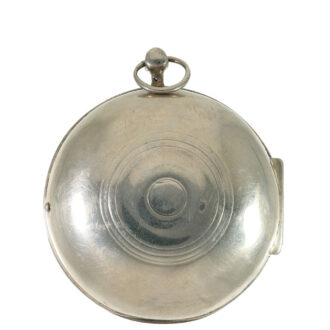
An exceptionally large oignon pocket watch made by Pierre Musson (the elder) in La Charité-sur-Loire, France, circa 1688. The heavy plain case of this “oignon” pocket watch was crafted from silver and its lid features a smooth, unadorned surface detailed only with concentric circular concentric rings around its center. The white enamel dial features raised radial Roman numeral cartouches and an inner quarter-hour track, paired with a single, highly stylized tulip-shaped hand made from blued steel. The fire gilt full plate movement features an intricate, pierced symmetrical balance cock paired with a traditional verge escapement.
The movement is signed.
–
Diameter: 60 mm
–
Weight: 162 g
–
Signed: Musson à La Charité
–
Musson dynasty
The history of the Musson workshop is tied to a multi-generational French horological dynasty that operated from 1625 to 1830, spanning across Orléans, Paris, and La Charité-sur-Loire. The lineage of the Musson family’s horological activities follows a structured progression across generations, shifting geographically to align with France’s primary trade centers:
1. The Early Pioneers (Orléans)
The foundational era of the lineage began in Orléans around the mid 17th century.
– Pierre Musson (1631–1709): One of the earliest documented master
clockmakers of the family. His work established the Musson name
within the local French guild system, focusing on early clock mechanics
and heavy, decorative timepieces during the height of Louis XIV’s reign.
2. The Mid Dynasty Node (La Charité-sur-Loire)
By the late 17th and early 18th centuries, branches of the family had moved toward La Charité-sur-Loire, creating a critical manufacturing base.
– Salomon Musson: He operated an active hub in La Charité. Rather
than remaining isolated, this branch served as a foundational
springboard for training the next generation of master watchmakers
who would eventually migrate back to France’s largest cities.
– Pierre Musson II: Born in La Charité (baptised at the parish of
St. Jacques), he learned the trade through the family pipeline before
moving his primary practice to Orléans. He married into an apothecary
family in 1732, expanding the workshop’s local prominence.
3. Expansion and Metropolitan Dominance (Paris & Geneva)
By the mid to late 18th century, the lineage split into highly strategic directions to capture Europe’s luxury watch markets:
– Pierre François Musson: Son of Pierre II, he took the family craft to
the ultimate stage by becoming a master watchmaker in Paris.
Operating in Paris allowed the workshop to transition from making
bulky “oignon” watches to producing high end complications, such as
specialised pocket watches featuring quarter hour chimes.
– François Musson: Another son of the lineage who ventured outward
to become a watchmaker in Geneva, Switzerland, connecting the
French workshop network directly to the booming Swiss horological
trade.
4. The Final Era (Late 18th to 1830)
– Pierre-Marc Musson (1745–1825): Representing the final pinnacle
of the family’s traditional watchmaking legacy, his work transitioned
through the French Revolution and into the early 19th century.
Timepieces from his era moved entirely away from brass oignons into
elegant, slim silver and gold cased pocket watches.
The lineage officially concluded around 1830, leaving behind a documented 200-year chain of master-to-apprentice succession that carried the family name from provincial clockmaking to elite Parisian horology.
Signed: Musson à La Charite
Share this page: