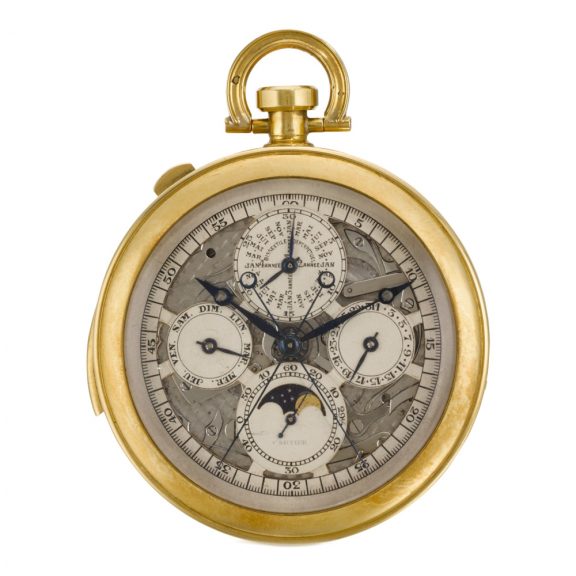
French/Swiss repeating perpetual calendar chronograph Circa 1931
- Kenmerk
- AS1753
- Diameter
- 50 mm
- Estimate
- € 50.000 - 120.000
- Price sold
- € 199.200
Gold calendar chronograph by Cartier and European Watch & Clock Co. Inc.
–
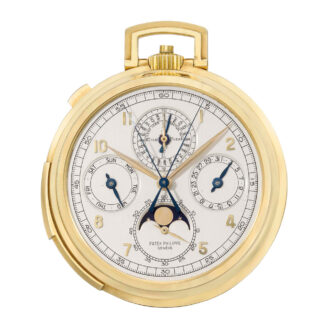
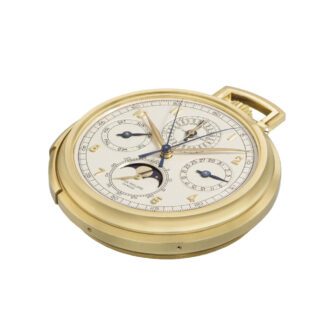
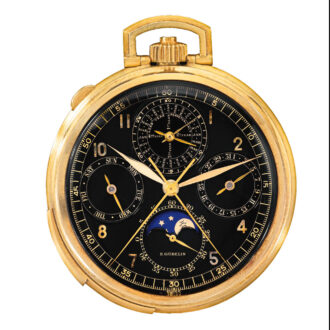
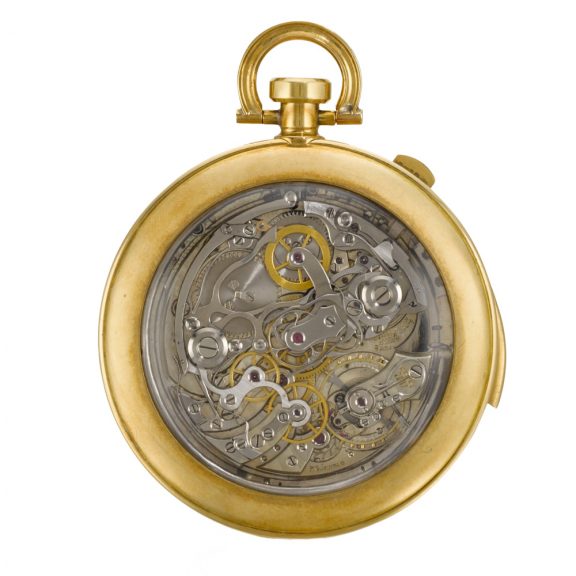
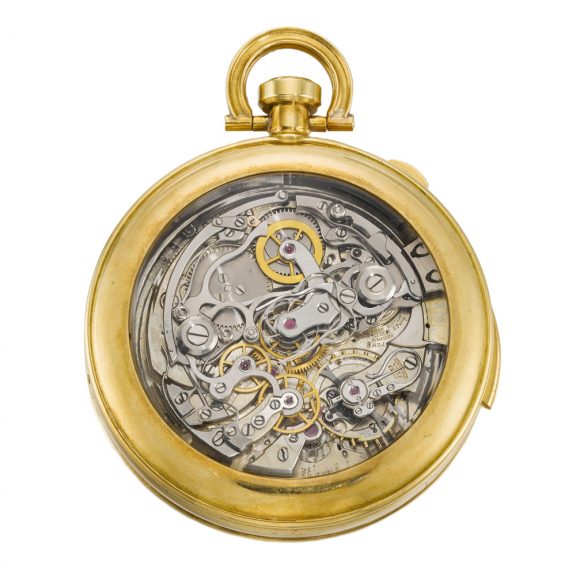
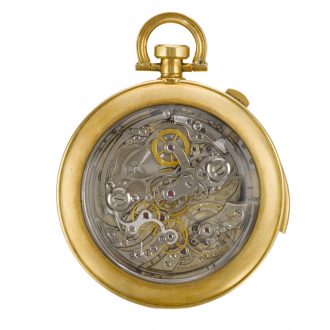
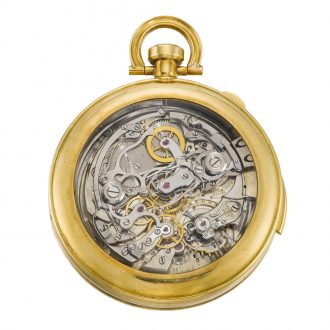
A superb and rare French/Swiss gold open faced skeletonized minute repeating perpetual calendar split-seconds chronograph watch with register, moon phases, and display back, circa 1931. The watch features a damascened movement with lever escapement, 36 jewels, a bimetallic compensation balance, swan-neck precision regulation, and a split chronograph mechanism partially visible on the backplate, repeating on coiled gongs, signed European Watch & Clock Co., Inc., Swiss. It also has a skeletonized silvered dial with subsidiary dials for day and date, month with leap year indication combined with a 30-minute register, subsidiary seconds combined with an aperture for moon phases, and French-calibrated days, months, and leap year. The outer track is for minutes/chronograph seconds, and all hands are blued steel. Signed Cartier.
–
The 18k gold case has polished rounded bezels and band, both sides glazed, a scooped bow, a sunken repeating slide and split pusher to the band, a chronograph pusher through the pendant, a scooped bow with French control marks, and hand-stamped numbers and French control marks on the underside of the front bezel and the case body’s inner bezel beneath.
–
Diameter: 50 mm
–
Signed: Cartier and European Watch & Clock Co., Inc.
–
This rare pocket watch features one of the most complex movements ever supplied by the European Watch & Clock Co. to Cartier. The ebauche is a LeCoultre calibre 17 JSMCCRVQ, first introduced by the watchmaker in 1928. The open-work dial and glazed case back allow for the exceptional finishing of the movement to be fully appreciated with its skeletonized design. Another example of this LeCoultre calibre can be found in F. Cologni’s book, “Jaeger-LeCoultre – The Story of the Grande Maison,” published by Flammarion in 2006, on pages 8 and 327. This latter watch is also signed to the backplate by the European Watch and Clock Co. and features a very similar open-work dial.
–
The watch movement is functioning properly, repeating and striking all other times without issue. The chronograph and split functions are activating and resetting as expected, with the chronograph minute register advancing. The winding and hand setting are smooth. However, the calendar functions may need adjustment as they are not registering the correct lengths of months at present.
The dial has some tarnishing and a few light scuffs and scratches, with the signature appearing faded. The case also has light scuffs and scratches, but the control marks and hand-stamped numbers remain clear. In addition to the French eagle’s head mark, there is another stamp on the opposite side of the bow that is difficult to read, although it is well-stamped and not rubbed.
–
The European Watch and Clock Co. Inc. was established in the 1920s as a collaboration between Cartier and Edmond Jaeger of the LeCoultre & Cie watch factory. Cartier worked with various watch movement manufacturers, including Vacheron Constantin, Audemars Piguet, and Movado, but many of their top products featured movements from the European Watch & Clock Company, which were manufactured at Jaeger-LeCoultre’s Le Sentier factory in Switzerland. The watch cases were made in Paris, Geneva, London, and New York, with each branch responsible for its production. However, the French branch also exported its watches to other stores. In 1930, Jaeger partnered with Jacques-David LeCoultre to form Jaeger-LeCoultre. In the 1920s, Henri Rodanet, the technical director of the Etablissements Ed. Jaeger, developed the Calibre Duoplan, one of the smallest movements with high accuracy.
Signed: Cartier and European Watch & Clock Co. Inc.
Share this page: