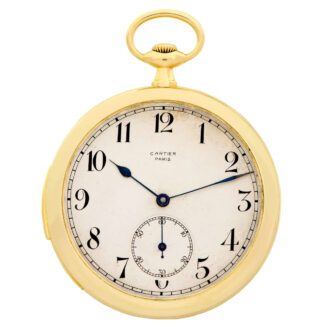
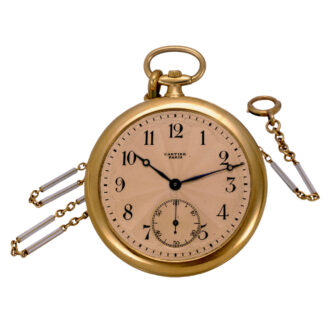
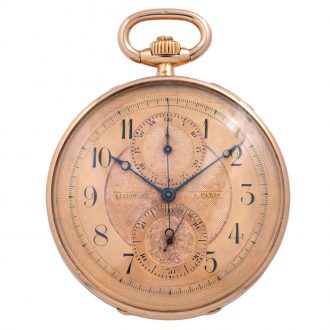
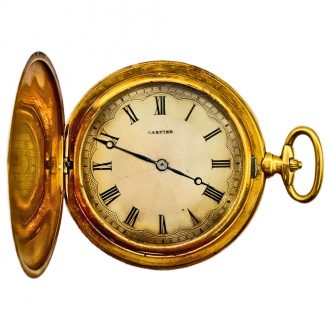
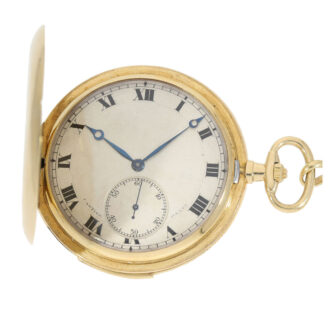
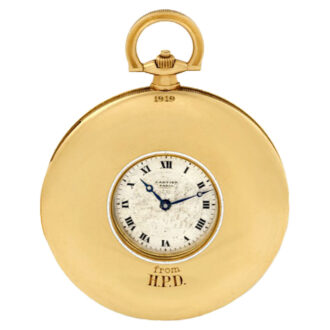
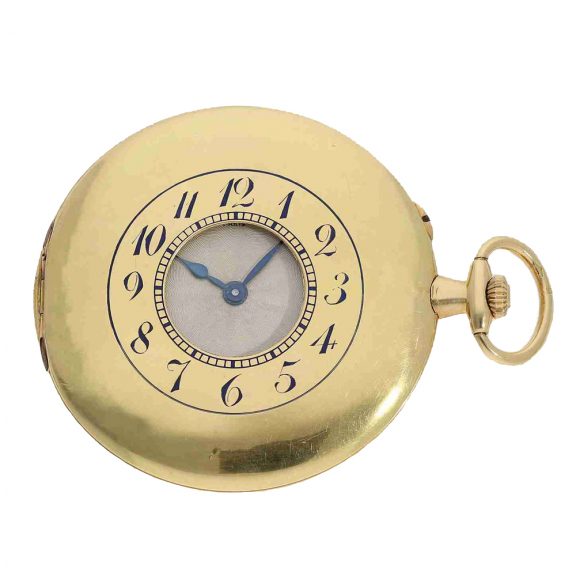
French gold ultra thin half hunting cased watch Circa 1915
- Kenmerk
- HC0526
- Diameter
- 50 mm
- Estimate
- € 3.250 - 6.000
- Price sold
- € 3.550
Gold knife edged pocket watch
–
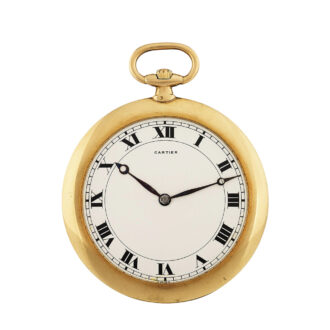
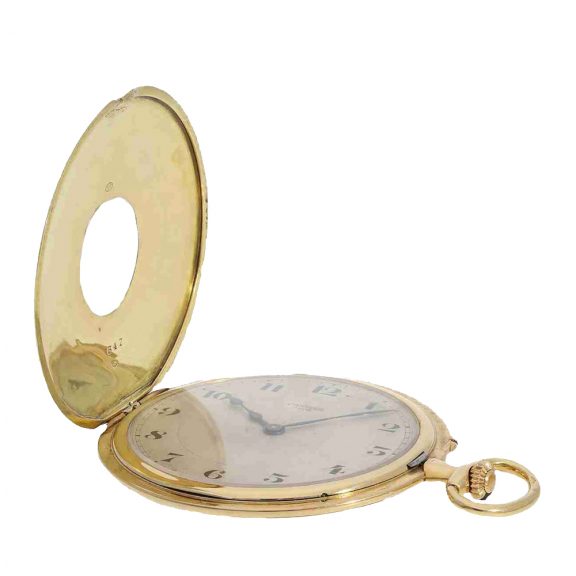
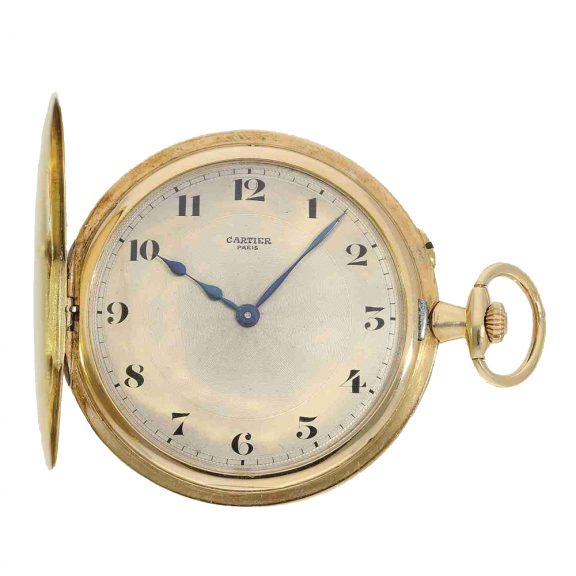
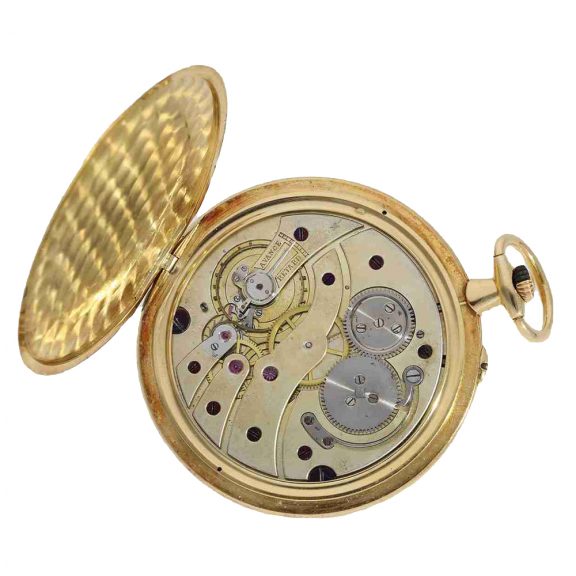
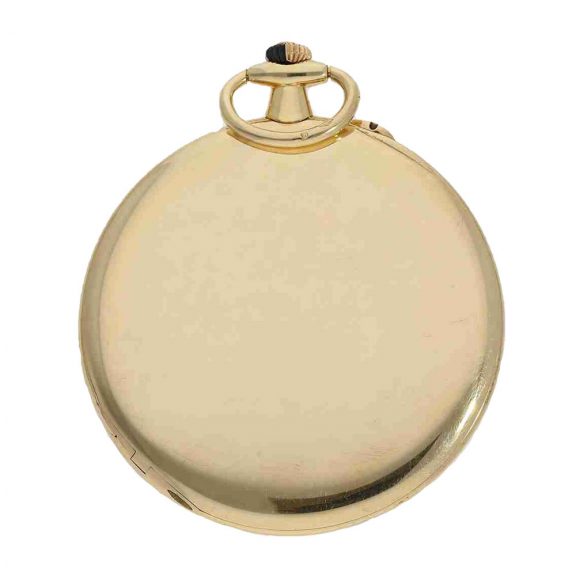
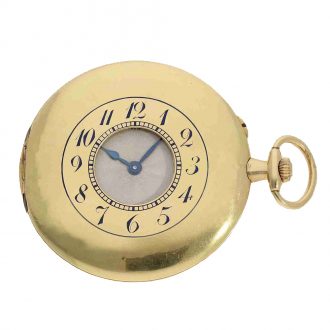
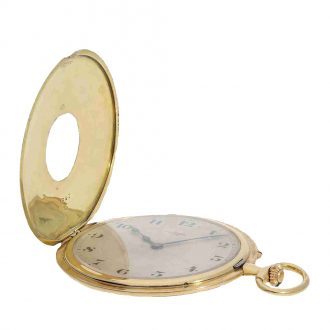
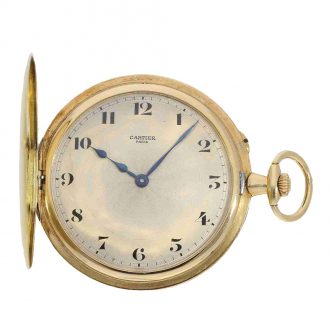
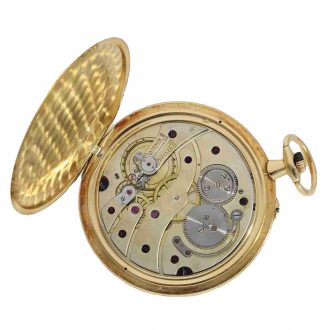
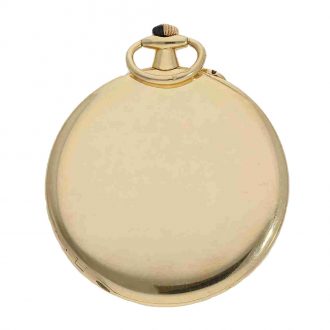
An ultra thin half hunting cased knife edged (montre couteau) pocket watch made by Cartier in Paris, France, circa 1915. Crafted from 18 carat gold, the plain case boasts an astonishingly slim profile, measuring a mere 5.5 mm in thickness. The case is ingeniously designed with an integrated hinge, allowing for easy access to the dial while protecting the delicate mechanism within. Imprinted with the number 23647 and the distinguished CP hallmark for Cartier Paris, this timepiece exemplifies the craftsmanship for which the company is renowned. The dial features an intricate engine turned design, Arabic hour numerals, an outer minute track and original, typical blued steel half hunter hands. At the heart of this remarkable pocket watch lies a movement that showcases Cartier’s commitment to precision. Equipped with an ultra flat precision lever escapement, the movement ensures accurate timekeeping and reliable performance.
Case, dial and movement are all signed.
–
Diameter: 50 mm
–
Weight: 55 g
–
Signed: Cartier Paris
–
The goal was to produce an ultra thin pocket watch, which corresponded to the taste of the time. Therefore, almost all montre couteau were made as open faced dress watches and had a thickness of about 4 mm. Only a few pieces are known today as a half hunting cased pocket watch.
–
Couteau is the term used by Cartier in their manufacturing records to describe the type of ultra thin watches with knife edged cases, open faced or hunting cased models. These watches, with thicknesses of less than 4 mm for the open faced and less than 5 mm for the hunting cased version, are among the thinnest mechanical watches ever produced.
–
For these thin watches from the first half of the 20th century, Cartier used movements from Edmund Jaeger (Jaeger-LeCoultre), who had just invented a movement only 2 mm thick. In the 1920s, Cartier and Jaeger formed a joint venture, the European Watch & Clock Co., whose signature can be found on many Cartier movements. Movements were further sourced from Vacheron & Constantin, who, from 1940, utilized a movement which was only 1.31 mm thick.
Signed: Cartier Paris
Share this page: