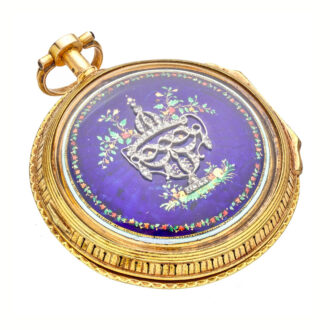
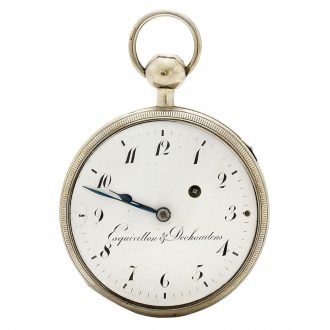
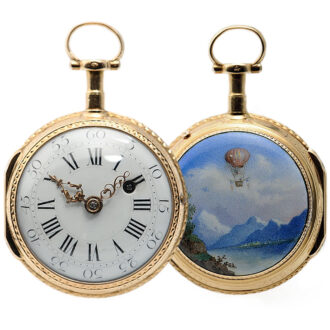
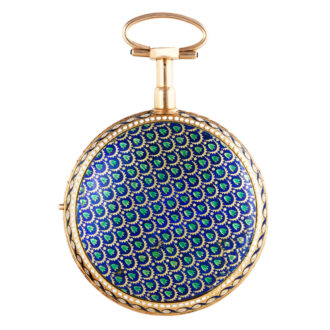
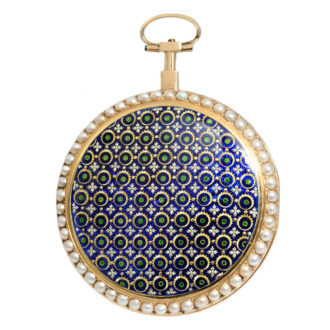
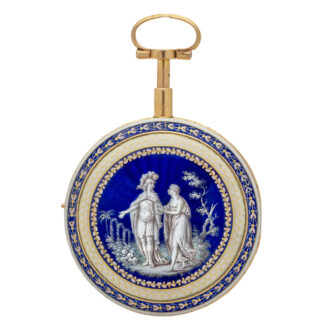
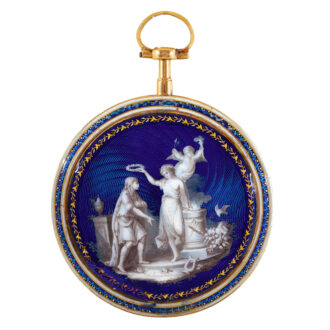
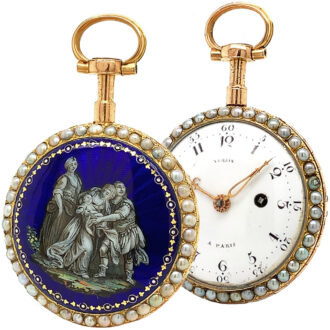
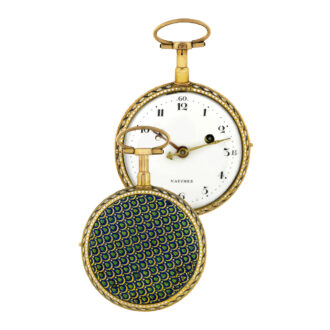
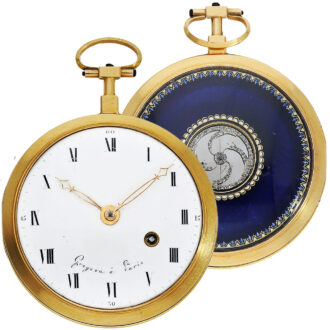
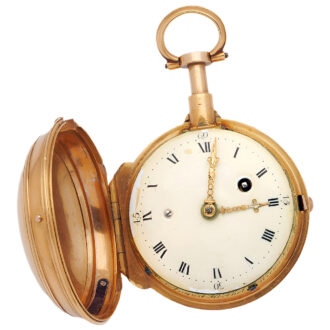
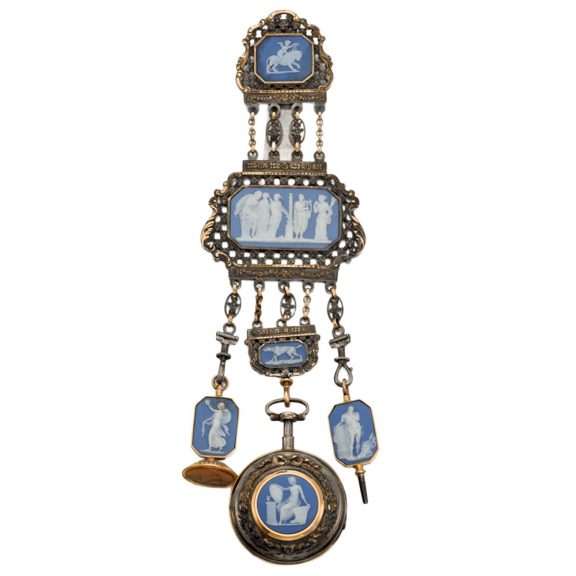
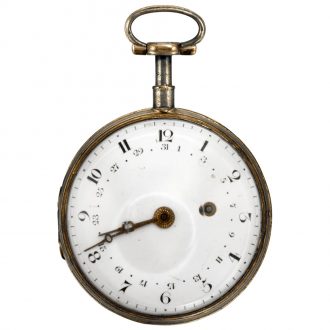
French verge watch with Jasperware mounted chatelaine Circa 1785
- Kenmerk
- AS2166
- Diameter
- 40 mm
- Estimate
- € 3.000 - 6.000
- Price sold
- € 5.500
Silver and gold verge watch by Andrè Hessen
–
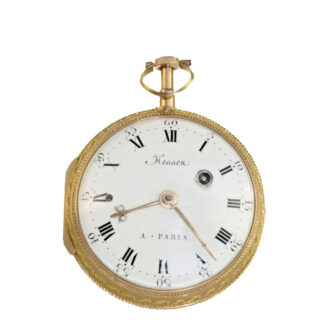
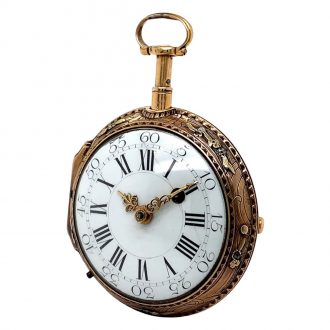
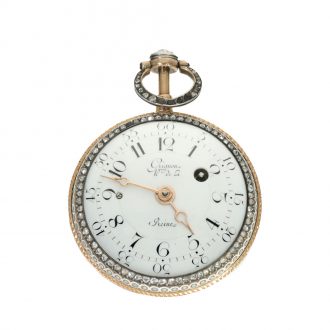
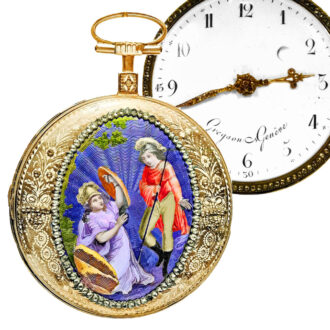
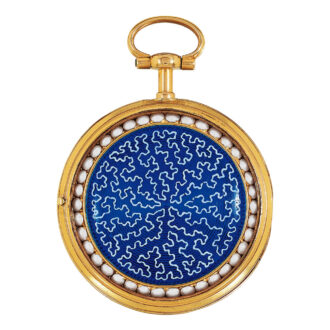
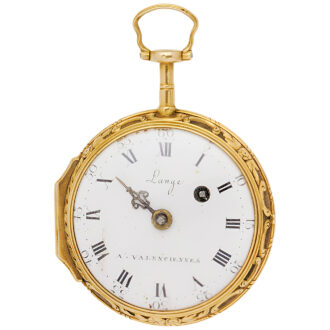
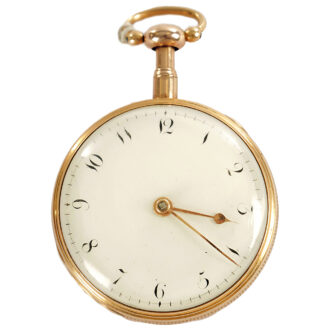
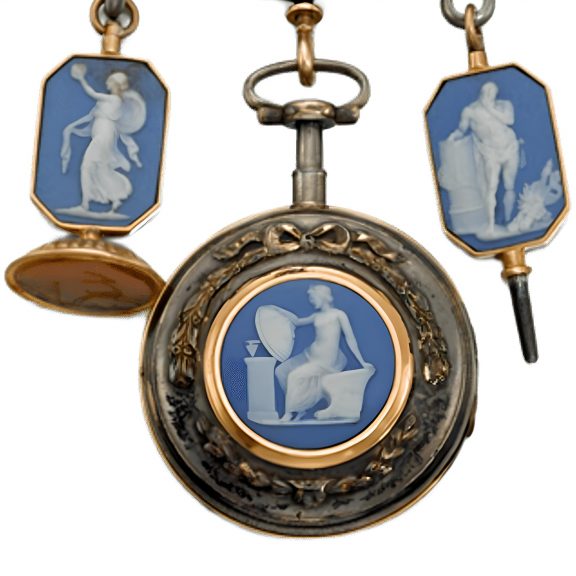
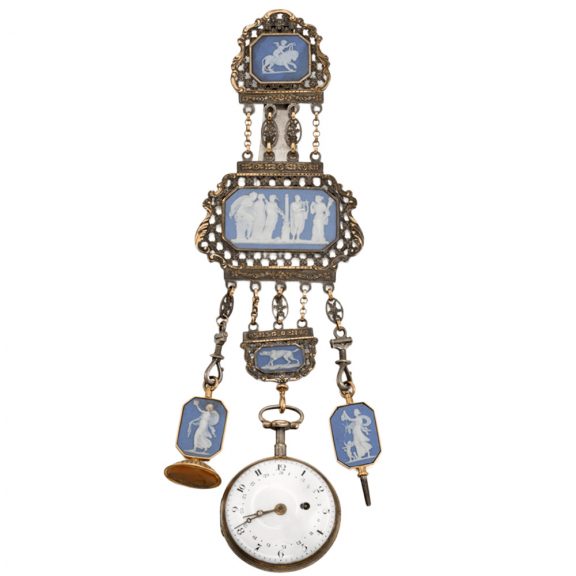
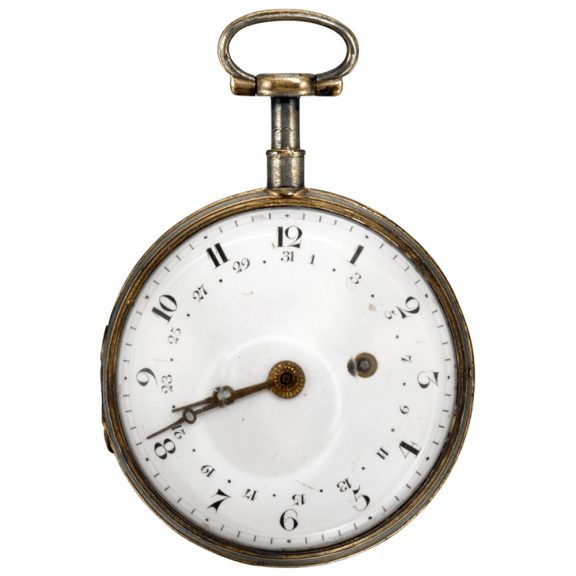
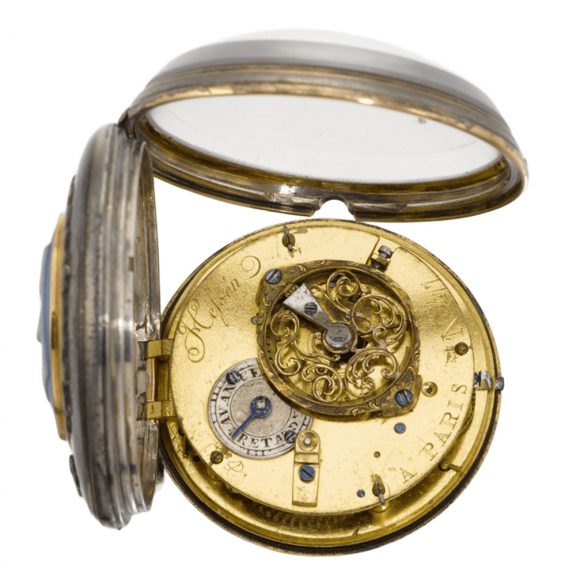
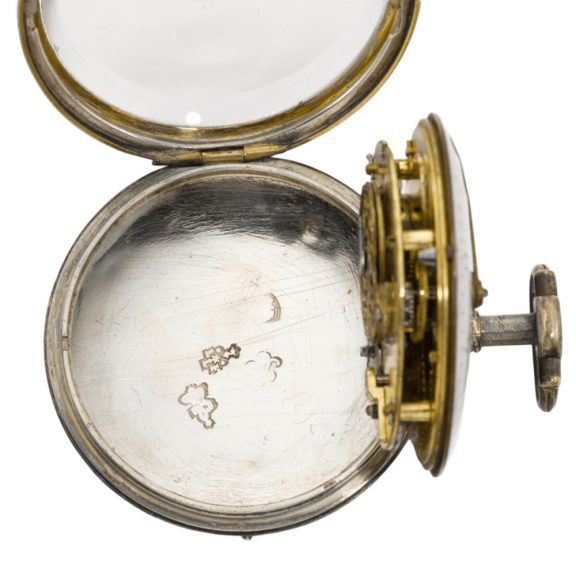
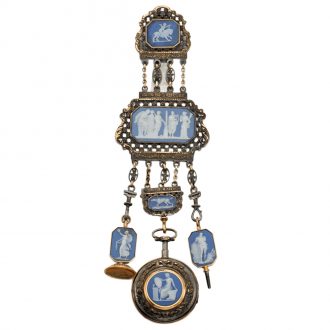
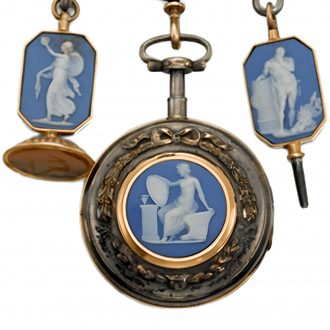
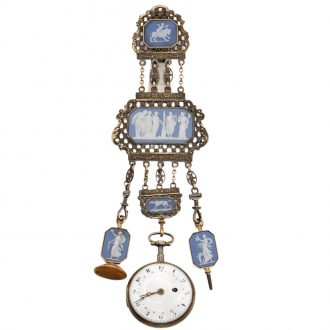
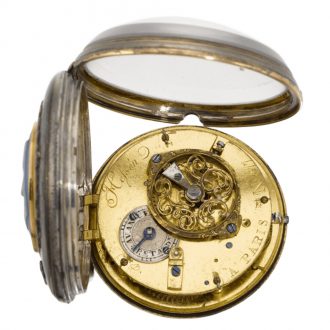
A French silver and gold open faced verge watch with date and jasperware mounted chatelaine, circa 1785. This watch features a gilded full plate movement, signed Hefsen, A Paris, No. 477, with a verge escapement, a pierced and engraved double screwed balance cock, and a fusee. (chain is missing). The white enamel dial displays Arabic numerals, an outer minute track, an inner date ring, and moon hands. The case is made of gold and silver, adorned with ribbon tied leaves and inlaid with a jasperware Classical plaque. It is suspended from a three piece chatelaine that includes a matching winder and a hardstone seal, all inset with additional jasperware plaques.
–
Diameter: 40 mm
–
Chatelaine 135 mm long
–
Signed: Hefsen, A Paris
–
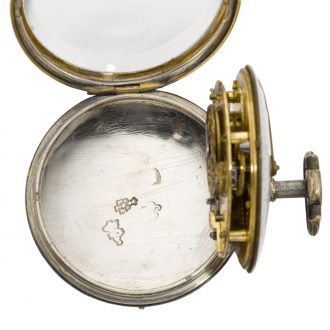
The dial has minor chips and six other scratches throughout, and the date hand is missing. The movement’s fusee chain is absent, and it is not running, appearing to be seized. It will require a complete service, overhaul, and repair. The case and chatelaine are worn throughout, though the jasperware is in good condition. Indistinct Paris marks are present on the inner case back.
–
André Hessen, Parisian Watchmaker, France
André Hessen, originally named Anders Bengtsson, was born in Sweden in 1745. He moved to Paris in 1767, where he gained recognition as a skilled watchmaker. The name Hessen (or Hesse) is derived from the hamlet of Hesse, near the village of Store Tuna in Sweden, and became a common name in France. Hessen received his education in Falun, Sweden.
–
By 1775, he had become the master and court watchmaker for Monsieur, the brother of King Louis XVIII of France. Hessen was known for creating richly decorated pocket watches and developed a calibre for flat pocket watches. In 1785, he published a treatise on watchmaking titled Mémoire sur l’Horlogerie, Contenant Une Nouvelle Construction de Montres Simples.
–
After the French Revolution in 1790, Hessen returned to Stockholm for a few years. In addition to Lépine, he was recognised for his watches with dust-proof case construction. Hessen lived on Rue Saint-Honoré in the parish of Saint-Germain l’Auxerrois, Paris.
–
He passed away on 12 Thermidor XIII (31 July 1805) in Paris, and the Swedish Consul General, Elof Signeul, was appointed executor of his will.
–
Jasperware, or jasper ware, is a type of pottery first developed by Josiah Wedgwood in the 1770s. It is generally classified as stoneware and features an unglazed, matte biscuit finish. Jasperware is available in various colours, the most famous being a pale blue known as Wedgwood blue. A key characteristic of jasperware is its relief decorations, typically in white but also in other colours, which create a cameo effect. These reliefs are produced using moulds and are applied to the pottery as sprigs.
Signed: Hefsen, A Paris
Share this page: