Very rare French chromed brass inking chronograph Circa 1860
- Kenmerk
- HC0626
- Diameter
- 61 mm
- Estimate
- € 1.500 - 3.000
- Price sold
- € 1.900
Chromed inking chronograph
–
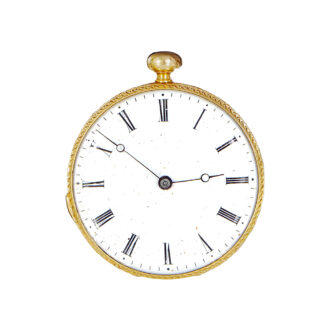
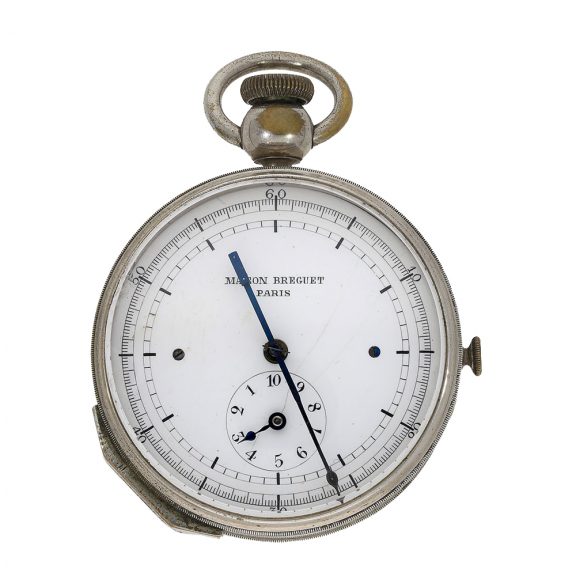
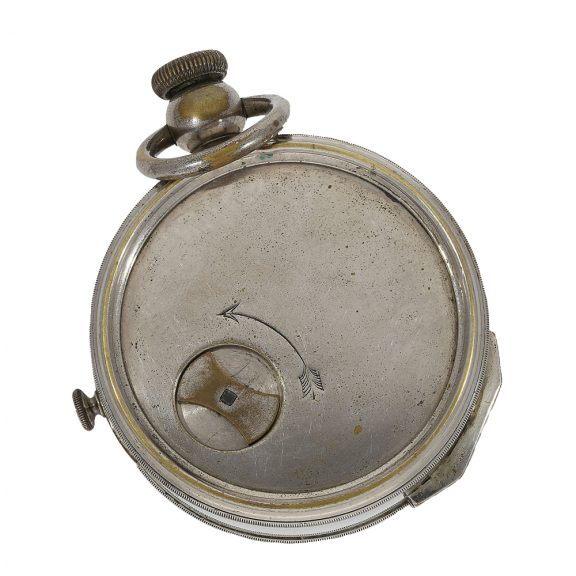
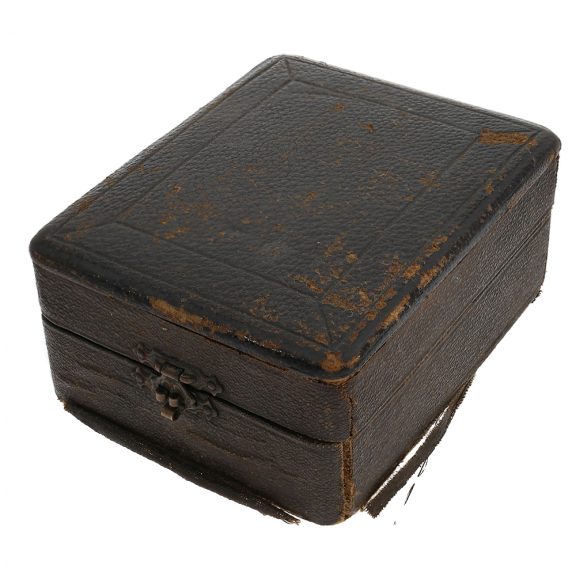
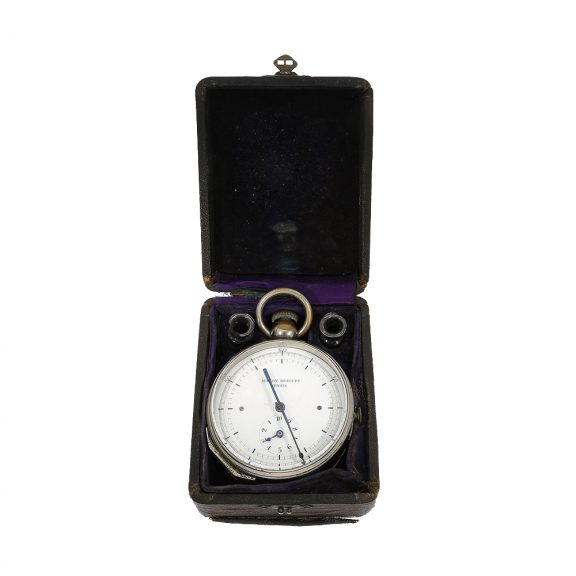
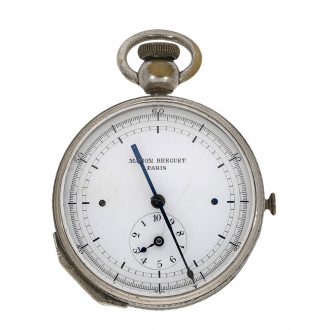
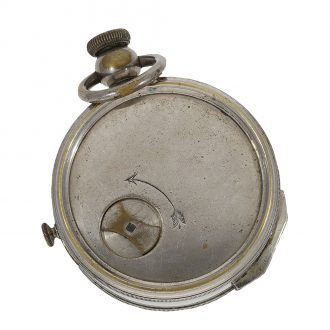
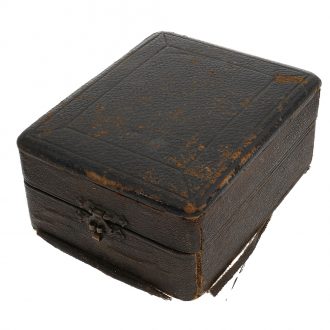
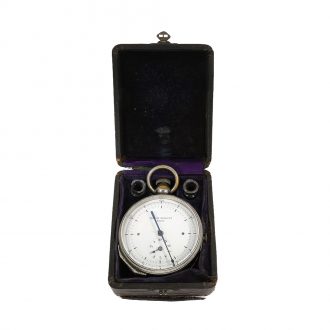
A very rare inking chronograph which comes with the original box including two inkwells made by Maison Breguet in Paris, France, circa 1860. This open faced piece has a chromed brass case with winding on the bottom and a lateral stop lever. The white enamel dial has an inner second track with five seconds markers, outer fifth of a second divisions with five second markers, outermost Arabic five second numerals, an anti clockwise running ten minute register at 6 o’clock and blued steel hands. The dial is signed.
–
Diameter: 61 mm
–
Signed: Maison Breguet Paris
–
Inking chronograph
An inking chronograph looks like a pocket watch, but it is not a watch. It is a mechanism to record elapsed time, which is indicated by dots of ink on the dial. The inking chronograph was invented in 1821 by Nicolas-Mathieu Rieussec, who was watchmaker to King Louis Philippe of France.
–
Nicolas-Mathieu Rieussec
Nicolas-Mathieu Rieussec (20 July 1781 – 18 June 1866) was a French watchmaker. He was the son of Joseph Rieussec, a merchant born in the 18th century in Lespinassière in the Languedoc, one of the largest provinces in the kingdom of France at the time. Today, Lespinassière is located in Aude, one of the five départements of the Languedoc-Roussillon region. Still a minor, young Rieussec was set up as a watchmaker at No. 14, Rue d Marché-Palu on the Île de la Cité.
The Almanach du commerce de Paris pour l’an XIII (the Parisian Business Yearbook for the year XIII) i.e. 1805, listed 190 watchmakers, including the renowned Breguet. Rieussec is not mentioned. However, five years later, he does appear among the 222 watchmakers in Paris. Nicolas-Mathieu married Anne Marie Delan, they had a son named Joseph-Ferdinand, born on December 15th, 1804, a few days after Napoleon was crowned Emperor of France. Two years later, Rieussec became a widower. His wife, born on July 21st, 1780, died on May 1st, 1806. Less than a year later, on February 7th, 1807, he remarried Marie Pierrette Flore Bourdin in Sainte-Marguerite church. Time passed. In 1815, the battle of Waterloo took place during which Napoleon and his Empire were swept away in defeat.
The 1820’s were the most prosperous in Nicolas-Mathieu’s life. It certainly did get off to an auspicious start. On September 1st, 1821, Rieussec attended the Champ-de-Mars in Paris. Not as a race spectator to watch the Arrondissement de la Seine race, but as a watchmaker testing a chronometer intended to consistently measure the time horses take to travel the prescribed race distances, not only the winning horse, but also all those that cross the line after it. Rieussec’s presence at the Arrondissement de la Seine race was not by chance. His elder brother, Nicolas Joseph, was an important person in French equestrian circles, which at the time were growing rapidly.
Sixteen years earlier, on August 31st, 1805, an imperial decree had established horse racing. It was in this context that, before 1805, Nicolas Joseph had founded the Buc stud farm, prior to purchasing that of Viroflay a few years later in 1812. He is also considered the promoter of the thoroughbred in France. Horse racing was the fashion and young watchmaker Nicolas-Mathieu quickly saw it as an opportunity to use his skill. Running the horses and determining the winner was one thing. Being able to measure the time for each of the racers was quite another. At this time, early in the 19th century, the need was felt for an instrument that could accomplish this.
On September 1st, 1820, many prominent figures had come to the Champ-de-Mars. A practised eye would have recognized Joseph Jérôme Comte Siméon, Minister and Junior Minister in the Ministry of the Interior and Gaspard de Chabrol, Prefect of the Seine département. Chabrol’s support was doubtless unnecessary, since the Minister had expressed his kindness to Rieussec the same day, giving him reason to hope for a patent on the basis of public utility. Both the Race Jury’s report and Prefect Chabrol’s letter referred to Rieussec’s invention as a chronometer or a timer. There was as yet no mention of a chronograph. The tests were judged to be satisfactory for the time being as witnessed by the Race Jury’s report. Rieussec’s invention met a real need. Better yet, it was a comfortable and reliable way to measure the times. Henceforth, there was no fear of any errors. It seemed destined for a promising future!
Signed: Maison Breguet Paris
Share this page: