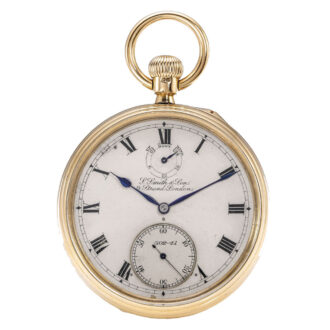
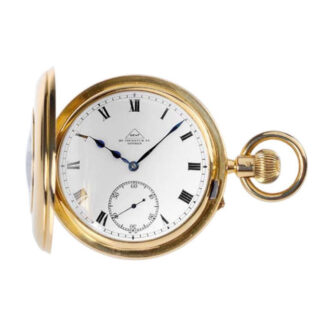
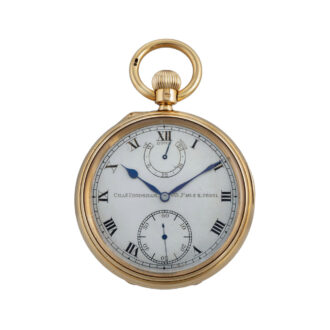
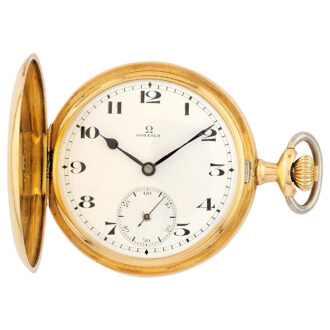
English 18 Carat gold one minute tourbillon watch Circa 1904
- Kenmerk
- TA1053
- Diameter
- 54 mm
- Estimate
- € 27.500 - 50.000
- Price sold
- € 31.850
Gold keyless detent chronometer watch
–
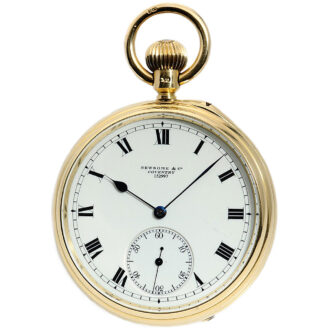
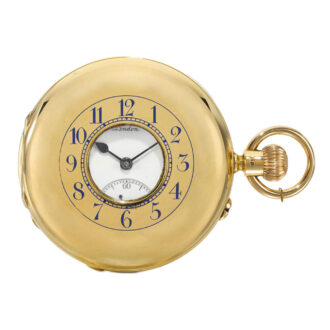
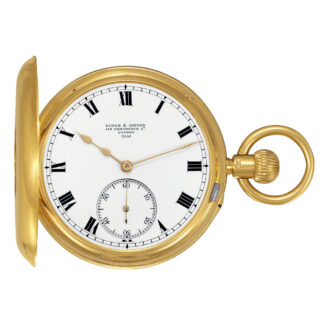
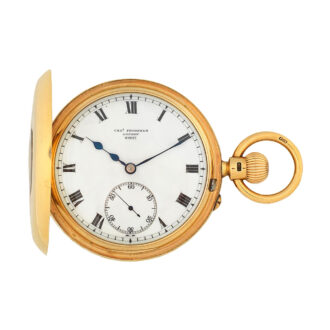
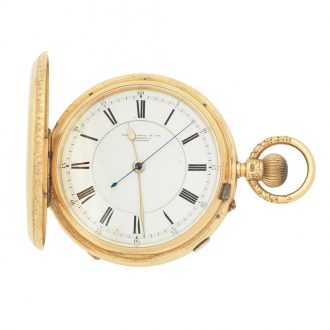
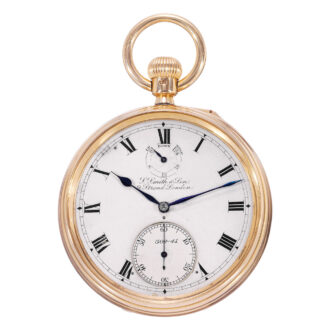
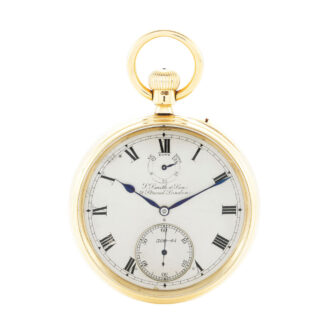
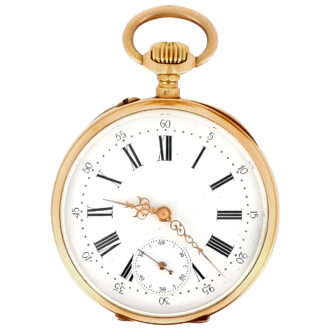
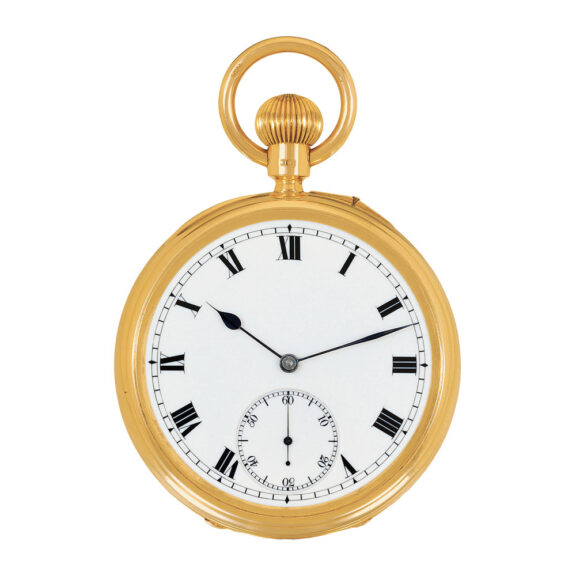
A very fine and exceptionally rare English 18 Carat gold keyless detent pocket chronometer with a one minute tourbillon regulator and Guillaume balance, made by Philip Woodman, circa 1904. One minute tourbillon Attributable to Nicole, Nielsen & Co. A solid polished, hinged gold cuvette. Off white enamel dial by Willis, radial Roman numerals, outer minute track, subsidiary seconds, blued steel spade hands.
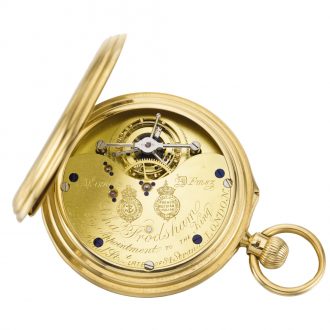
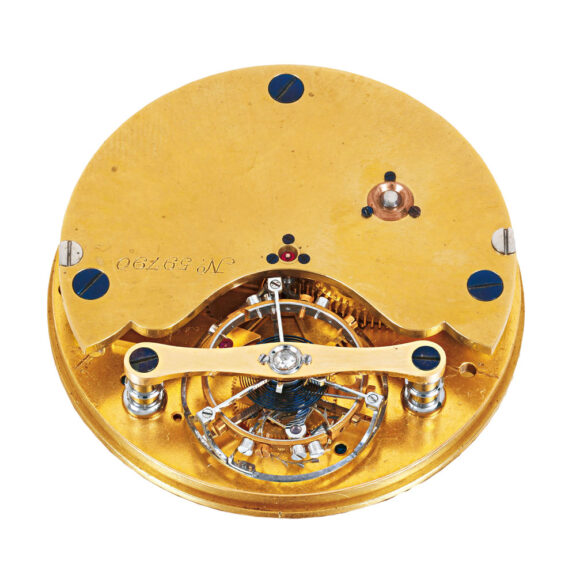
Three quarter plate movement, gilt brass, ringed cylindrical pillars, jewelled to the center, going barrel, Nicole Nielsen winding and hand setting, one minute equidistant 3 arm steel tourbillon carriage, Earnshaw type spring footed detent escapement, Anibal brass Guillaume balance with gold temperature and mean time adjustment screws, blued steel double over coiled free sprung Breguet balance spring, diamond end stone, a lateral gold bridge on two polished steel ringed pillars.
Case and movement numbered.
–
Diameter: 54 mm
–
Signed: Philip Woodman London
–
Nicole, Nielsen & Co. Perhaps the leading manufacturers of complicated watches in late 19th century London, Nicole Nielsen & Co. made watches and carriage clocks for leading makers such as Frodsham but also marketed under their own name. The firm originated in 1840 when Adolphe Nicole, a partner in the firm of Nicole & Capt, Geneva, settled in London. From 1858 the firm was at 14 Soho Square, where it remained for the next 75 years. In 1862 Nicole patented his chronograph stop system incorporating a flyback mechanism. In 1888 the firm was purchased by R.B. North, Nielsen being retained as joint managing director with Harrison Mill Frodsham. In 1888 the firm took the name of Nicole, Nielsen & Co. In 1917 the name of the firm was changed to North & Sons Ltd. They continued in business until 1933. Anibal (Acier au Nickel pour Balanciers) An alloy invented by the Nobel prize winner Dr Charles Edouard Guillaume, exhibits unusual properties, both in terms of thermal expansion and in changes in elasticity. These properties are very different from those of two other famous alloys invented by Guillaume, Invar and Elinvar. Around 1900 Guillaume attempted to eliminate the so called middle temperature error caused by the fact that the change of rate in a timekeeper with a steel brass bi metallic balance is approximately a linear function of temperature, while the change of rate caused by a change in the elasticity of a balance spring is approximately a quadratic function. Thus, it equals zero at only two temperatures, causing a secondary error. Countless attempts were made to eliminate middle temperature error, usually by means of auxiliary compensation devices. In 1899, Guillaume noticed that steel with an addition of 44.4% nickel had a negative square coefficient of thermal expansion. This alloy, combined with brass in a bi metallic lamina, makes its expansion close to quadratic. Balances with bimetallic rims made of Anibal and brass are usually called Guillaume balances, or, as their inventor called them, integral balances. When combined with special balance springs, they exhibit remarkable temperature stability, on occasion not exceeding 1/50 second per day at 1oC.
Signed: Philip Woodman London
Share this page: