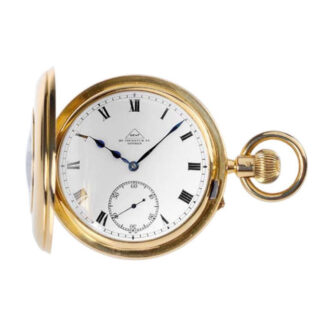
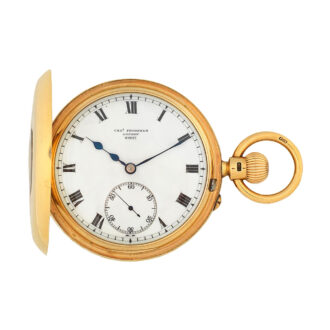
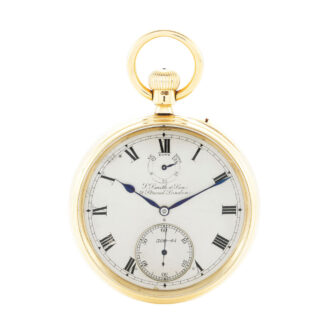
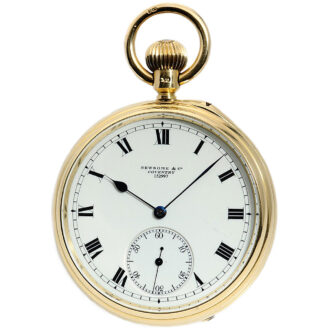
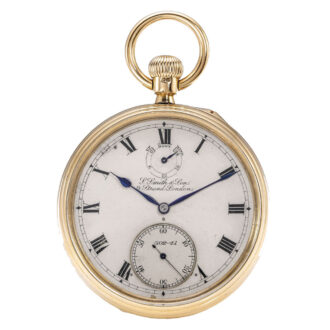
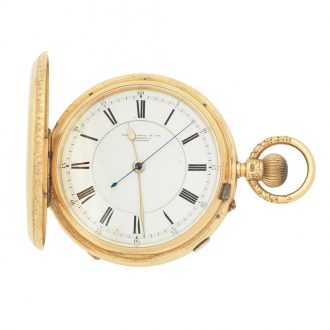
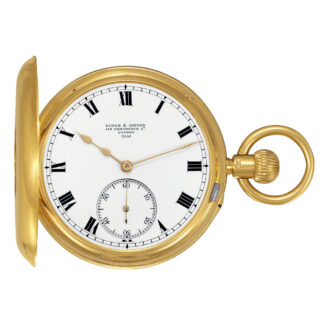
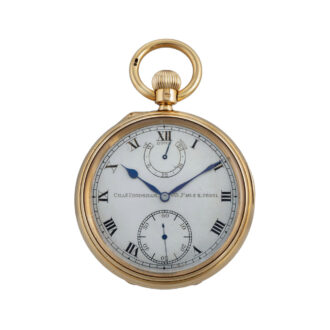
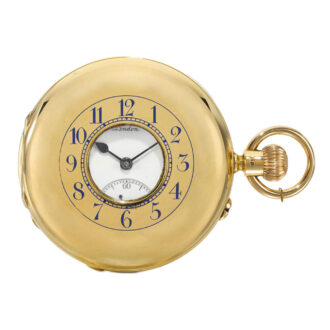
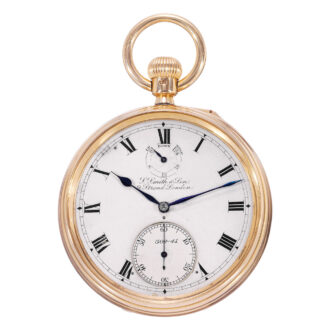
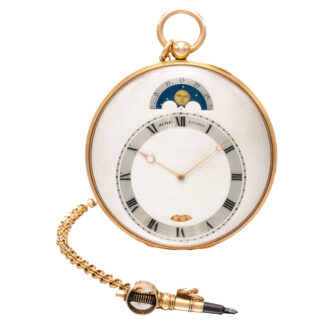
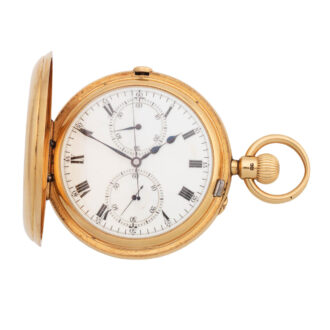
Rare English gold six minute tourbillon lever watch Circa 1904
- Kenmerk
- AS1706
- Diameter
- 60 mm
- Estimate
- € 30.000 - 60.000
- Price sold
- € 40.950
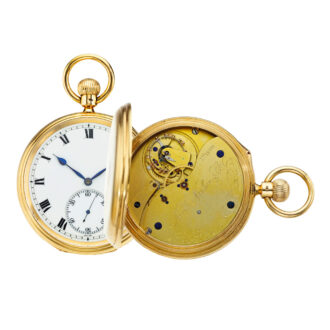
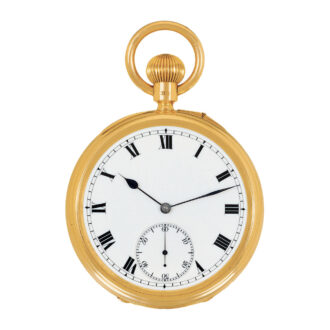
Gold open faced tourbillon watch by Charles Frodsham
–
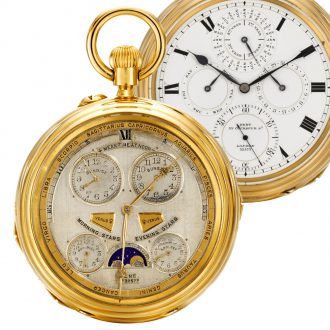
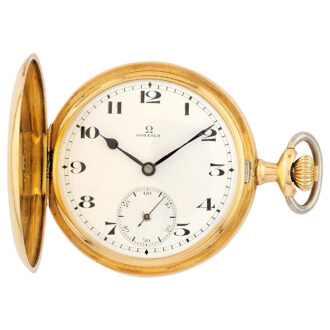
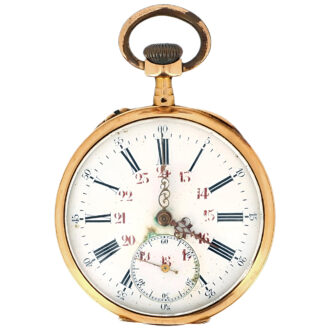
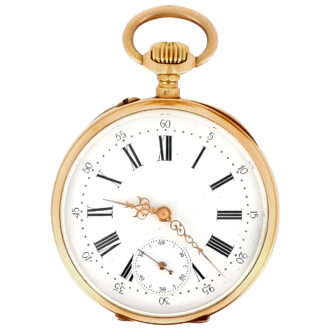
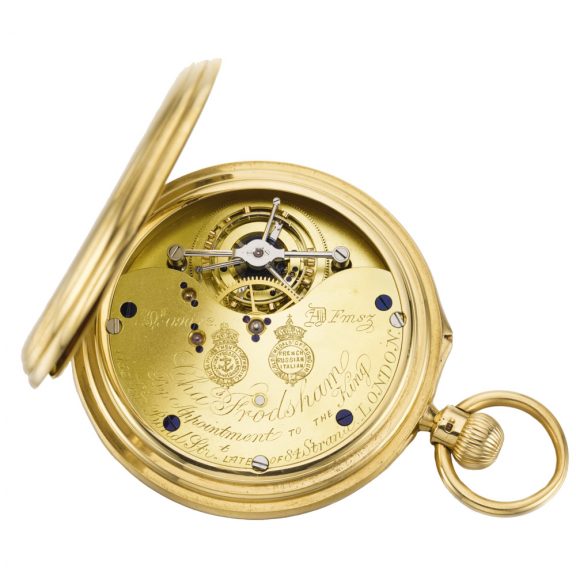
A very fine English gold open faced lever pocket watch with six minute tourbillon, circa 1904. This timepiece features a high quality gilded ¾ plate movement with a lever escapement housed in a six minute tourbillon carriage with polished steel bridges. It is signed and numbered Chas. Frodsham AD Fmsz By Appointment to the King at 115 New Bond Strt late of 84 Strand London. The watch also displays shields for the Royal Warrant and a medal of honour from France, Russia and Italy. The dial is a T. J. Willis type Venetian enamel dial with Roman hour numerals, an outer ring calibrated for minutes and subsidiary seconds. It is signed Chas. Frodsham 09072 AD Fmsz. The large 18K gold case is polished and features a central blue enamel monogram on the back, a gold hand-set button and a plain gold cuvette. It is hallmarked London 1904 and bears the maker’s mark HMF for Harrison Mill Frodsham on both the cuvette and back of the case with the pendant displaying the maker’s mark A.B.
–
Diameter: 60 mm
–
Signed: Chas. Frodsham
–
Accompanied by a Certificate of Origin from Charles Frodsham and Co., confirming that the watch was added to their stock in 1904. It is noteworthy that the manufacturing records indicate that this watch was initially tested in a silver case at Kew and achieved 83 marks in December 1904. Subsequently, the watch was transferred to a gold case made by Nicole Nielson in April 1905.
–
Charles Frodsham a distinguished horologist was born on April 15th, 1810 and he died on January 11th, 1871. Soon after marrying Elizabeth Mill (1813 – 1879), he founded his own business at 7 Finsbury Pavement, London. He rapidly established himself as a leading London chronometer maker.
–
With the death of another major chronometer maker, John Roger Arnold (son of the eminent John Arnold), Charles acquired the Arnold business in 1843, moving his family and business address to 84 Strand, London. Trading as Arnold & Frodsham till 1858 when the firm Charles Frodsham was officially established. Through his many publications and timepieces, Frodsham dedicated himself to the exploration and improvement of timekeeping in its many forms, achieving acclaim for his work from chronometers to barometers. The Frodsham balance, which was designed for phenomenal accuracy, can be found in coach clocks and some mantel clocks dating to as early as 1851. Frodsham was a founding member, and later Vice President, of the British Horological Institute and a Liveryman of the Worshipful Company of Clockmakers of which he became free in 1845 and in which he served as Master in 1855 and 1862.
–
On the death of Benjamin Lewis Vulliamy (1780–1854), Frodsham purchased the goodwill of the Vulliamy business and on the recommendation of Airy succeeded Vulliamy as ‘Superintendent and Keeper of Her Majesty’s Clocks at Buckingham Palace’, cementing the firm’s position as leading international clockmakers. In 1855 Frodsham won the Gold Medal of Honour at the Paris Exhibition. In 1862 he was awarded the Medal of Honour for his service as a juror at the Great International Exhibition in South Kensington. He continued to achieve recognition at exhibitions from Russia to Paris.
–
Charles Frodsham excelled at his art until he died of liver disease at the age of 60. Upon Charles’s death, his son, Harrison Mill Frodsham (1849–1922), took charge of the firm and incorporated it in 1893 as Charles Frodsham & Co Ltd. He proved to be an able horologist and businessman and the firm continued to flourish. It continues today specializing in fine precision timepieces.
Signed: Chas. Frodsham AD Fmsz By Appointment to the King at 115 New Bond Strt late of 84 Strand London
Share this page: