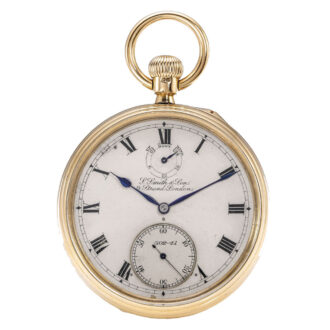
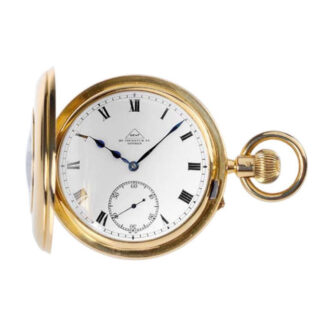
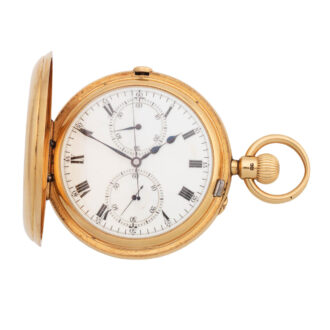
Important English ultra complicated double dialled watch Circa 1904

- Kenmerk
- AS2068
- Diameter
- 79 mm
- Estimate
- € 350.000 - 750.000
- Price sold
- € 751.600
Gold ultra complicated clock watch
–
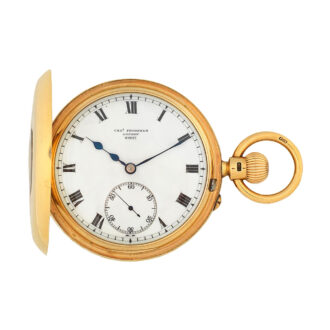
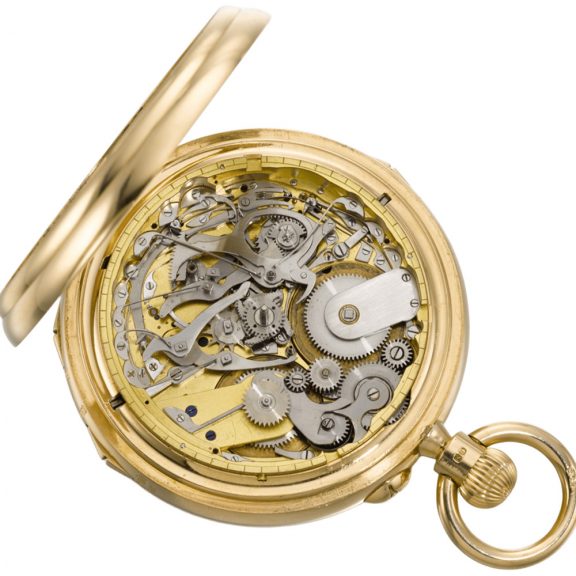
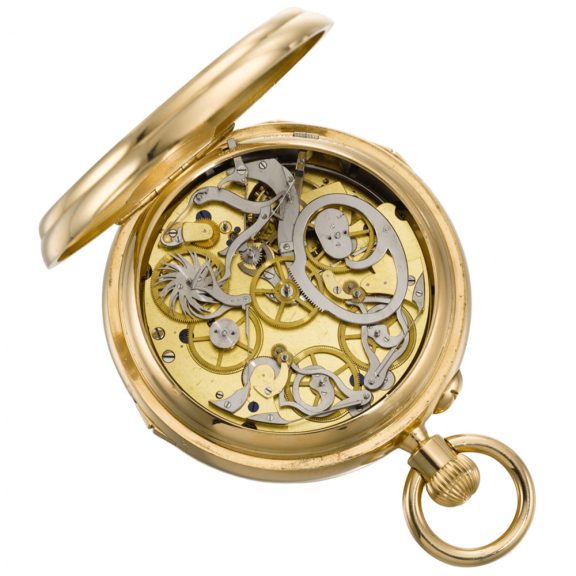
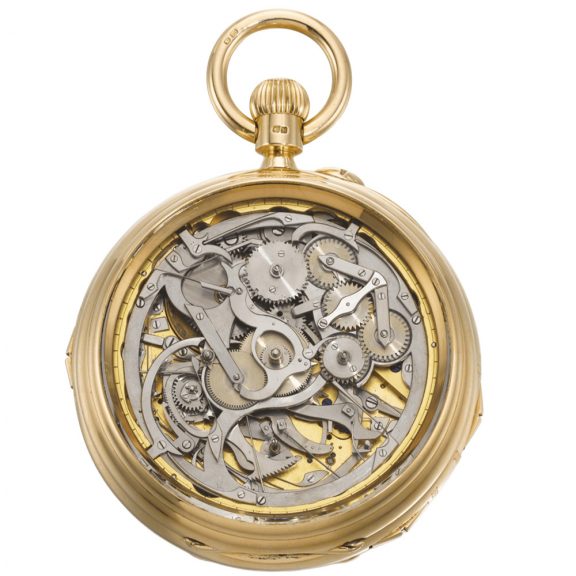
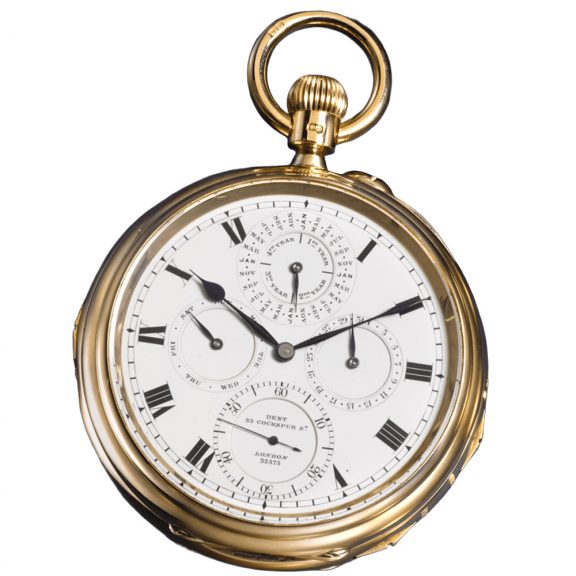
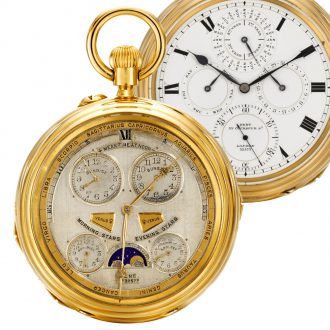
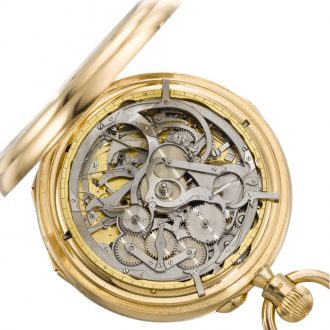
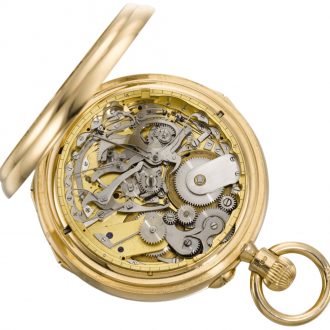
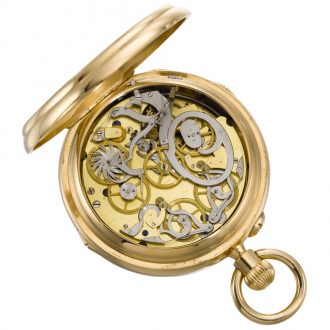
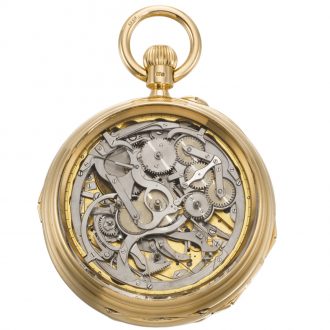
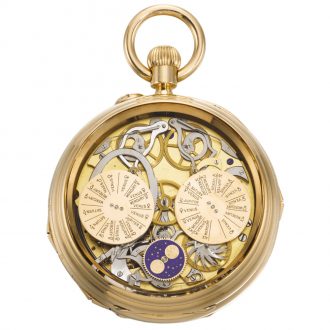
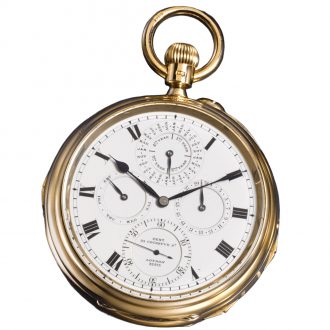
A highly significant, large and heavy English ultra complicated gold keyless clock watch featuring a double dial and perpetual calendar made by MF Dent in London, circa 1904. This minute repeating grande and petite sonnerie watch includes equation of time, signs of the zodiac, times of sunrise and sunset, moonrise and moonset and moon phases, along with the appearance of the Big Dipper (Plough) during alternate black moons.
–
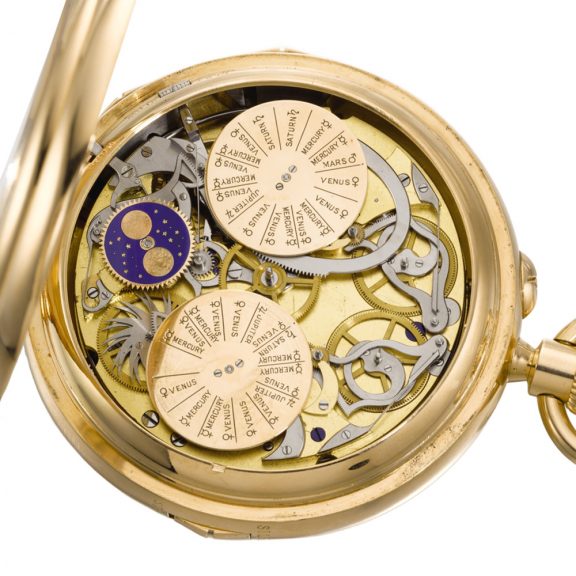
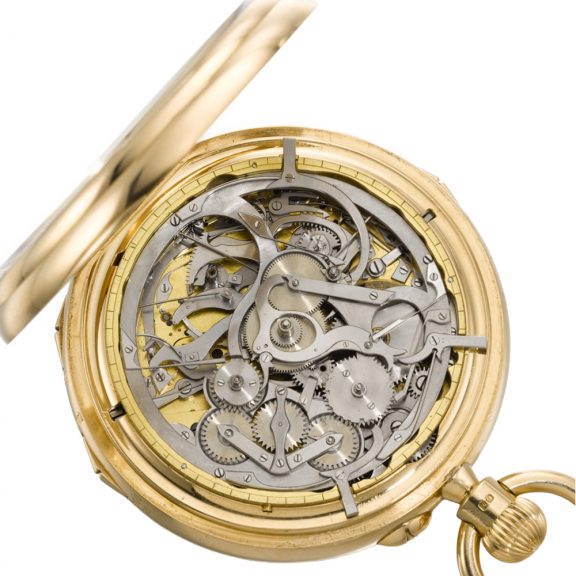
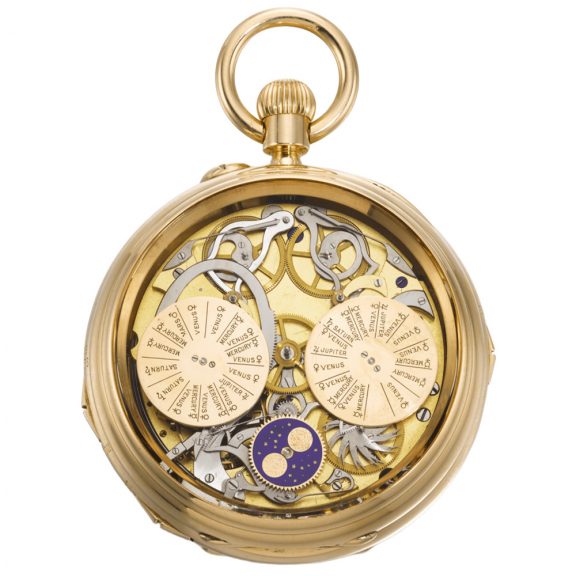
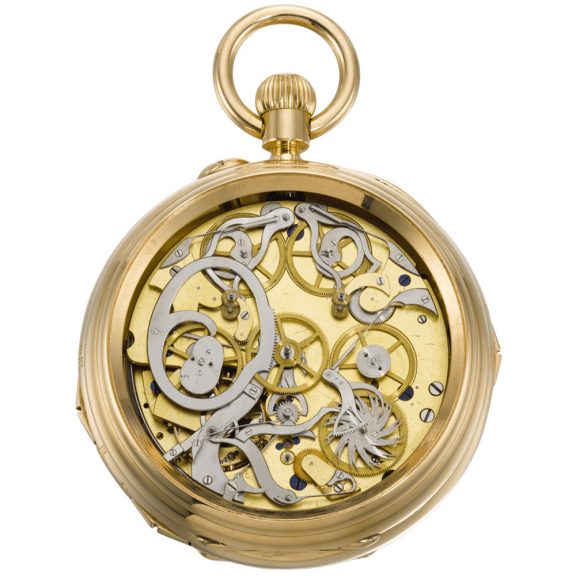
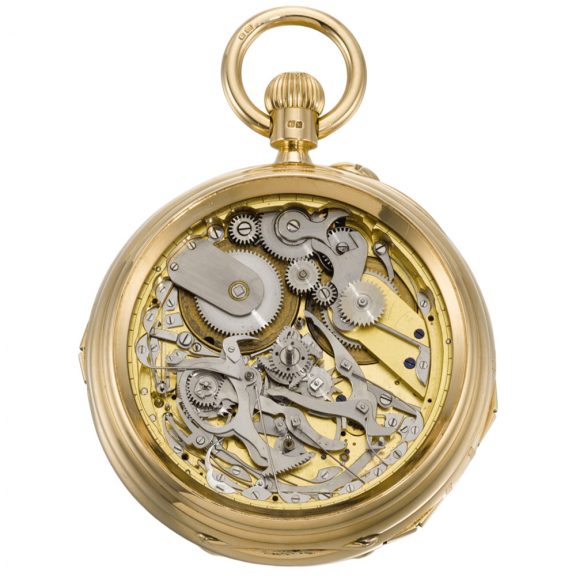
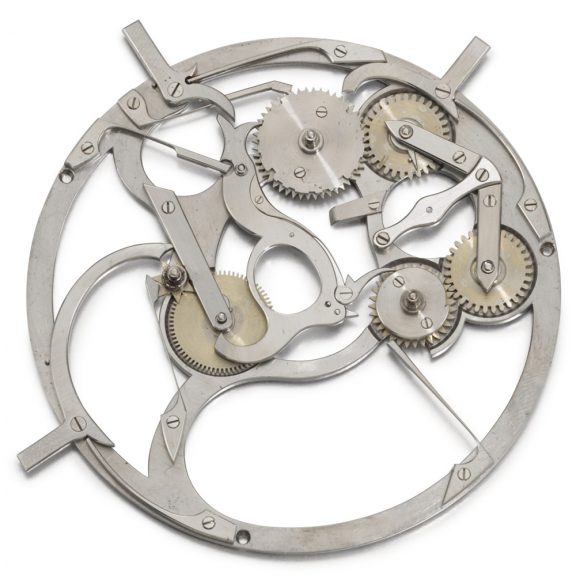
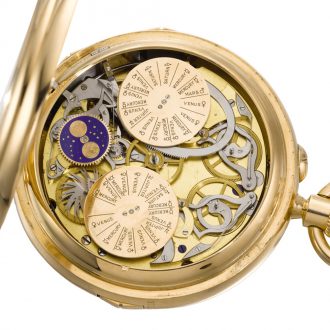
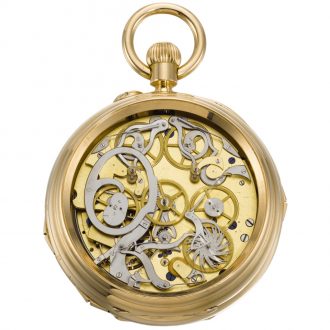
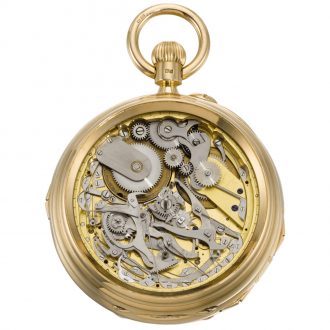
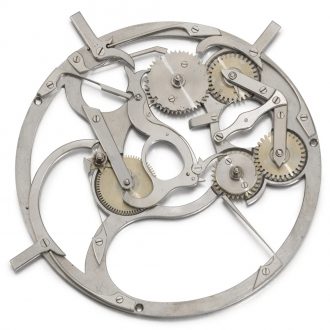
The watch has a movement with a multi layered design. It features a gilded English ¾ main plate, lateral lever escapement, bimetallic compensation balance and a blued steel balance spring with a Phillips terminal curve. The timekeeping side includes a removable skeletonized plate for the perpetual calendar function leaving the striking train and minute repeating mechanism partially visible, chiming on gongs. The astronomical side is equipped with a kidney shaped cam for equation work, along with discs for morning and evening stars and moon phases.
–
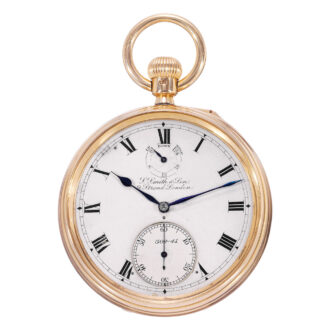
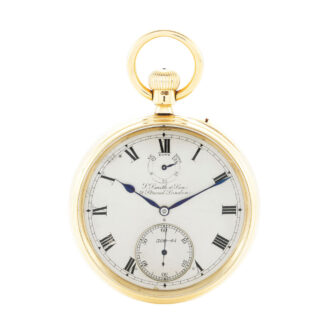
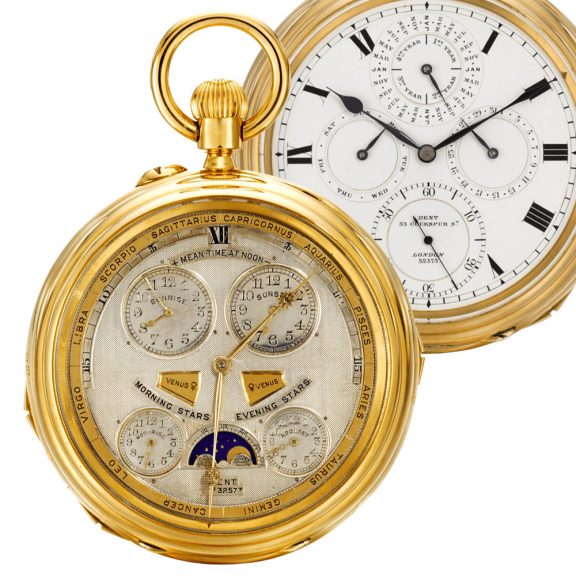
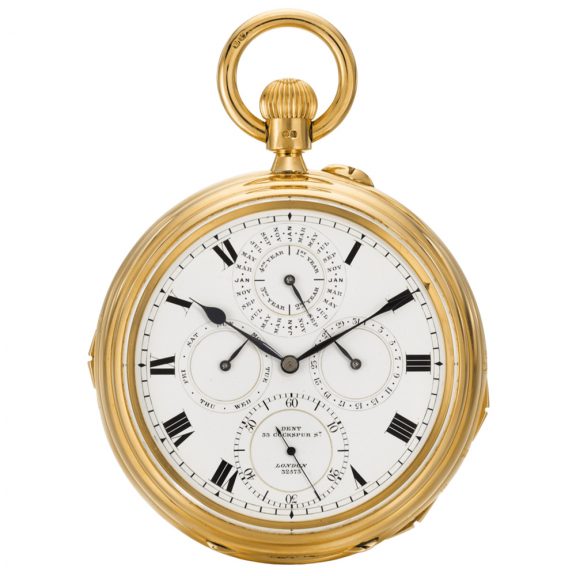
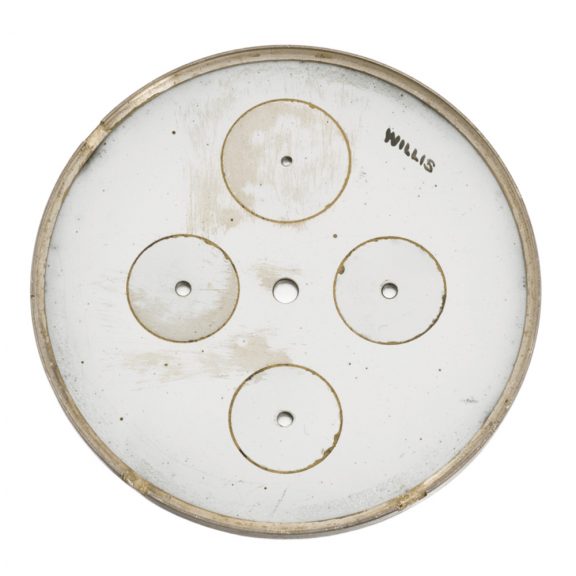
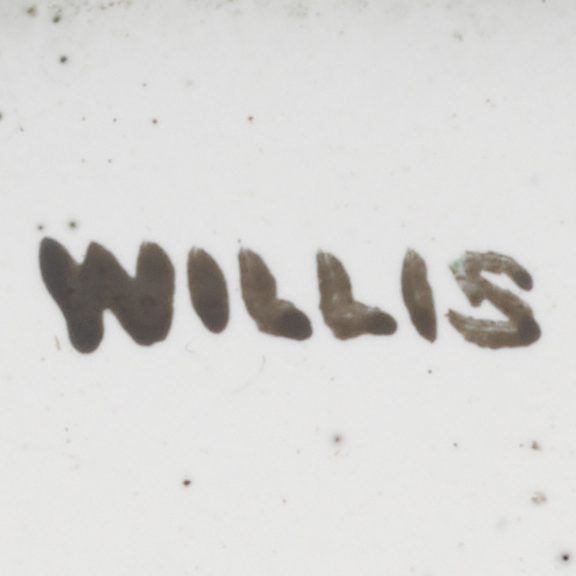
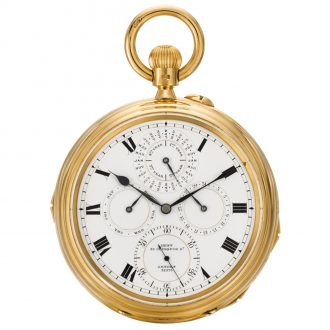
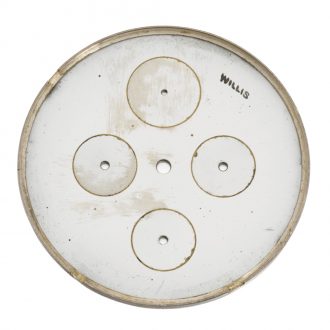
Two Dials: The first dial is of white enamel and is signed Willis on the reverse, with black Roman hour numerals and an outer minute ring. It includes four subsidiary dials with sunken centres, indicating the months with a leap year cycle, the date, seconds and days of the week. It features blued steel spade hands and is signed and numbered Dent 33 Cockspur Street London 32573.
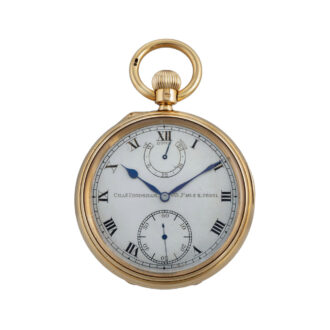
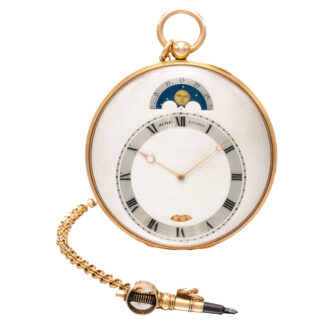
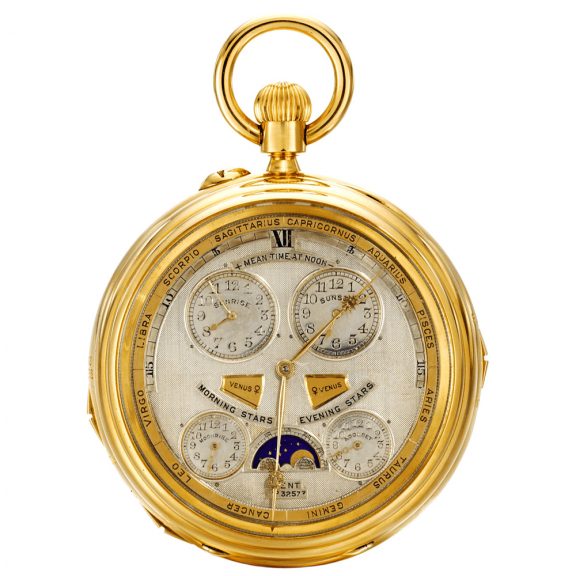
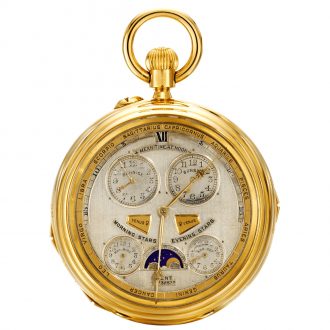
The second dial is of silver with a finely engine turned surface and an outer sector that indicates the equation of time. It includes four polished subsidiary dials for sunrise, sunset, moonrise, and moonset. Two wedge shaped apertures reveal gold discs representing the morning and evening stars. The outermost gold ring displays the zodiac signs. The central gold hands include one tipped with a star for the equation of time and the other tipped with a globe for zodiac indication. Additionally, there is a small aperture beneath the bezel for regulation.
–
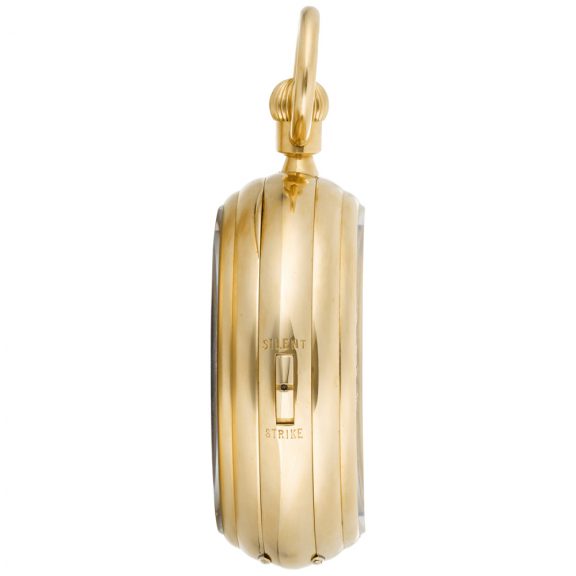
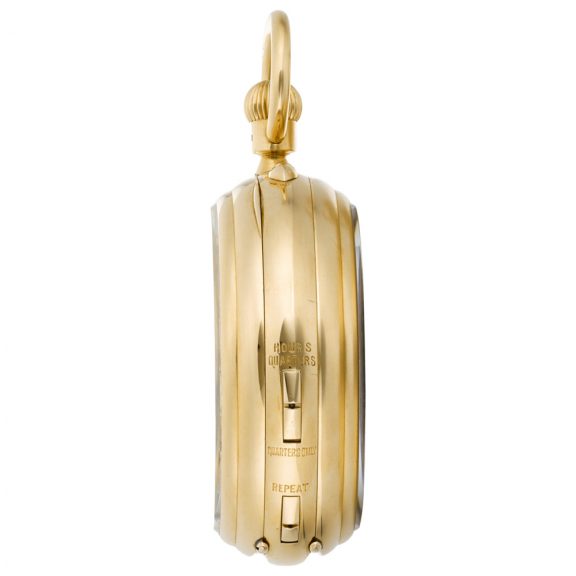
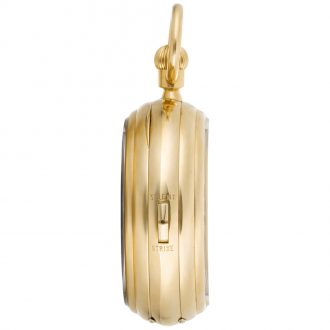
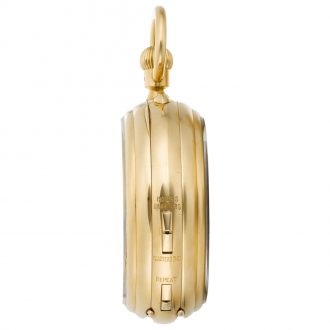
It has an 18 carat yellow gold double open faced case. Both bezels are elegantly twin stepped and rounded. There are three short slides on the sides for adjusting functions: strike/silent, hours & quarters/quarters only and trip repetition. Both covers are glazed and hinged with short lever adjusters beneath the bezel for easy adjustment of the day, month, and date. The gold pendant and bow are stamped with London hallmarks, confirming their 18 carat gold authenticity.
–
Diameter: 79 mm
–
Signed: Dent 33 Cockspur Street London
–
The movement is running but would likely benefit from servicing. All slides and adjusters for the day, month and date beneath the bezel are functioning. The enamel dial appears to be in good condition. The silver dial’s engine turning remains crisp, with a few very light spots and minor scratches on the subsidiary dials and a slight loss of some black numeral infill. The case is in good overall condition, with some light polishing.
–
The Dent Ultra Complication was a groundbreaking timepiece, considered one of the most sophisticated watches of its era. Featuring 19 complications, it boasted only five fewer functions than the Henry Graves Supercomplication, crafted by Patek Philippe 25 years later. This remarkable watch was the result of a unique collaboration between the English firm Dent, the Swiss company Capt & Cie. of Solliat and the watchmaker Léon Aubert of Le Brassus. Likely created in response to a special client request, Dent tasked Capt & Cie. with developing the intricate complications needed for the watch’s complex movement. A letter dated January 8, 1904, from Capt, outlines the approach to Léon Aubert for designing the calendar and astronomical mechanisms, which were almost certainly intended for this extraordinary timepiece.–
–
The movement of the Dent Ultra Complication is of exceptional quality, executed on multiple levels. Its perpetual calendar mechanism is a skeletonized module positioned beneath the time dial and above the movement’s repeating and striking work. The most extraordinary feature, however, is its astronomical indications, particularly those that calculate the times of moonrise and moonset. In his article for Chronométrophilia, Daniel Aubert details the complex calculations and gearing necessary to provide a continuous, highly accurate indication for moonrise and moonset. To display these times, the watch is engineered to account for two consecutive passages of the moon over the meridian, an average interval of 24 hours, 50 minutes and 30 seconds. A sidereal moon revolution takes 27 days, 7 hours, 43 minutes and 11.5 seconds.
–
Perpetual Calendar Dial
The front dial not only shows standard time but also features a perpetual calendar. This calendar accurately displays the day of the week, date, and month, automatically adjusting for the varying lengths of months and leap years. Since a solar year is 365 days, 5 hours, 48 minutes and 48 seconds long, and a mean year is 365 days, an extra day is added every four years as a leap year. Additionally, a leap year is omitted every four centuries according to the Gregorian calendar reforms of 1582. Century years divisible by 400 without remainder are considered leap years. As a result, this watch’s perpetual calendar will remain accurate until the year 2100, when it will require its first adjustment.
–
Astronomical Dial
The central sun-tipped hand on the dial indicates the equation of time along a semi-circular track. This track is calibrated to show the difference between apparent solar time (as shown by a sundial) and mean time (the average solar time). Due to Earth’s elliptical orbit, this difference varies from +14 minutes 59 seconds to -16 minutes 15 seconds. Solar time aligns with mean time around April 15, June 15, August 31 and December 24. Another central hand, ending in a sphere, points to the current zodiac sign displayed at the dial’s edge. Four subsidiary dials separately indicate the times of sunrise, sunset, moonrise and moonset. Three apertures display the moon phases, with its age marked at the edge, as well as the morning and evening stars. The Morning and Evening Stars apertures show the currently visible planet: Venus, Jupiter, Mercury, Saturn and Mars, which may appear singly or in pairs.
–
The Contributing Makers
Léon Ernest Aubert (1845-1920) began his watchmaking career as an apprentice to Magnenat of Solliat. In 1872, he established his own small workshop in Le Brassus, specialising in creating perpetual calendar mechanisms and astronomical features for pocket watches. He predominantly supplied these intricate components to watchmakers in the Vallée de Joux. These completed watches were often sold under different final names, such as Dent 32573.
–
Léon’s grandson, Daniel Aubert, has extensively researched and documented Léon’s work. Daniel noted that around 1895, Léon invented a mechanism for displaying the equation of time, which he provided to notable companies like Victorin Piguet and Patek Philippe. Among these was Patek Philippe no. 111.505. Additionally, Léon collaborated with his apprentice, Paul Auguste Golay, on Patek Philippe no. 198.023, crafted for James Ward Packard.
–
Another significant movement created by Léon Aubert, numbered 28432, was developed for Golay Fils & Stahl. This piece was sold at Sotheby’s Geneva on May 19, 1992, as lot 270. It was made for the Maharaja of Patiala and featured a minute repeater, an equation of time, a perpetual calendar, moon phases, and the times of sunrise and sunset.
–
Here is an excerpt from Léon Aubert’s obituary in Antiquarian Horology: “With his passing, we have lost one of the last skilled craftsmen of the old school, who worked quietly at home on those remarkable, intricate calendars. Two years ago, he shared with us that he had just marked 60 years at his workbench, having completed one of those exceptionally complex mechanisms that were his specialty. These creations undoubtedly brought significant prestige to the watch manufacturers they were crafted for. Yet, he remarked, despite his horological talents that could have earned him a fortune, he never made a living from them.”
–
Capt & Cie, the successors to Nicole & Capt, was established in 1875 at Le Solliat in the Vallée de Joux, originally known as Capt & Meylan. A visiting card from Capt & Meylan, featured in Daniel Aubert’s article for Chronométrophilia, highlighted the company’s specialisation in crafting watches in the English style and their expertise in producing complex timepieces, including repeaters, split-second chronographs, perpetual calendars, and clock watches. This proficiency in creating intricate watches in the English style positioned them perfectly to meet Dent’s demanding requirements.
–
The enamel dial on this watch is marked “Willis” on the back. The Willis family was renowned as one of the finest English dial makers of the 19th and early 20th centuries. An 1889 advertisement for T. J. Willis states that the company was founded in 1787. In his book “Old Clocks and Watches and their Makers,” F. J. Britten mentions the enameller John Willis, who was active in Smithfield, London, from 1820 to 1836. His son, Thomas John, described as “an excellent dial maker,” continued the business, relocating to 10 Rydon Crescent, London EC, and later to 19 River Street, Myddelton Square, London EC. Thomas John passed away in 1893 at the age of 57. After his death, the company continued producing dials into the 1920s. An 1889 advertisement in Antiquarian Horology highlighted T. J. Willis’s speciality in “Venetian Enamel Dials,” known for their distinctive creamy, off-white hue.
–
Edward John Dent, born in 1790, began his apprenticeship at 14 with his grandfather, a tallow chandler. Fortunately, he lived with his cousin Richard Rippon, a watchmaker, during this time. Influenced by his cousin, Dent developed a keen interest in horology, prompting his grandfather to allow him to transfer the remaining years of his apprenticeship to Edward Gaudin, another watchmaker, in 1807. Dent quickly gained a reputation as an exceptional craftsman and worked as a chronometer maker for several firms, including Vulliamy, Barraud, and McCabe, between 1815 and 1829. By 1830, his skills were so esteemed that John Roger Arnold invited him to form a partnership at 84 Strand, London, which lasted ten years. In 1831, Dent was admitted to the Clockmakers’ Company and became a Freeman of the City of London. In 1840, he established his own business at 82 Strand and expanded to 33 Cockspur Street by 1843, the address on the present watch’s dial. Edward Dent passed away in 1853, leaving his business to his two stepsons, Frederick and Richard Rippon, on the condition they adopt his family name. Frederick managed the firm’s outlets at the Royal Exchange and the Strand, while Richard inherited the Cockspur Street shop. Both stepsons died shortly after Dent, with Richard passing away three years later and Frederick seven years after their stepfather. Richard’s widow, Marianna Frederica, inherited his portion of the business, renaming it M. F. Dent, while Frederick’s share went to his mother and sisters, Elizabeth and Amelia. Edward John Dent is best remembered for being awarded the contract to build the great Westminster clock, famously known as ‘Big Ben.’
–
MF Dent, an esteemed English watchmaker, was based in London at 33 & 34 Cockspur Street, Charing Cross, around 1896. The company held the prestigious title of Chronometer Maker to the Queen. It gained renown for creating the most intricate Dent watch ever made, No. 32573, crafted by Léon-Ernest Aubert. This watch is comparable to the La Fabuleuse pocket watch by Louis Elisée Piguet, which was ultimately completed by Richard Daners for Gübelin in 1985.
–
Marianna Frederica Dent, the widow of Richard Edward Dent, was a stepson of Edward John Dent. Richard Edward Dent was actually the son of watchmaker Richard Rippon and his wife Elizabeth Davis. After Richard Rippon’s death, Elizabeth married Edward John Dent. Following her husband’s passing, Marianna Frederica Dent remarried lawyer Samuel Ward Tucker. Despite her death, the name MF Dent persisted for many years. The company continued under the leadership of individuals such as Frederick Knudsen (1811-?), John Smith as Manager in 1870, and Edward White, who also operated under his own name. Ultimately, in 1920, the company was incorporated into E. Dent & Co.
Signed: Dent, 33 Cockspur Street, London
Share this page: