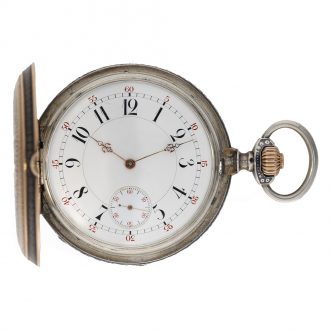
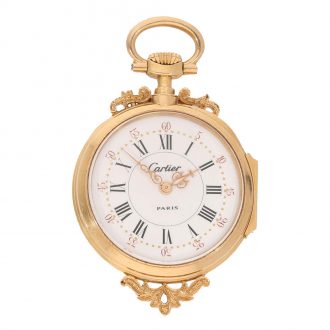
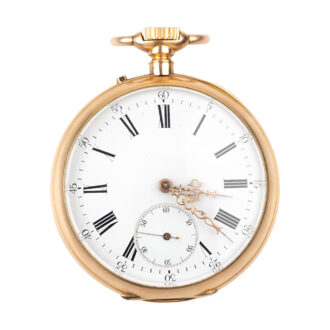
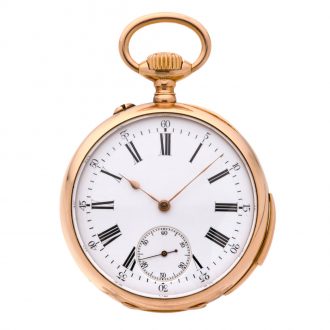
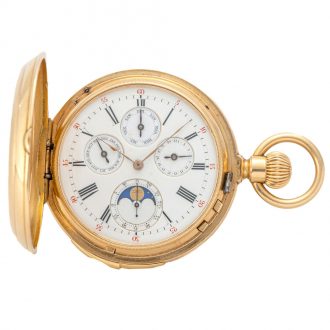
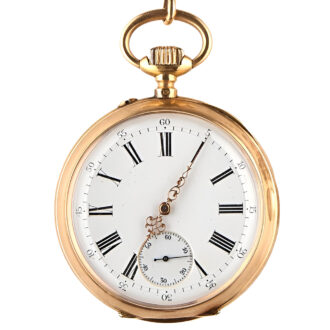
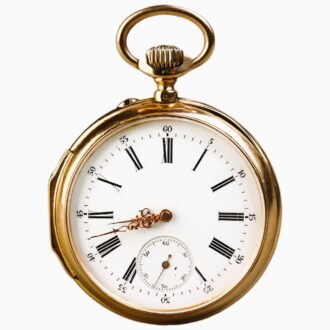
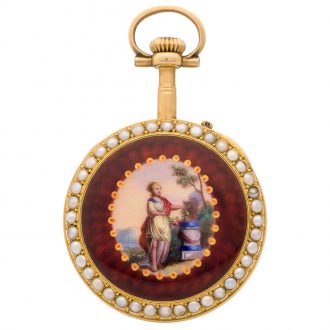
Historically important French 18K rose gold repeater Circa 1890
- Kenmerk
- TA1759
- Diameter
- 52 mm
- Estimate
- € 60.000 - 100.000
- Price sold
- -
Rose gold lever pocket watch
–
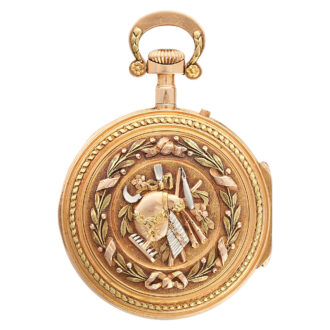
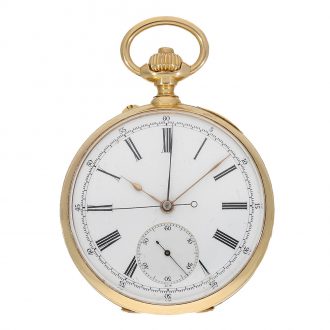
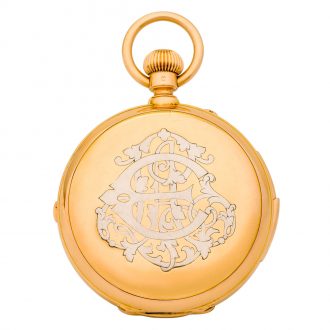
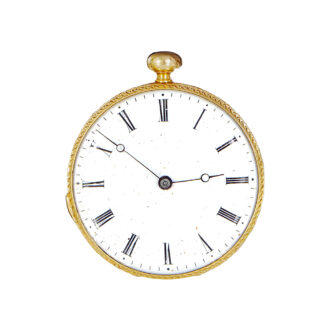
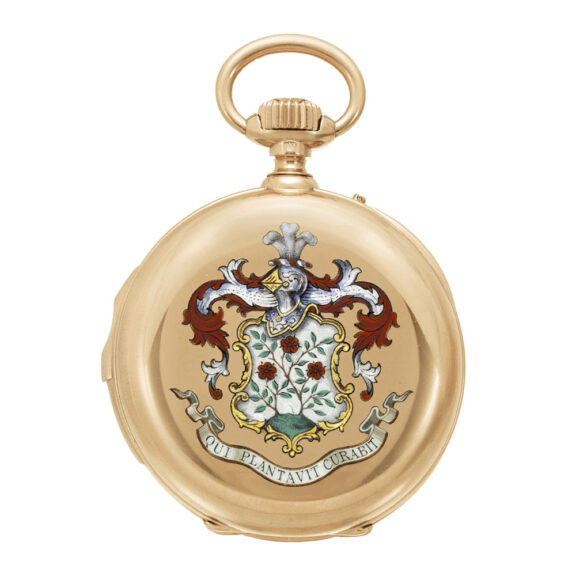
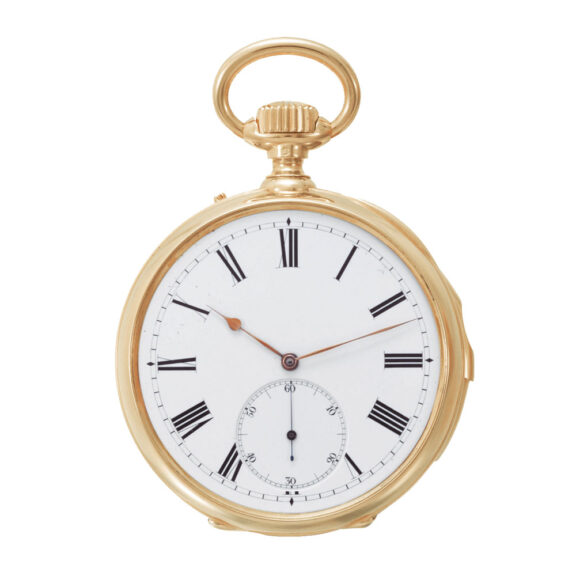
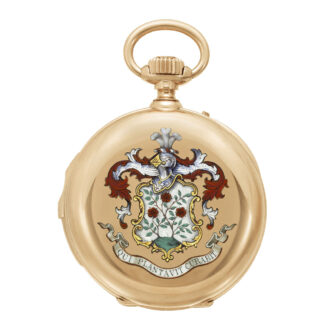
A very fine French, rare and historically important, minute repeating, 18K rose gold and polychrome enamel keyless pocket watch with helical balance spring, circa 1890. President Franklin Delano Roosevelt by Le Roy & Fils, Horlogers de la Marine, Palais Royal, 13&15 Gallerie Montpensier, Paris, 57, New Bond St., London, Delivered to James Roosevelt Snr. for Franklin Delano Roosevelt, President of the United States, and thence by descent to James Roosevelt Jnr. and sold by him in 1988.
–
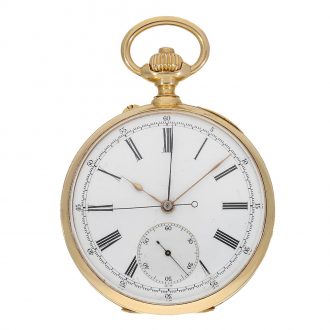
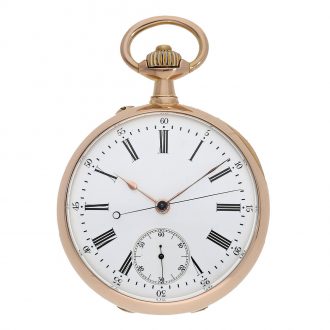
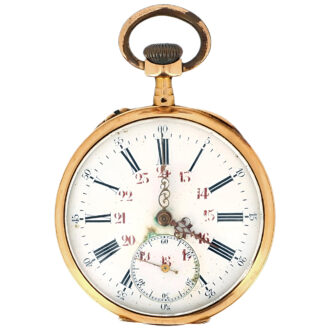
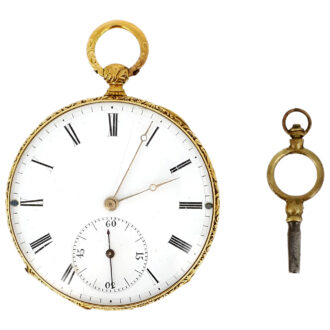
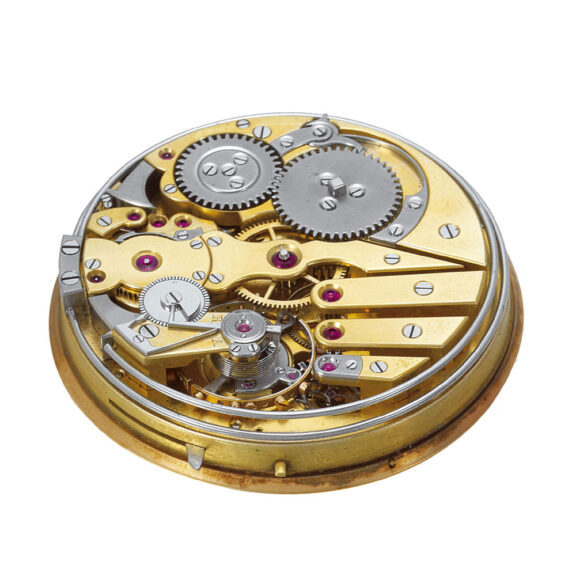
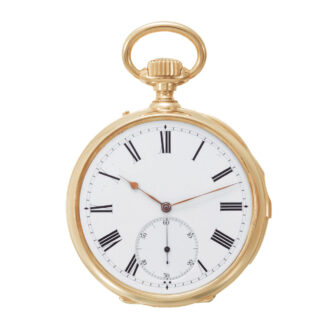
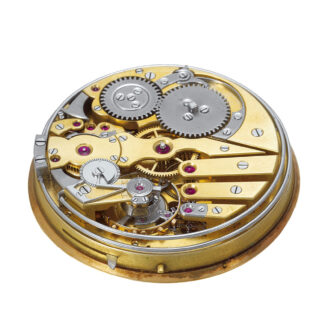
A polished case, flat band, the back cover decorated with the fine polychrome enamel champlevé enamel coat of arms and motto of the Roosevelt family. Hinged gold cuvette. White enamel dial with radial Roman numerals, outer minute track, subsidiary seconds. Gold spade hands. A frosted gilt movement, 29 jewels, counterpoised straight-line lever escapement, cut bimetallic compensation balance with gold temperature and meantime adjustment screws, special alloy helical balance spring, snail micrometre regulator, repeating on gongs activated by a slide on the band. Cuvette signed.
–
Diameter: 52 mm
–
Signed: Le Roy & Fils Paris
–
Provenance: James Roosevelt Snr. (1828-1900) – Franklin Delano Roosevelt (1882-1945) – James Roosevelt Jnr. (1907-1991) – Sold by James Roosevelt Jr. Sotheby’s, New York, October 26, 1988. 302
–
L. Leroy & Cie Was founded in 1764 by Charles Le Roy, in the Quai des Orfèvres in Paris. At a time when most watches sold in France were imported from Switzerland, Le Roy offered a choice of watches and pendulums produced in his workshop. This was enough to earn him the support of the King, the Queen and the Court, as well as a faithful clientele throughout Europe. During the French revolution, his connections to the ancien régime were a source of trouble to Charles Le Roy and almost caused him to lose his life. During the Terreur (a period of the revolution that lasted from September 5, 1793, to July 27, 1794), he was obliged to turn his signature into the anagram, which can still be found today on the dials of clocks and on the plates of watches he produced during that era. In 1827, Charles Le Roy took his son Louis into partnership, changing the company’s name to Le Roy & Fils, Horlogers du Roi. In 1889, Louis Leroy took over the company, whose name was changed again, becoming Ancienne Maison Le Roy & Fils, Horlogers du Roy, L. Leroy & Cie. Louis Leroy carefully studied Swiss and French watch production, and decided to open manufacture in Besançon, where many resources were available for the production of high-quality watches. He began his own production, merging various workshops, and consequently abandoned his former Swiss suppliers. This course of action was soon rewarded with success.
–
Le Roy began to participate in the timing contests organized for chronometers at the Observatory of Besançon, with remarkable results. Whereas in 1890 the best watch was awarded 171 marks, when Le Roy took part in his first contest in 1894, he was awarded 197 marks, a gold medal and the prize for the five best chronometers. In 1895, he received 3 gold medals and the prize for the five best chronometers. In 1898 and in 1899, he again was awarded 3 gold medals and the prize for the five best chronometers. When, at the end of the century, Paris business centre moved from the Palais Royal to the Opera district, L. Leroy & Cie. transferred their premises to 7, Boulevard de la Madeleine. In 1914, Louis Leroy took his brother Léon into partnership, without changing the company name. Together the two brothers continued to develop the production of chronometers, astronomical regulators, complicated watches, carriage clocks and mantel regulators. Appointed Horloger de la Marine de l’Etat, the Le Roy company was also the main supplier of watches and chronometers to the Merchant Marine, the French Air Force and civil aviation, and French and foreign Observatories. At the most important industrial and universal exhibitions, Leroy exhibited highly important and unique pieces, bringing France fame and recognition for the high quality of its watch and clock production.
–
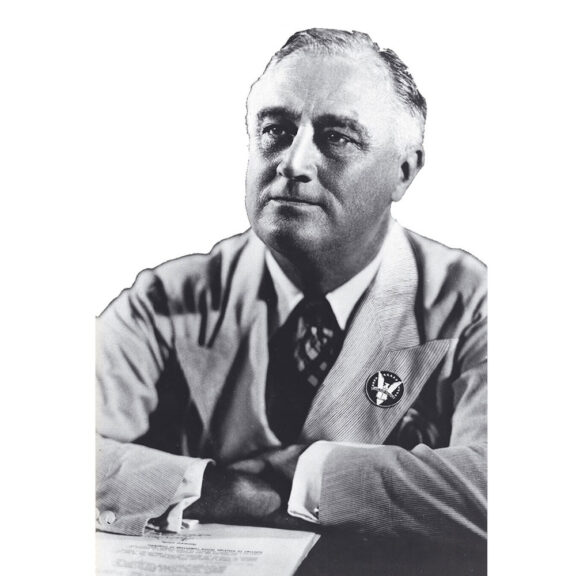
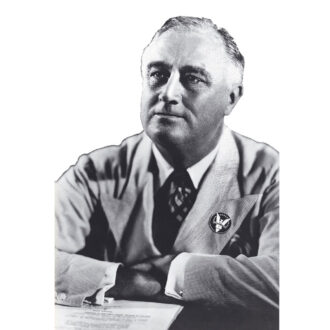
Franklin Delano Roosevelt (1882 – 1945) was the 32nd President of the United States. His first term was characterized by an unfolding of the New Deal program, with greater benefits for labour, the farmers, and the unemployed, and the progressive estrangement of most of the business community. Aware of the menace to world peace posed by totalitarian fascism, from 1937 on Roosevelt tried to focus public attention on the trend of events in Europe and Asia. As a result, he was widely denounced as a warmonger. He was reelected in 1936 over Gov. Alfred M. Landon of Kansas by the overwhelming electoral margin of 523 to 8, and the gathering international crisis prompted him to run for an unprecedented third term in 1940. Roosevelt’s program to bring maximum aid to Britain and, after June 1941, to Russia was opposed until the Japanese attack on Pearl Harbor restored national unity. During the war, Roosevelt shelved the New Deal in the interests of conciliating the business community, both in order to get full production during the war and to prepare the way for a united acceptance of the peace settlements after the war. A series of conferences with Winston Churchill and Joseph Stalin laid down the bases for the postwar world. In 1944 he was elected to a fourth term, running against Gov. Thomas E. Dewey of New York. On April 12, 1945, Roosevelt died of a cerebral haemorrhage at Warm Springs, Ga., shortly after his return from the Yalta Conference. His wife, (Anna) Eleanor Roosevelt, whom he married in 1905, was a woman of great ability who made significant contributions to her husband’s policies.
Signed: Le Roy & Fils Paris
Share this page: