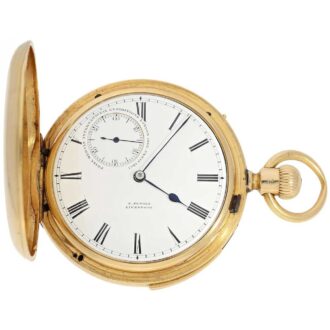
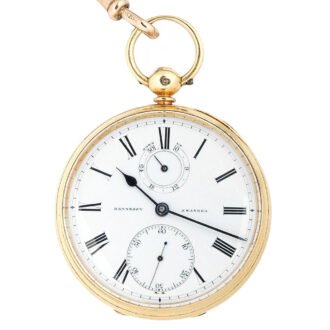
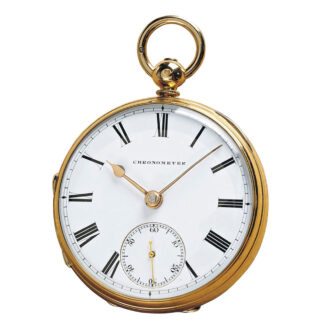
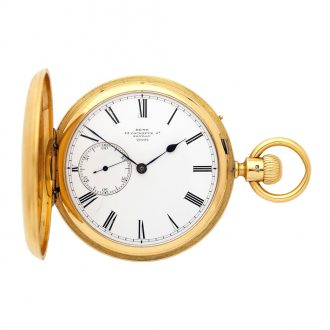
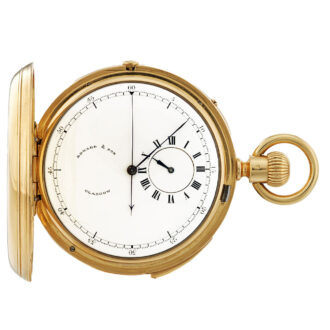
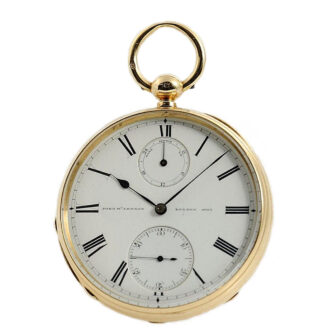
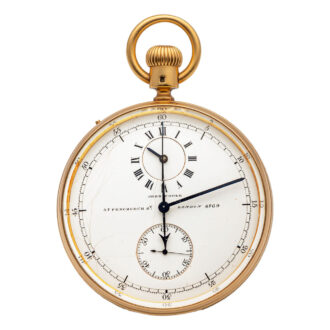
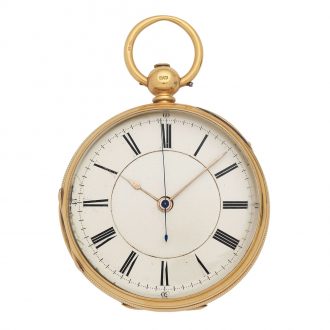
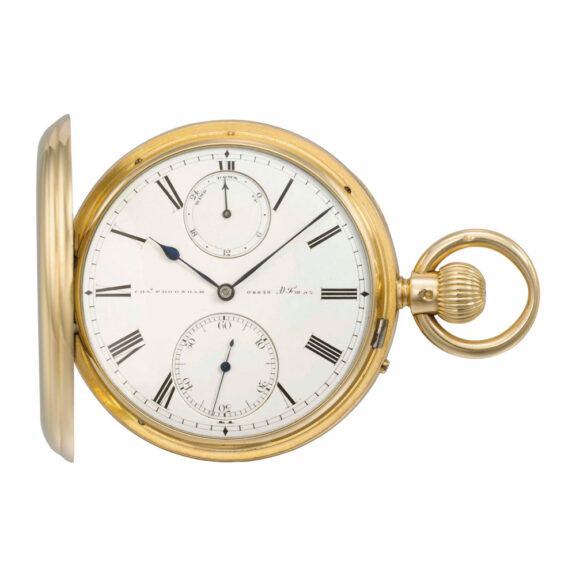
English 18K gold chronometer with power reserve Circa 1874
- Kenmerk
- CH0627
- Diameter
- 53 mm
- Estimate
- € 4.000 - 8.000
- Price sold
- € 6.050
Gold hunting cased chronometer by Charles Frodsham
–
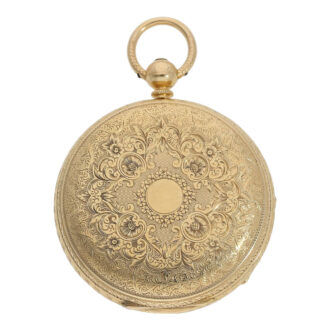
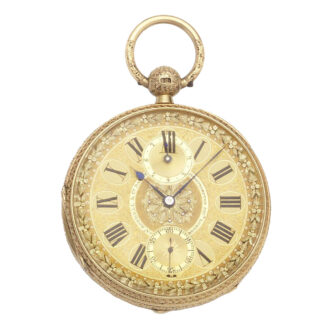
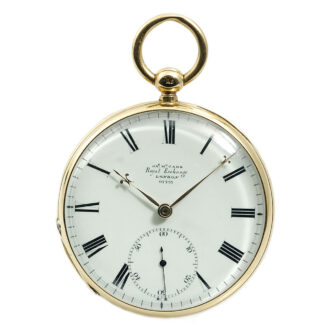
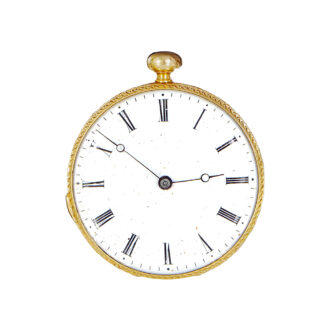
A fine English 18 carat gold hunting cased keyless pocket chronometer with power reserve, circa 1874. Gilt finished half plate chain fusée movement, Earnshaw spring detent escapement, large bimetallic compensation balance, freesprung blued steel helical hairspring, diamond endstone. Gold cuvette. Tinted enamel dial with Roman numerals, two sunk subsidiary dials for 24 hour power reserve and constant seconds. Plain case. Case and cuvette stamped with casemaker’s initials G.A.P. for George Augustus Potter and London date letter for 1874, dial and movement signed and numbered.
–
Diameter: 53 mm
–
Signed: Chas. Frodsham 04828 AD.Fmsz 84 Strand London
–
This watch pays tribute to the genius and inventive spirit of the celebrated Charles Frodsham, one of the leading manufacturers of high quality clocks, watches and chronometers in the 19th century and early 20th century.
–
Charles Frodsham (born 18 April 1810), was apprenticed for seven years to his father William Frodsham, an established London clockmaker, at the age of 14. At twenty, he distinguished himself by submitting one of his first marine chronometers to the Premium trials at Greenwich Observatory, receiving the second prize of 170. In 1834 he was made a fellow of the Royal Astronomical Society. Shortly after and doubtless encouraged by his recent successes, Charles ventured out on his own establishing his business in London, where he soon gained an enviable reputation for the manufacture of precision timekeepers, as a supplier of marine chronometers to the Admiralty, regulators to the world’s observatories, and as a provider of fine watches to discerning clients worldwide. He later acquired the three prestigious businesses of J.R. Arnold, Vulliamy and William Johnson late of Grimalde & Johnson. In 1854 Charles was granted the Royal Warrant and made Superintendent and Keeper of Her Majesty’s clocks. For over 130 years Charles Frodsham & Co. were responsible for the maintenance of the Royal clocks and remained the last independent firm permitted to have workshops in Buckingham Palace.
–
Throughout the second half of the 19th century the firm participated at all the major international exhibitions, including, Paris, Philadelphia, Sydney and the Great Exhibition of 1851 at Crystal Palace, where a first class medal was received. In all, Frodshams obtained fourteen medals and diplomas. From 1850 the majority of the finest Frodsham watches were distinguished with the code AD.Fmsz, a cryptogram for the year 1850. The code is formed by the numerical sequence of the letters in ‘Frodsham’, with a ‘Z’ for zero. Many of these pieces were sent to Kew Observatory for rigorous timing tests, attaining consistently high marks, most notably tourbillon watch no. 09182 holding the record for any English watch tested at the Kew Observatory, with a mark of 93.9, in 1906. This watch is now in the celebrated Lord Harris Collection, at Belmont, in Kent.
–
In 1893, Charles Frodsham & Co. became a limited company. With the advent of the motor car in the early part of the 20th century, the business expanded with the introduction of speedometers and car clocks. From the late 1940s until the 1980s, the firm concentrated on the manufacture of mantel and carriage clocks, producing amongst others the ‘Princess’ clock presented in 1947 to HRH Princess Elizabeth on the occasion of her marriage. Today Charles Frodsham & Co. proudly maintains the exacting standards and enthusiasm of its founder, Charles Frodsham.
–
A detailed account of the life and times of Charles Frodsham and the company can be found in The Frodshams, The Story of a Family of Clockmakers by Vaudrey Mercer, published by The Antiquarian Horological Society, 1981.
Signed: Chas. Frodsham 04828 AD.Fmsz 84 Strand London
Share this page: