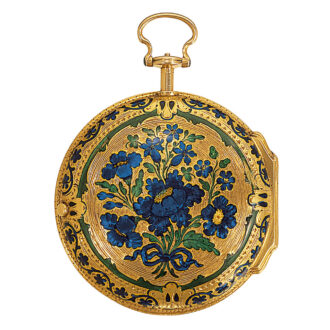
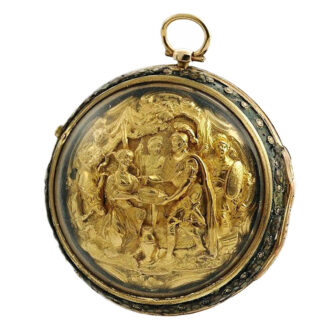
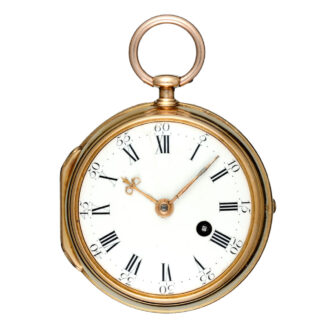
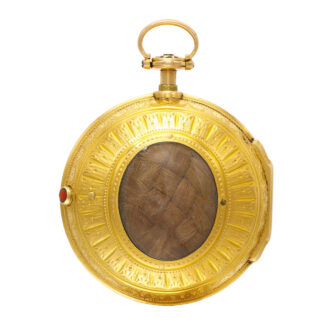
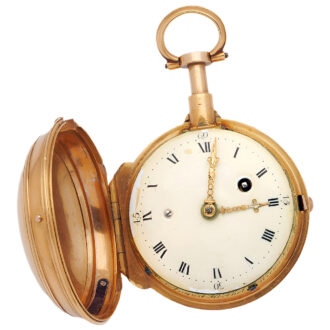
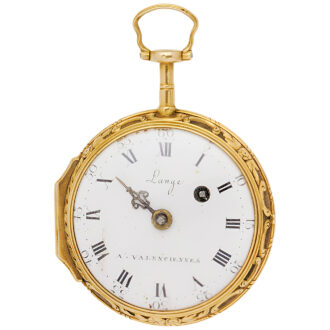
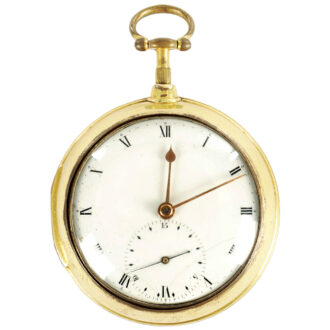
English gold, enamel and diamond-set repeating watch Circa 1768
- Kenmerk
- SB1010
- Diameter
- 51 mm
- Estimate
- € 17.500 - 35.000
- Price sold
- -
Gold decorated quarter repeater by Justin Vulliamy
–
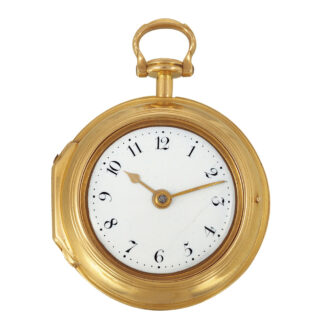
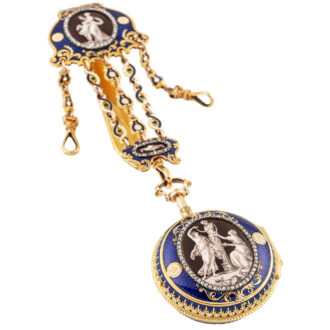
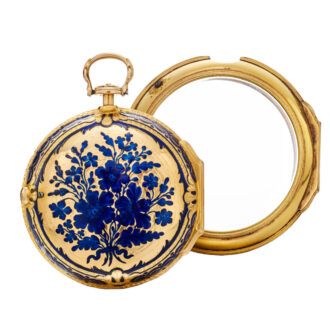
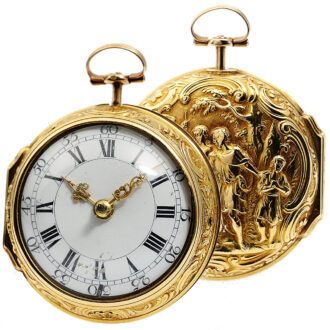
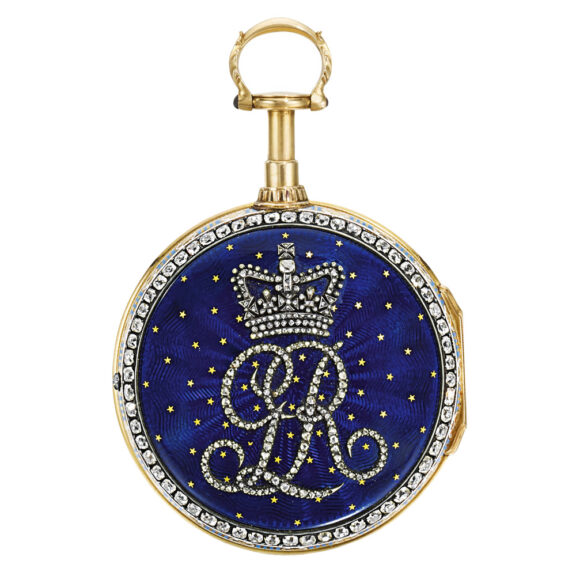
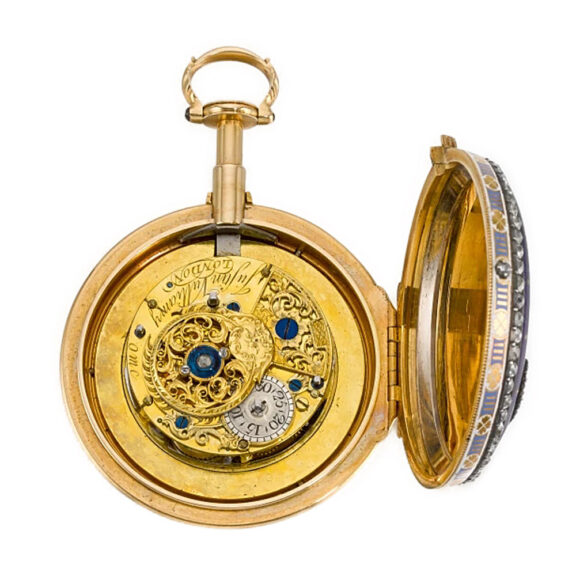
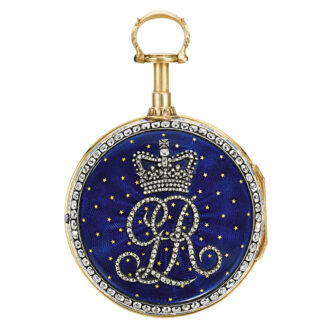
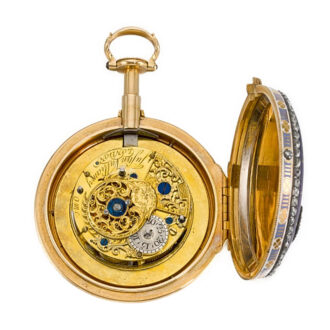
An English 18 carat gold, enamel and diamond-set dumb quarter repeating cylinder pocket watch, circa 1768. Fusée movement, cylinder escapement, plain steel 3-armed balance, diamond end-stone, balance cock engraved with mask and foliate scrolls, two hammers striking on the dust cap. White enamel dial with Roman hours and outer Arabic minute chapter ring, diamond-set skeletonised cross-over style hands. Translucent blue enamel on the case back, gold stars, decorative blue and white enamel bands, applied diamond-set Royal Coronet and Cipher, GR on reverse, plunge repeat through the bow. Movement signed.
–
Diameter: 50.5 mm
–
Signed: Justin Vulliamy
–
Justin Vulliamy was the patriarch of three generations of watch and clockmakers. He left Switzerland and moved to England, becoming the partner of Benjamin Gray, whose daughter he married. Following his father-in-law’s death, Vulliamy continued to employ Gray’s coded numbering system, which is still not fully understood. It is known that the coding system moved from three letters to four letters around 1812. This is one of a small number of watches in large cases covered in blue enamel and lavishly set with diamonds, which bear the crowned cypher of King George III (reign 1760-1820). There are two currently in the British Royal Collection, and two that sound very similar were exhibited in a ‘Royal Treasures’ loan exhibition in 1937. The cypher does not indicate that such watches were for the King’s use but rather that they were royal gifts to friends and close personal acquaintances within the Court circle. For example, one of the two in the Royal Collection is reputed to have been given by the King to the Earl of Courtown.
–
Like this piece, the two watches in the Royal Collection originally contained movements by François Justin Vulliamy (1712-1797). The movement in the Courtown watch is now missing, but it was almost certainly Justin Vulliamy ama, while the other movement is signed Justin Vulliamy rzr. Interestingly, these code numbers and that of the present watch indicate that the movements were made several years apart – circa 1764 for ama, circa 1768 for omc, and as late as circa 1789 for rzr. This suggests that a number of these specific cases may have been made early in the reign of George III, and movements were subsequently inserted as required and resized when necessary, as with this watch. This was not an uncommon practice with particularly prized cases, and the surviving Vulliamy business papers record several such instances and the reverse process of re-casing earlier movements. Unfortunately, they do not cover these royal watches.
–
The immigrant Swiss watchmaker Justin Vulliamy had previously been in business with his father-in-law Benjamin Gray, who had been King’s Watchmaker to George II from 1742 until that King died in 1760. On Gray’s death in 1764, Vulliamy took full control of the firm. Although he never obtained the Royal Warrant as King’s Watchmaker, probably because he was not naturalised and remained ineligible for this Civil List post, he maintained close links with the horologically-minded new King, George III, and the Royal Household. Indeed, he received a personal appointment as clockmaker to Queen Charlotte. In contrast, his son and partner Benjamin Vulliamy (1747-1811) received a warrant as King’s Clockmaker in 1772 and was in due course to be succeeded in this post by his son Benjamin Lewis Vulliamy (1780-1854). The latter retained the Royal Warrant under several sovereigns until he died in 1854.
Signed: Justin Vulliamy
Share this page: