Possibly unique Swiss 18k gold tourbillon watch Circa 1929
- Kenmerk
- SA0933
- Diameter
- 62 mm
- Estimate
- € 150.000 - 300.000
- Price sold
- € 264.000
Possibly unique gold tourbillon
–
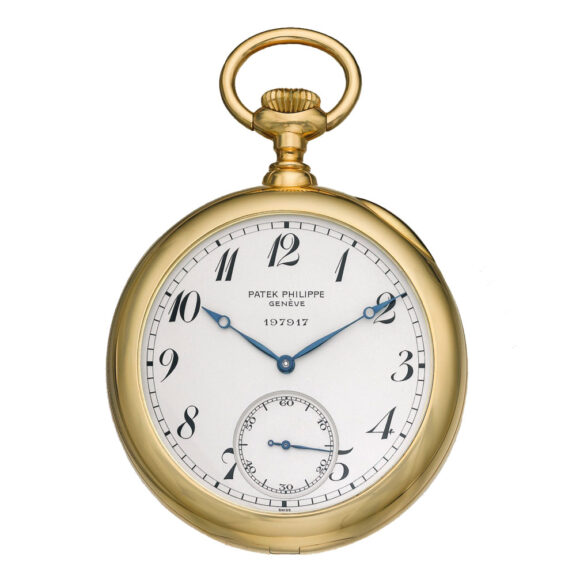
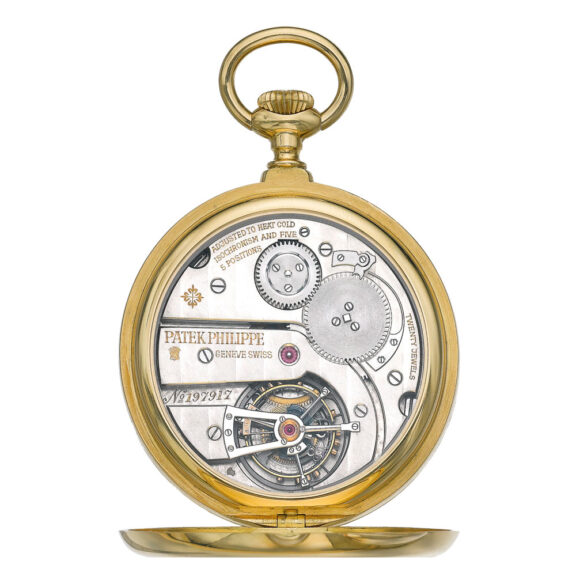
An exceptional Swiss and possibly unique gold open-faced tourbillon pellaton ‘Bulletin D’observatoire’, movement circa 1929, case made in 1984, extra quality nickel rhodié Pellaton style one-minute tourbillon, 20 jewels, mirror polished steel cage, cut bimetallic Guillaume balance with eagle head arms and pink gold setting screws, mirror polished tourbillon bridge with pink gold chaton, stamped with the seal of Geneva.
–
An exceptional Swiss and possibly unique gold open-faced tourbillon pellaton ‘Bulletin D’observatoire’, movement circa 1929, case made in 1984, extra quality nickel rhodié Pellaton style one-minute tourbillon, 20 jewels, mirror polished steel cage, cut bimetallic Guillaume balance with eagle head arms and pink gold setting screws, mirror polished tourbillon bridge with pink gold chaton, stamped with the seal of Geneva.
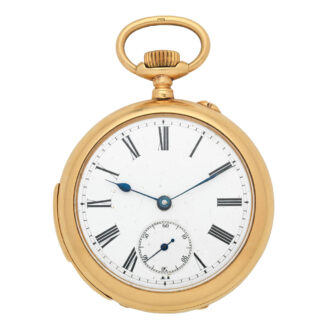
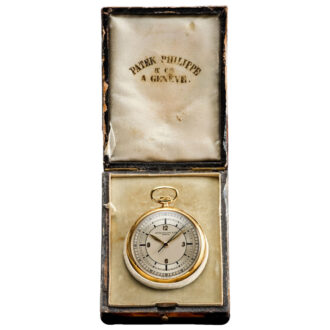
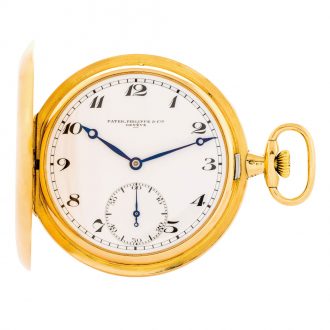
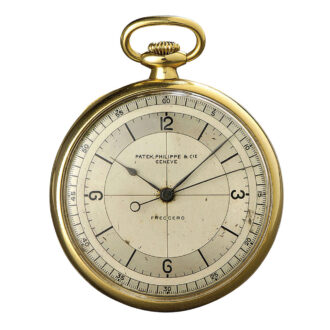
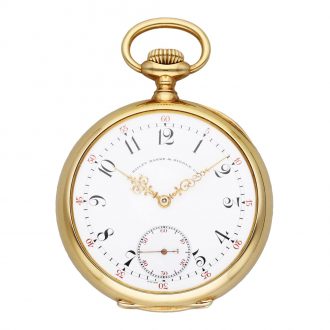
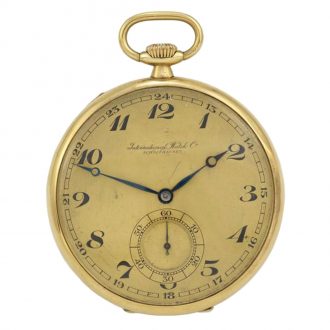
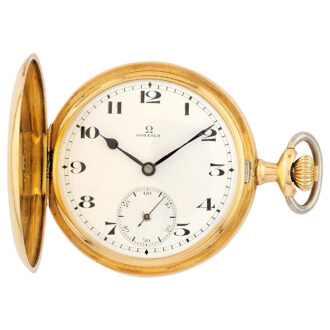
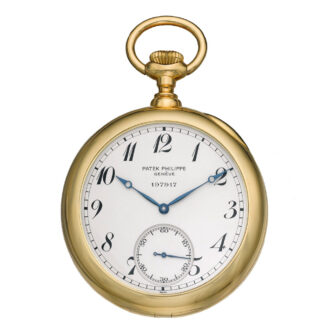
Silvered dial, black painted Breguet numerals, subsidiary dial for constant seconds, outer minute track, Breguet antique blued hands.
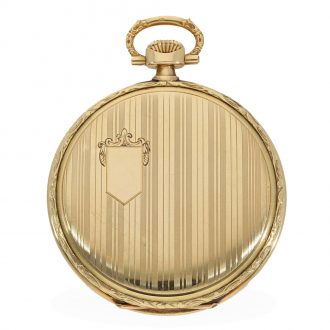
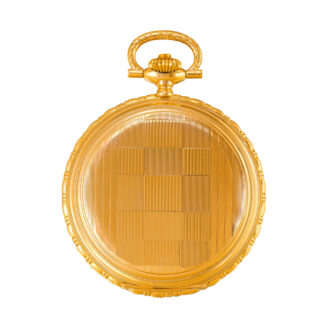
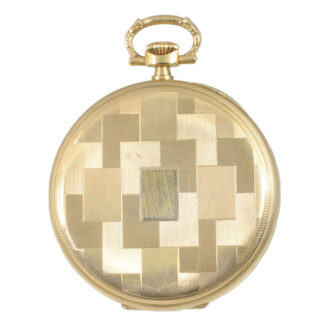
18k Yellow gold case with invisible hinge and sapphire crystal glass, dial, case and movement signed.
–
Diameter: 62 mm
–
Thickness: 17 mm
–
Signed: Patek Philippe Genève
–
With a presentation case, two bulletins d’observatoire, a booklet with all the results of the tests, one original certificate from Beyer, one original certificate handwritten and signed by Philippe Stern, one file containing various documents related to the watch. It is extraordinary to note that the present watch passed, 11 times, the rigorous tests of l’Observatoire de Geneve; according to our research, this movement won the first prize in 1929 with 849 points. The two bulletins de l’oservatoire documents mention results from March-April 1952, it obtained a note ‘A’ with 812.2 points, upon further testing in January 1953, the watch was again noted ‘A’ with 817.3 points. Testing at the Geneva Observatory initially lasted 40 days and required the watch to be tested in different positions and at varying temperatures to check its ability to maintain outstanding accuracy. Accuracy in timekeeping has been critical to advances in Science and, in 1873, the Observatory in Geneva held its first annual Chronometer competition. Patek Philippe won the much-coveted 1st prize for the first time in 1884. The person in charge of the regulation of this piece for the Observatoire was the famous regleur, François Modoux. François Modoux and Henri Wehrli were two of the most accomplished watchmakers in the first half of the 20th century. As regleurs, or regulators, their exacting work in finely adjusting Patek Philippe’s chronometers elevated the prestige of the company in the competitions, thereby raising public awareness to the watchmaker’s achievements. The watchmaker who made the tourbillon cage was the famous master watchmaker and tourbillon constructor, Hector Golay. To the best of our knowledge, the few chronometers that were produced around this serial number were completed by Hector Golay. As a master watchmaker for chronometers, Hector Golay is known to have prepared and finished the tourbillon cages for Patek Philippe during this period. THE TOURBILLON:Originally invented to improve the accuracy of pocket watches, the tourbillon is considered one of the most challenging of all horological complications. Invented in 1801 by Abraham-Louis Breguet, a tourbillon counters the effects of gravity by mounting the escapement and balance wheel in a rotating cage in order to negate the effect of gravity when the timepiece, and thus the escapement, is in constant motion. At the time of the tourbillon’s invention, gravity and movement were known to have an adverse effect on the accuracy of timepieces, horologists knew that pocket watches suffered from the effects of gravity since they were usually carried in the same pocketed position, continuously moved during the day and then held in a different position while being read, all of which affected their accuracy. In a tourbillon, the entire escapement assembly rotates, including the balance wheel, the escape wheel, the hairspring, and the pallet fork, in order to average out the effect of gravity in the different positions and thereby improve the watch’s timekeeping.
18k Yellow gold case with invisible hinge and sapphire crystal glass, dial, case and movement signed.
–
Diameter: 62 mm
–
Thickness: 17 mm
–
Signed: Patek Philippe Genève
–
With a presentation case, two bulletins d’observatoire, a booklet with all the results of the tests, one original certificate from Beyer, one original certificate handwritten and signed by Philippe Stern, one file containing various documents related to the watch. It is extraordinary to note that the present watch passed, 11 times, the rigorous tests of l’Observatoire de Geneve; according to our research, this movement won the first prize in 1929 with 849 points. The two bulletins de l’oservatoire documents mention results from March-April 1952, it obtained a note ‘A’ with 812.2 points, upon further testing in January 1953, the watch was again noted ‘A’ with 817.3 points. Testing at the Geneva Observatory initially lasted 40 days and required the watch to be tested in different positions and at varying temperatures to check its ability to maintain outstanding accuracy. Accuracy in timekeeping has been critical to advances in Science and, in 1873, the Observatory in Geneva held its first annual Chronometer competition. Patek Philippe won the much-coveted 1st prize for the first time in 1884. The person in charge of the regulation of this piece for the Observatoire was the famous regleur, François Modoux. François Modoux and Henri Wehrli were two of the most accomplished watchmakers in the first half of the 20th century. As regleurs, or regulators, their exacting work in finely adjusting Patek Philippe’s chronometers elevated the prestige of the company in the competitions, thereby raising public awareness to the watchmaker’s achievements. The watchmaker who made the tourbillon cage was the famous master watchmaker and tourbillon constructor, Hector Golay. To the best of our knowledge, the few chronometers that were produced around this serial number were completed by Hector Golay. As a master watchmaker for chronometers, Hector Golay is known to have prepared and finished the tourbillon cages for Patek Philippe during this period. THE TOURBILLON:Originally invented to improve the accuracy of pocket watches, the tourbillon is considered one of the most challenging of all horological complications. Invented in 1801 by Abraham-Louis Breguet, a tourbillon counters the effects of gravity by mounting the escapement and balance wheel in a rotating cage in order to negate the effect of gravity when the timepiece, and thus the escapement, is in constant motion. At the time of the tourbillon’s invention, gravity and movement were known to have an adverse effect on the accuracy of timepieces, horologists knew that pocket watches suffered from the effects of gravity since they were usually carried in the same pocketed position, continuously moved during the day and then held in a different position while being read, all of which affected their accuracy. In a tourbillon, the entire escapement assembly rotates, including the balance wheel, the escape wheel, the hairspring, and the pallet fork, in order to average out the effect of gravity in the different positions and thereby improve the watch’s timekeeping.
Signed: Patek Philippe and Cie Genève
Share this page: