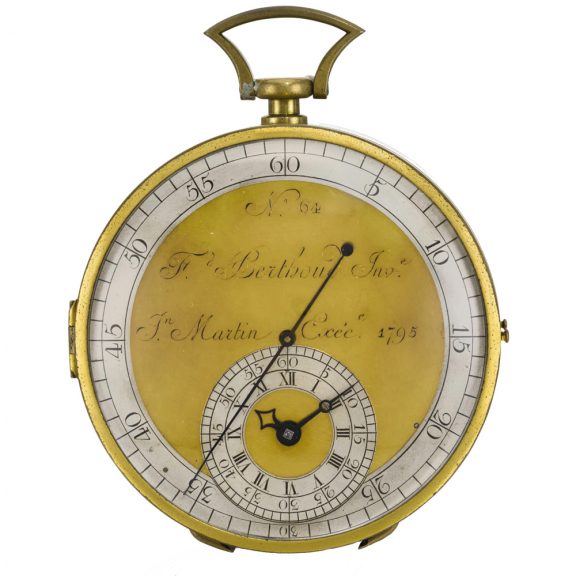
Rare French early marine pocket chronometer watch Circa 1795
- Kenmerk
- AS1657
- Diameter
- 65 mm
- Estimate
- € 40.000 - 80.000
- Price sold
- € 51.200
Brass chronometer by Ferdinand Berthoud & Jean Martin
–
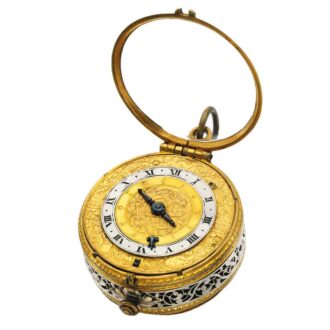
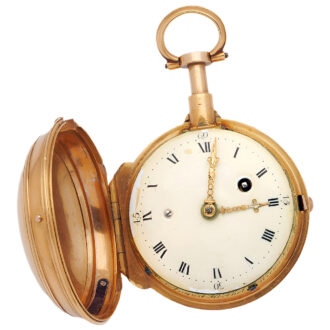
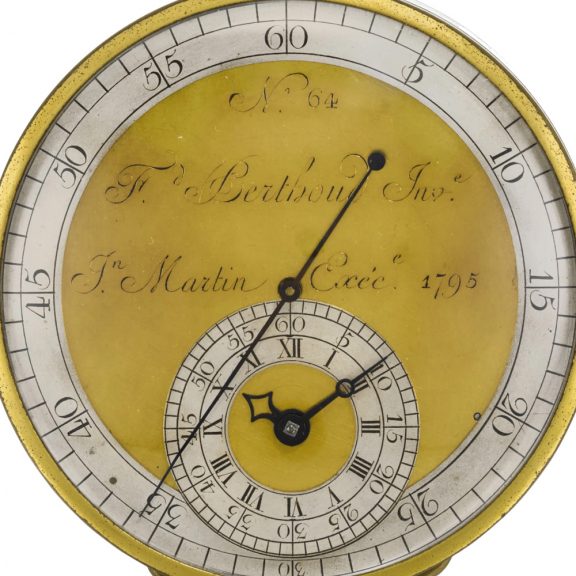
A very rare and fine French early brass-cased marine chronometer, circa 1795. The watch showcases a gilded full plate movement with an early spring detent. Its brass dial/top plate features a silvered subsidiary chapter ring for hours and minutes, an outer chapter ring with Arabic seconds, blued steel hands, and is signed and numbered Fd. Berthoud Invt., Jn. Martin Exéce. 1795 and 64. The brass-bound case includes a hinged gilt metal bezel, a glazed hinged back, and a broad bezel.
–
Diameter: 65 mm
–
Signed: Fd. Berthoud Invt., Jn. Martin Exéce. Paris
–
Some spotting and light scuffs are present on the silver chapter rings, while there is some tarnishing on the hands. The case shows wear to the gilding and pitting throughout. The movement is not running, but the balance rotates with a slight tarnishing.
–
Ferdinand Berthoud (1727–1807) was born in the Swiss Jura and left for Paris following a three-year apprenticeship to his brother, Jean Henri. He received the title of Master Watchmaker in 1754 and dedicated the rest of his life to studying and developing accurate marine chronometers. In 1764, he received the title of Horologer de la Marine; a post particularly esteemed at a period when the race to construct a timepiece capable of finding longitude at sea was of critical importance.
–
King Louis XV appointed him to visit London to observe John Harrison’s famous H4. Harrison, suspicious that Berthoud would use his knowledge for the benefit of the French Navy, only showed him H1, H2, and H3. Regardless of this setback, Berthoud established several key relationships on this trip, and on his second visit in 1765, he met with Thomas Mudge, who described the working principles of H4 without showing it to him.
–
Berthoud returned to France with an understanding of the new British technology and designed two marine clocks, which were successfully used on some voyages by the French Navy. From then on, he produced all marine clocks and watches used on the King’s ships, dedicating nearly 50 years to the study of accurate marine chronometers. He experimented with multiple design variants, beginning early on with weight-driven chronometers and then moving to spring-powered chronometers. He later built compensating mechanisms into the balance itself. In all, Berthoud produced between 70 and 80 marine chronometers, of which several important examples reside in the Conservatoire des Arts et Métiers in Paris. For detailed information on Berthoud’s life and work, see Hans Von Bertele, Marine and Pocket Chronometers, pp. 42–43, and Rupert T. Gould, The Marine Chronometer, pp. 126–166.
–
Jean Martin worked as Berthoud’s student for many years before establishing himself as a naval watchmaker in Brest in 1785. In 1793, two years before the creation of the present lot, he returned to Berthoud’s workshop and continued to work under him, notably creating several longitude clocks and watches, such as the present piece.
Signed: Fd. Berthoud Invt., Jn. Martin Exéce. Paris
Share this page: